
Nvidia stock loses 3.3% amid CEO Huang visit plans to China and chip policy talks
As of January 21, Nvidia stock is trading at $179.84, down 3.3% in the last 24 hours. The stock continues to consolidate after reaching a 52-week high near $212 in late October. The recent decline reflects both technical resistance and growing geopolitical overhangs.
Highlights
- Nvidia stock declined 3.3% ahead of CEO Jensen Huang’s planned China visit for AI chip export discussions.
- The trip comes at a critical time as Nvidia faces regulatory uncertainty and rising local competition in China’s semiconductor market.
- Traders are watching key support at $175 and resistance near $195 for short-term direction.
The short-term technical structure shows support emerging near the $175 mark, which coincides with the December breakout level and the 21-day exponential moving average. Below that, stronger support lies near the $160–$165 area, where price consolidated for several weeks in September and early October. A breakdown below that range would suggest a deeper retracement and could expose the $145–$150 zone as the next downside target.
On the upside, Nvidia faces resistance at $190, with stronger resistance near $195–$200. This is where sellers have repeatedly capped gains since early January. A confirmed breakout above this level would be technically significant and could open the path toward a retest of the all-time highs in the $210–$212 range. However, volume on recent rallies has been relatively light, indicating some hesitancy among buyers.
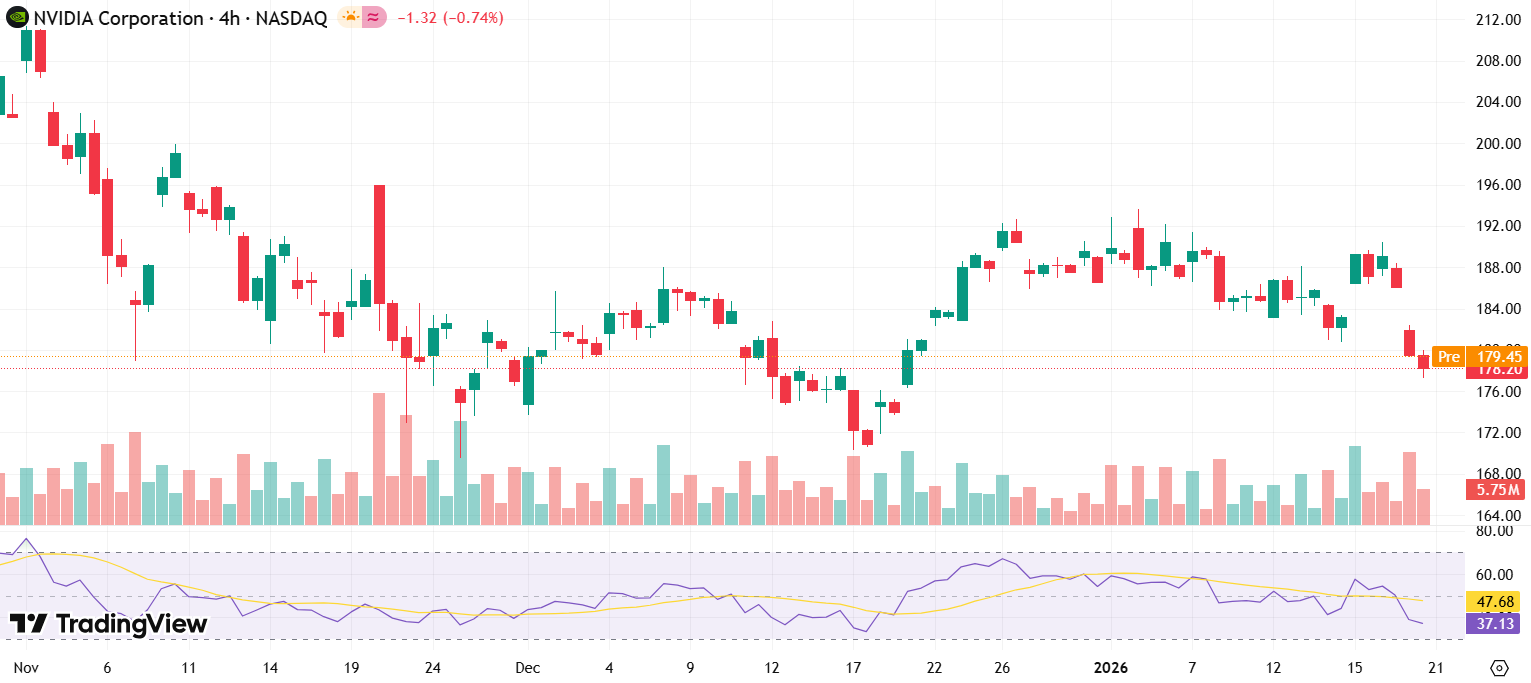
Nvidia stock price dynamics (November 2025 - January 2025). Source: TradingView
Momentum indicators, including the 14-day Relative Strength Index (RSI), are hovering around neutral territory, reflecting the consolidation phase. A move below 40 on RSI would reinforce downside pressure, while a bounce above 60 could signal bullish re-acceleration.
China visit raises expectations amid regulatory and competitive risks
The key macro driver for NVDA in the near term is CEO Jensen Huang’s planned visit to China in late January. Huang is expected to attend Lunar New Year events and meet with partners and officials as Nvidia attempts to stabilize its China business amid U.S. export restrictions. While the U.S. has imposed limits on sales of Nvidia’s advanced AI chips to China, recent regulatory adjustments allow for restricted exports of downgraded models such as the H200.
This visit comes at a pivotal time. China has historically accounted for a significant portion of Nvidia’s data center revenue. However, the company now faces intensifying competition from domestic Chinese firms such as Huawei and Biren Technology, which are rapidly developing their own AI chip solutions. Combined with ongoing export restrictions from the U.S., Nvidia’s long-term position in the Chinese market is under pressure. Huang’s trip may be an effort to reaffirm Nvidia’s presence in the region and assess the outlook for future product access and regulatory cooperation.
Complicating the picture are critical voices in the U.S. tech sector. Over the weekend, Anthropic CEO Dario Amodei likened the sale of high-performance AI chips to China to "selling nuclear weapons to North Korea." This kind of rhetoric underscores the growing tension between commercial interests and national security policy, and it reinforces the sense that Nvidia’s international business could remain under political scrutiny.
Price prediction and near-term scenarios
In the bullish scenario, if Huang’s trip leads to clarity on regulatory approvals or secures concrete orders for permitted AI chips, the market may view it as a signal of stabilization in China operations. In that case, NVDA could regain momentum and push back above $190, with potential upside toward $205–$210. A strong earnings report in February could reinforce this trajectory.
The base case suggests that the most probable outcome over the next 2–3 weeks is continued range-bound trading between $175 and $195. This would reflect ongoing uncertainty around China policy, global chip demand, and overall tech sector rotation. Traders will likely remain cautious until concrete news emerges.
RBC Capital Markets initiated coverage on Nvidia with an Outperform rating and a $240 price target, citing over 30% upside from current levels. Analyst Srini Pajjuri highlighted Nvidia’s leadership in AI and noted its current valuation is attractive relative to long-term growth prospects in AI infrastructure.









-
 Afghanistan
-
 Albania
-
 Algeria
-
 Angola
-
 Argentina
-
 Armenia
-
 Australia
-
 Austria
-
 Azerbaijan
-
 Bahamas
-
 Bahrain
-
 Bangladesh
-
 Belarus
-
 Belgium
-
 Bolivia
-
 Botswana
-
 Brazil
-
 Brunei
-
 Bulgaria
-
 Cambodia
-
 Cameroon
-
 Canada
-
 Chile
Chile
-
 China
China
-
 Colombia
-
 Congo
Congo
-
 Costa Rica
-
 Cote d'Ivoire
-
 Croatia
-
 Cuba
Cuba
-
 Cyprus
-
 Czechia
-
 DR Congo
-
 Denmark
-
 Dominican Republic
-
 Ecuador
-
 Egypt
Egypt
-
 El Salvador
-
 Estonia
-
 Eswatini
-
 Ethiopia
-
 Finland
-
 France
-
 Georgia
-
 Germany
-
 Ghana
Ghana
-
 Greece
-
 Haiti
Haiti
-
 Hong Kong
-
 Hungary
-
 India
India
-
 Indonesia
-
 Iran, Islamic republic
-
 Iraq
Iraq
-
 Ireland
-
 Israel
-
 Italy
Italy
-
 Jamaica
-
 Japan
Japan
-
 Jordan
-
 Kazakhstan
-
 Kenya
Kenya
-
 Korea
Korea
-
 Kuwait
-
 Kyrgyzstan
-
 Laos
Laos
-
 Latvia
-
 Lebanon
-
 Lesotho
-
 Libya
Libya
-
 Lithuania
-
 Luxembourg
-
 Madagascar
-
 Malaysia
-
 Malta
Malta
-
 Mauritius
-
 Mexico
-
 Moldova
-
 Mongolia
-
 Montenegro
-
 Morocco
-
 Mozambique
-
 Myanmar
-
 Namibia
-
 Nepal
Nepal
-
 Netherlands
-
 New Zealand
-
 Nigeria
-
 North Macedonia
-
 Norway
-
 Oman
Oman
-
 Pakistan
-
 Palestine
-
 Panama
-
 Papua New Guinea
-
 Paraguay
-
 Peru
Peru
-
 Philippines
-
 Poland
-
 Portugal
-
 Puerto Rico
-
 Qatar
Qatar
-
 Reunion
-
 Romania
-
 Rwanda
-
 Saudi Arabia
-
 Serbia
-
 Singapore
-
 Slovakia
-
 Slovenia
-
 Somalia
-
 South Africa
-
 Spain
Spain
-
 Sri Lanka
-
 Sweden
-
 Switzerland
-
 Syria
Syria
-
 Taiwan
-
 Tajikistan
-
 Tanzania
-
 Thailand
-
 Trinidad and Tobago
-
 Tunisia
-
 Turkey
-
 UAE
UAE
-
 Uganda
-
 Ukraine
-
 United Kingdom
-
United States
-
 Uruguay
-
 Uzbekistan
-
 Venezuela
-
 Vietnam
-
 Yemen
Yemen
-
 Zambia
-
 Zimbabwe
- Forex
- Crypto












