

Nvidia stock dips 2.1% despite Goldman Sachs confirming Buy and $250 target
As of February 6, Nvidia stock is trading at $170.65, down 2.1% over the past 24 hours, extending a short-term pullback after failing to sustain momentum above the $180 area, where repeated attempts to break higher were met with increased selling pressure.
Highlights
- Nvidia shares are under short-term pressure, trading below key moving averages after failing to hold above the $180 resistance zone.
- Goldman Sachs reiterated its Buy rating and $250 price target, signaling continued confidence in Nvidia’s long-term AI growth story despite near-term volatility.
- Price action now hinges on whether the stock can defend the $170 support level or slips toward the mid-$160s.
From a technical perspective, Nvidia is currently positioned in a corrective structure within a broader long-term uptrend. The stock is trading below its key moving averages, with the 50-day moving average near $184 and the 200-day moving average closer to $187. This configuration confirms that medium-term momentum remains bearish until NVDA can reclaim the $185–190 zone on a closing basis.
Immediate support is located at $170, a psychologically important level that has already been tested during the current session. A daily close below this area would expose Nvidia to the next support band at $164–165. Below that, stronger structural support is seen near $155, where dip buyers previously entered aggressively.
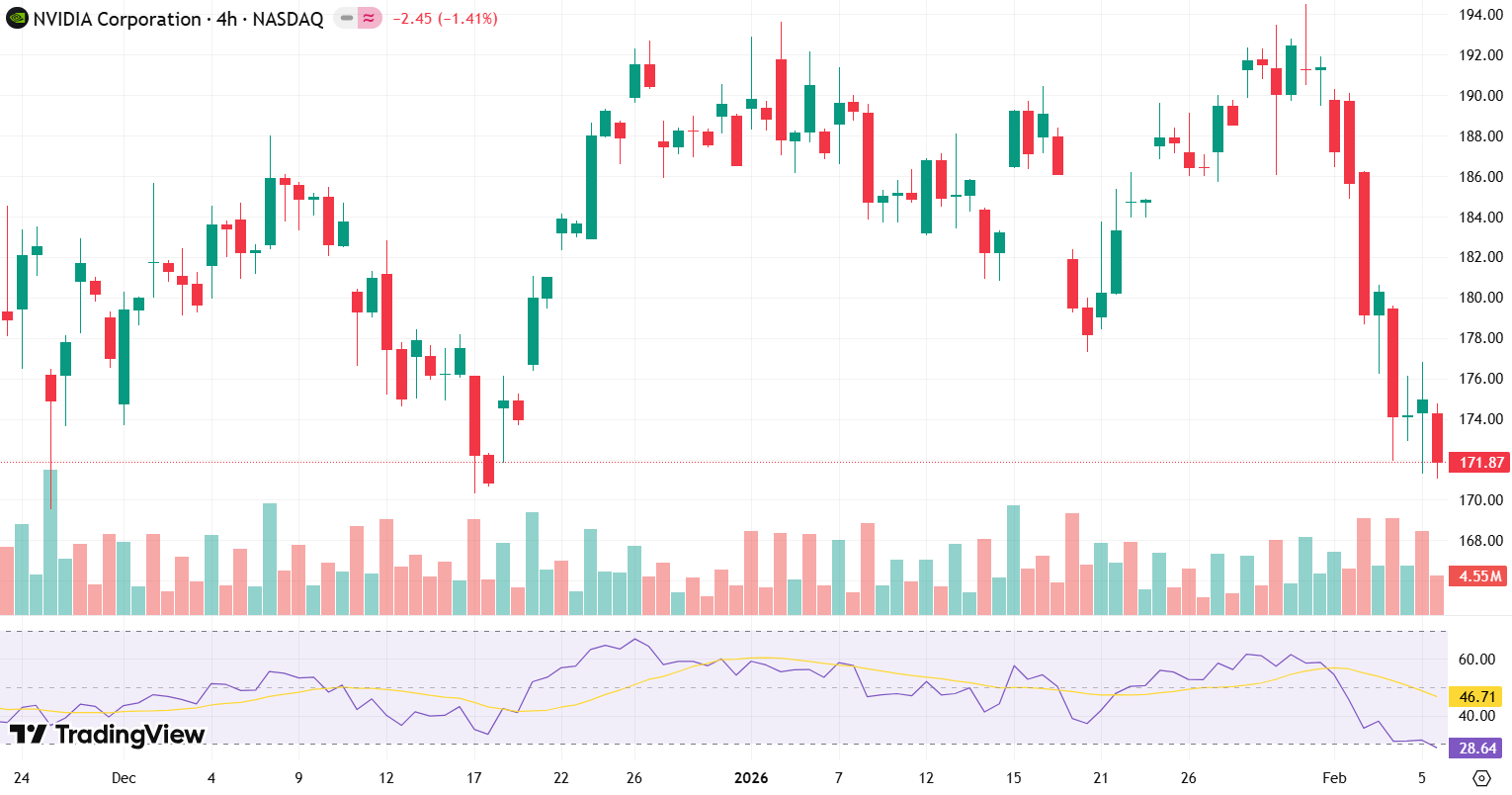
Nvidia stock price dynamics (December 2025 - February 2026). Source: TradingView
On the upside, initial resistance stands at $178, followed by a heavier supply zone between $185 and $190. This region coincides with both the 50-day and 200-day moving averages, making it a critical pivot for trend direction. Momentum indicators remain mixed. The Relative Strength Index on the daily chart is hovering in the low-40s, suggesting Nvidia is not yet oversold and still vulnerable to further downside before buyers regain control.
Goldman Sachs reiterates Buy amid AI demand confidence
Despite the technical weakness, fundamental sentiment remains strongly supportive. Goldman Sachs reiterated its Buy rating on Nvidia and maintained a $250 price target, citing sustained demand for AI accelerators and robust hyperscaler capital expenditure trends. The bank emphasized that Nvidia continues to dominate the AI compute stack, with no credible near-term challenger capable of matching its combined hardware, software, and ecosystem advantages.
Goldman also acknowledged that expectations for fiscal 2026 are elevated and largely reflected in the current valuation. However, it argued that upside optionality remains underappreciated, particularly from incremental demand tied to next-generation AI models, sovereign AI initiatives, and expanding enterprise adoption. While visibility into fiscal 2027 remains limited, Goldman views Nvidia’s execution track record as a mitigating factor.
Broader market conditions, however, have capped upside. The semiconductor sector has experienced profit-taking as investors rotate out of high-multiple growth stocks amid macro uncertainty and rate sensitivity. Nvidia’s recent decline also reflects positioning ahead of its upcoming earnings report, with traders unwilling to add exposure until guidance clarity improves. Nevertheless, consensus analyst targets remain well above current levels, reinforcing the view that the current pullback is cyclical rather than structural.
Price prediction and scenarios
In the short term, Nvidia’s price action is likely to remain range-bound with a bearish tilt. The base-case scenario sees the stock fluctuating between $165 and $185 over the coming sessions as the market digests earnings expectations and waits for a catalyst. Holding above $170 would signal underlying demand, even if upside momentum remains capped.
In a bearish scenario, a confirmed breakdown below $170 could accelerate losses toward $160–165. This zone is expected to attract medium-term buyers, but failure there would open the door to a deeper retracement toward $150, particularly if broader tech sentiment deteriorates.
Nvidia is in ongoing talks with the U.S. government over the licensing terms for exporting H200 AI chips to China, with the debate shifting from approval to the specific conditions attached. The key sticking point is whether compliance requirements, including safeguards against military use, are commercially viable rather than the licensing process itself.





Latest NVIDIA News



-
 Afghanistan
-
 Albania
-
 Algeria
-
 Angola
-
 Argentina
-
 Armenia
-
 Australia
-
 Austria
-
 Azerbaijan
-
 Bahamas
-
 Bahrain
-
 Bangladesh
-
 Belarus
-
 Belgium
-
 Bolivia
-
 Botswana
-
 Brazil
-
 Brunei
-
 Bulgaria
-
 Cambodia
-
 Cameroon
-
 Canada
-
 Chile
Chile
-
 China
China
-
 Colombia
-
 Congo
Congo
-
 Costa Rica
-
 Cote d'Ivoire
-
 Croatia
-
 Cuba
Cuba
-
 Cyprus
-
 Czechia
-
 DR Congo
-
 Denmark
-
 Dominican Republic
-
 Ecuador
-
 Egypt
Egypt
-
 El Salvador
-
 Estonia
-
 Eswatini
-
 Ethiopia
-
 Finland
-
 France
-
 Georgia
-
 Germany
-
 Ghana
Ghana
-
 Greece
-
 Haiti
Haiti
-
 Hong Kong
-
 Hungary
-
 India
India
-
 Indonesia
-
 Iran, Islamic republic
-
 Iraq
Iraq
-
 Ireland
-
 Israel
-
 Italy
Italy
-
 Jamaica
-
 Japan
Japan
-
 Jordan
-
 Kazakhstan
-
 Kenya
Kenya
-
 Korea
Korea
-
 Kuwait
-
 Kyrgyzstan
-
 Laos
Laos
-
 Latvia
-
 Lebanon
-
 Lesotho
-
 Libya
Libya
-
 Lithuania
-
 Luxembourg
-
 Madagascar
-
 Malaysia
-
 Malta
Malta
-
 Mauritius
-
 Mexico
-
 Moldova
-
 Mongolia
-
 Montenegro
-
 Morocco
-
 Mozambique
-
 Myanmar
-
 Namibia
-
 Nepal
Nepal
-
 Netherlands
-
 New Zealand
-
 Nigeria
-
 North Macedonia
-
 Norway
-
 Oman
Oman
-
 Pakistan
-
 Palestine
-
 Panama
-
 Papua New Guinea
-
 Paraguay
-
 Peru
Peru
-
 Philippines
-
 Poland
-
 Portugal
-
 Puerto Rico
-
 Qatar
Qatar
-
 Reunion
-
 Romania
-
 Rwanda
-
 Saudi Arabia
-
 Serbia
-
 Singapore
-
 Slovakia
-
 Slovenia
-
 Somalia
-
 South Africa
-
 Spain
Spain
-
 Sri Lanka
-
 Sweden
-
 Switzerland
-
 Syria
Syria
-
 Taiwan
-
 Tajikistan
-
 Tanzania
-
 Thailand
-
 Trinidad and Tobago
-
 Tunisia
-
 Turkey
-
 UAE
UAE
-
 Uganda
-
 Ukraine
-
 United Kingdom
-
United States
-
 Uruguay
-
 Uzbekistan
-
 Venezuela
-
 Vietnam
-
 Yemen
Yemen
-
 Zambia
-
 Zimbabwe
- Forex
- Crypto












