
Verizon stock forecast for 2030: Frontier integration and 1M subscriber goal chase $70

Dan Schulman is transforming Verizon at a speed that the telecom industry hasn't experienced in decades. In just under five months as CEO, he has completed a $20 billion acquisition, laid off 13,000 employees, ousted his consumer division leader, approved $25 billion in share buybacks, filed a lawsuit against T-Mobile in federal court, and promised a new value proposition set to launch in the first half of this year.
Highlights
- Verizon stock trades at $50.14 near 52-week highs, up roughly 26% since January earnings after breaking out from extended consolidation.
- Stock could reach $60-75 by 2030 if Frontier fiber integration delivers $1B synergies and subscriber growth sustains 1M annual adds.
- VZ closed $20B Frontier acquisition adding 30M fiber passings, posted 616K postpaid phone adds, but forced out consumer chief and faces $131B debt.
The real question now isn't whether Verizon is changing, but whether it can manage all of these changes at once while dealing with $131 billion in debt. On January 20, 2026, Verizon and Frontier Communications got all the necessary government approvals and closed the deal. The deal combines Frontier's fiber internet with Verizon's 5G mobile network. This means that Verizon's fiber internet will now reach almost 30 million people in 31 states and Washington, D.C. The Frontier deal adds more than 30 million fiber passings, and management has doubled the expected cost synergies to more than $1 billion in savings by 2028.
Verizon price update
Verizon's stock price is currently priced at $50.14, reflecting a 2.56% increase. This marks a breakout from a prolonged consolidation phase where the price fluctuated between $38 and $45 throughout 2025. In late January 2026, the stock experienced a significant surge, surpassing all major EMAs.
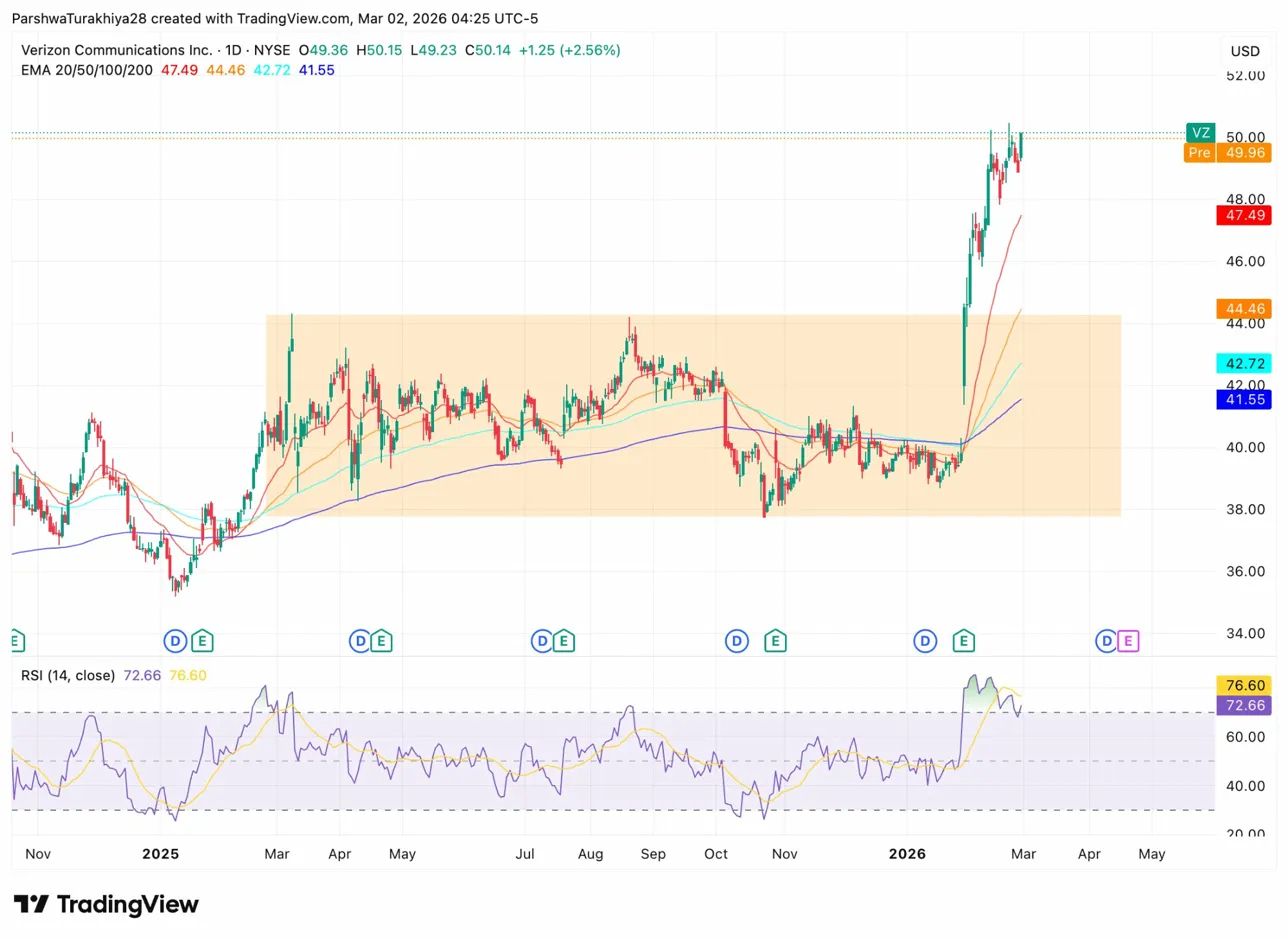
VZ price action (Source: TradingView)
At present, it is trading above the 20-day EMA at $47.49, the 50-day EMA at $44.46, the 100-day EMA at $42.72, and the 200-day EMA at $41.55, indicating robust bullish momentum. The RSI stands at 72.66, which is in the overbought zone, hinting at a potential consolidation or pullback in the near future. Immediate support is found at the 20-day EMA around $47.49, with stronger support levels between $44 and $45. The resistance level at $50.48 marks the 52-week high.
Record subscriber quarter since 2019
Verizon delivered its highest quarterly total mobility and broadband volumes since 2019. More than 1 million total net additions across mobility and broadband, with 616,000 postpaid phone net additions. Consumer postpaid phone additions hit 551,000, the highest in five years. Broadband net adds were 372,000, including 319,000 fixed wireless access and 67,000 Fios Internet additions.
Total operating revenue was $36.4 billion in Q4, topping the $36.06 billion consensus. Full-year revenue was $138.2 billion. Free cash flow was $20.1 billion in 2025. Adjusted EPS of $1.09 beat the $1.06 estimate.
Consumer chief exits amid transformation
Sowmyanarayan Sampath is stepping down as CEO of Verizon's consumer unit. Alfonso Villanueva, a former PayPal executive who joined Verizon in November, will assume the role on an interim basis. Verizon's Consumer Group has turned over its leader four times in seven years. The consumer division generates the majority of Verizon's revenue and has no permanent leader as the new value proposition launches in the first half of 2026.
Verizon is targeting 750,000 to 1 million retail postpaid phone net additions in 2026, approximately 2 to 3 times the 2025 level. Adjusted EPS of $4.90 to $4.95 came in above consensus estimates. Free cash flow guidance of $21.5 billion-plus represents approximately 7% growth from 2025.
Additionally, Verizon's board approved share repurchases of up to $25 billion over three years, with at least $3 billion planned for 2026. The company announced a quarterly dividend increase to $0.7075 per share, marking the twentieth consecutive year of rising dividend payments. At $50.14, the annualized dividend of $2.83 per share yields roughly 5.6%.
Verizon's total unsecured debt increased from $117.9 billion at the end of Q4 2024 to $131.1 billion at the end of Q4 2025. Net unsecured leverage is expected to return to the 2.0x-2.25x range in the 2027 timeframe.
Recently, Verizon broke out from $38-$45 consolidation to $50.14 after closing the Frontier acquisition and posting record subscriber adds, with the stock testing 52-week highs as investors weighed whether $25 billion in buybacks and 5.6% yield justify the $131 billion debt burden and consumer leadership vacuum.





Latest Verizon News








-
 Afghanistan
-
 Albania
-
 Algeria
-
 Angola
-
 Argentina
-
 Armenia
-
 Australia
-
 Austria
-
 Azerbaijan
-
 Bahamas
-
 Bahrain
-
 Bangladesh
-
 Belarus
-
 Belgium
-
 Bolivia
-
 Botswana
-
 Brazil
-
 Brunei
-
 Bulgaria
-
 Cambodia
-
 Cameroon
-
 Canada
-
 Chile
Chile
-
 China
China
-
 Colombia
-
 Congo
Congo
-
 Costa Rica
-
 Cote d'Ivoire
-
 Croatia
-
 Cuba
Cuba
-
 Cyprus
-
 Czechia
-
 DR Congo
-
 Denmark
-
 Dominican Republic
-
 Ecuador
-
 Egypt
Egypt
-
 El Salvador
-
 Estonia
-
 Eswatini
-
 Ethiopia
-
 Finland
-
 France
-
 Georgia
-
 Germany
-
 Ghana
Ghana
-
 Greece
-
 Haiti
Haiti
-
 Hong Kong
-
 Hungary
-
 India
India
-
 Indonesia
-
 Iran, Islamic republic
-
 Iraq
Iraq
-
 Ireland
-
 Israel
-
 Italy
Italy
-
 Jamaica
-
 Japan
Japan
-
 Jordan
-
 Kazakhstan
-
 Kenya
Kenya
-
 Korea
Korea
-
 Kuwait
-
 Kyrgyzstan
-
 Laos
Laos
-
 Latvia
-
 Lebanon
-
 Lesotho
-
 Libya
Libya
-
 Lithuania
-
 Luxembourg
-
 Madagascar
-
 Malaysia
-
 Malta
Malta
-
 Mauritius
-
 Mexico
-
 Moldova
-
 Mongolia
-
 Montenegro
-
 Morocco
-
 Mozambique
-
 Myanmar
-
 Namibia
-
 Nepal
Nepal
-
 Netherlands
-
 New Zealand
-
 Nigeria
-
 North Macedonia
-
 Norway
-
 Oman
Oman
-
 Pakistan
-
 Palestine
-
 Panama
-
 Papua New Guinea
-
 Paraguay
-
 Peru
Peru
-
 Philippines
-
 Poland
-
 Portugal
-
 Puerto Rico
-
 Qatar
Qatar
-
 Reunion
-
 Romania
-
 Rwanda
-
 Saudi Arabia
-
 Serbia
-
 Singapore
-
 Slovakia
-
 Slovenia
-
 Somalia
-
 South Africa
-
 Spain
Spain
-
 Sri Lanka
-
 Sweden
-
 Switzerland
-
 Syria
Syria
-
 Taiwan
-
 Tajikistan
-
 Tanzania
-
 Thailand
-
 Trinidad and Tobago
-
 Tunisia
-
 Turkey
-
 UAE
UAE
-
 Uganda
-
 Ukraine
-
 United Kingdom
-
United States
-
 Uruguay
-
 Uzbekistan
-
 Venezuela
-
 Vietnam
-
 Yemen
Yemen
-
 Zambia
-
 Zimbabwe
- Forex
- Crypto











