
U.S. tariff hike from Trump administration — Microsoft stock trades lower

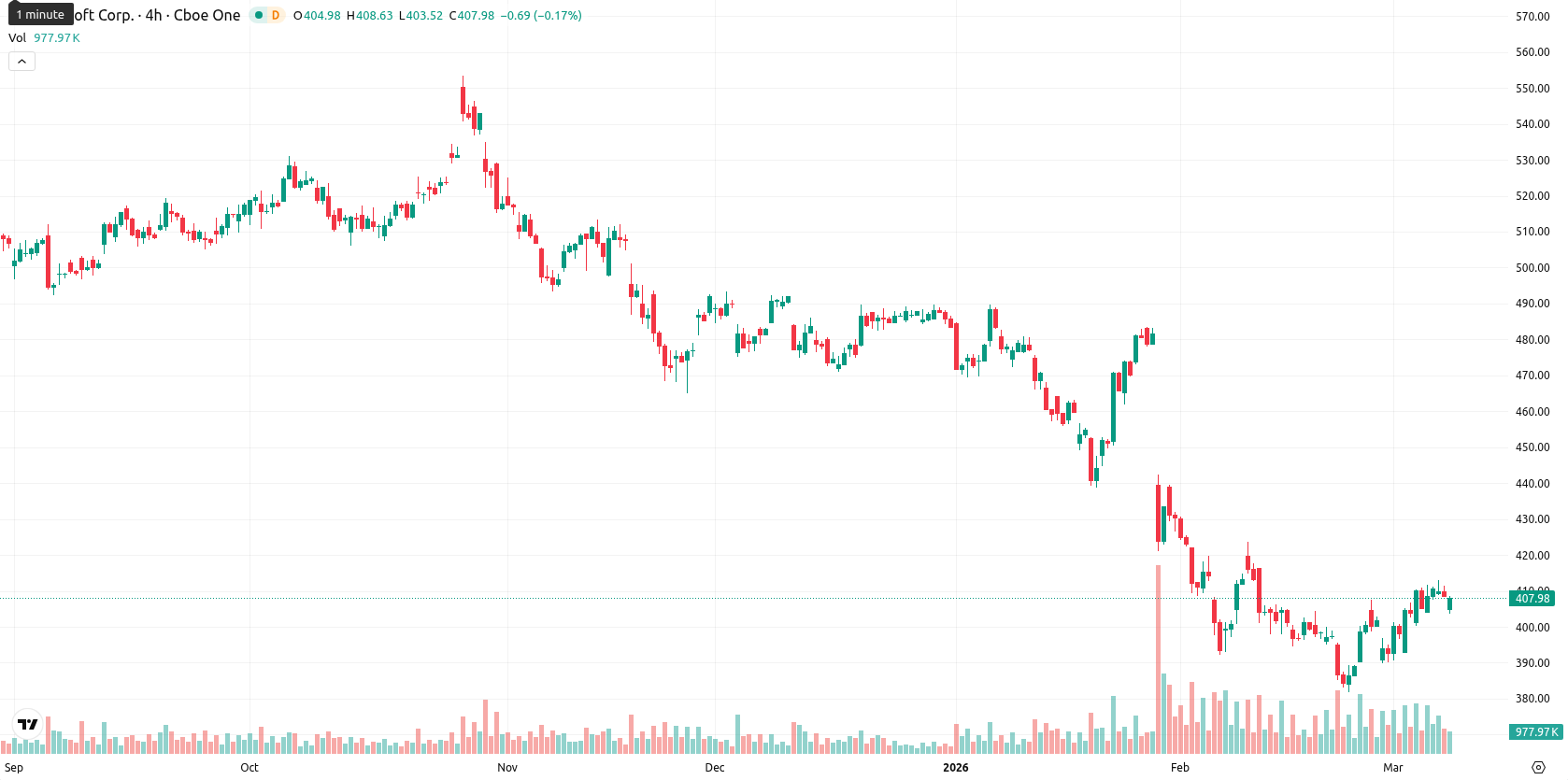
Microsoft Corporation (MSFT) is trading at $407.65, above its 20-day Moving Average of $401.18 but well below the 50-day ($437.75) and 200-day ($484.54) levels. This positioning points to short-term resilience for MSFT, yet continued medium- and long-term downside pressure, with the Ichimoku Kijun level at $412.11 acting as immediate resistance.
 405.75
405.75
405.75
Highlights
- Microsoft faces elevated geopolitical and regulatory risks as the U.S. plans a global tariff hike from 10% to 15%, raising likelihood of retaliatory measures and higher international costs.
- Critical system failures linked to January 2026 security updates and continued targeting by zero-day exploits increase regulatory scrutiny and reputational threats for Microsoft.
- Technical indicators signal weak momentum and downside pressure, with $398.70 as key support and weekly price action likely constrained to a $398.70–$411.34 corridor.
Rising tariff and cyber risks weigh on Microsoft amid global scrutiny
Treasury Secretary Scott Bessent confirmed an upcoming increase in President Trump's global tariff rate from 10% to 15% within the week, raising the likelihood of retaliatory trade actions that could increase cost pressures for Microsoft internationally. In January 2026, Microsoft security updates led to critical system failures, exposing ongoing regulatory and reputational risks if such issues continue amid rising scrutiny from global regulators. Last year, Microsoft was identified as the top target for zero-day cyberattacks, with 25 vulnerabilities exploited, reflecting elevated exposure to cyber risk and highlighting the possibility of government actions linked to cyber incidents originating from Microsoft platforms. U.S. monetary policy uncertainty tied to oil price surges and inflation concerns has further contributed to volatility for large-cap technology stocks, though price action has remained under broader selling pressure.
Divergence in momentum signals as intraday weakness persists
Momentum indicators are cautious for MSFT: MACD and ADX on the daily chart show ongoing selling pressure, while RSI is at a neutral-to-weak level of 47.20. Stochastic RSI and CCI signal overbought levels, but Bull/Bear Power points to mild seller dominance, and the Awesome Oscillator offers no clear direction. The price opened just below the previous close and trades in the lower third of today’s $403.55–$408.50 range, highlighting moderate volatility and prevailing intraday pressure. These mixed technicals reveal a divergence between overheated oscillators and weak momentum, with intraday declines mirroring the downtrend bias.
Sideways outlook dominates as upside probability remains limited
For the coming week, MSFT is likely to fluctuate in a typical volatility band between $398.70 and $411.34, with a probability of a price increase considered very low at under 20%. The baseline scenario is for sideways movement within this range, with the stock struggling to retake resistance levels. If MSFT rises above $412.11, the bullish scenario would target the upper end of the corridor, while a decisive break below $398.70 would confirm a bearish trend and put further support at risk.
Previously it was reported that Microsoft shares are trading above the 20-day moving average but remain under pressure below medium- and long-term averages, with sellers maintaining control as momentum indicators, including MACD and ADX, confirm a bearish bias. Immediate support is seen near $401, with resistance at $412, and further downside is likely if support is breached, given weak upside odds and persistent negative signals on both daily and weekly charts.


Latest Microsoft News





-
 Afghanistan
-
 Albania
-
 Algeria
-
 Angola
-
 Argentina
-
 Armenia
-
 Australia
-
 Austria
-
 Azerbaijan
-
 Bahamas
-
 Bahrain
-
 Bangladesh
-
 Belarus
-
 Belgium
-
 Bolivia
-
 Botswana
-
 Brazil
-
 Brunei
-
 Bulgaria
-
 Cambodia
-
 Cameroon
-
 Canada
-
 Chile
Chile
-
 China
China
-
 Colombia
-
 Congo
Congo
-
 Costa Rica
-
 Cote d'Ivoire
-
 Croatia
-
 Cuba
Cuba
-
 Cyprus
-
 Czechia
-
 DR Congo
-
 Denmark
-
 Dominican Republic
-
 Ecuador
-
 Egypt
Egypt
-
 El Salvador
-
 Estonia
-
 Eswatini
-
 Ethiopia
-
 Finland
-
 France
-
 Georgia
-
 Germany
-
 Ghana
Ghana
-
 Greece
-
 Haiti
Haiti
-
 Hong Kong
-
 Hungary
-
 India
India
-
 Indonesia
-
 Iran, Islamic republic
-
 Iraq
Iraq
-
 Ireland
-
 Israel
-
 Italy
Italy
-
 Jamaica
-
 Japan
Japan
-
 Jordan
-
 Kazakhstan
-
 Kenya
Kenya
-
 Korea
Korea
-
 Kuwait
-
 Kyrgyzstan
-
 Laos
Laos
-
 Latvia
-
 Lebanon
-
 Lesotho
-
 Libya
Libya
-
 Lithuania
-
 Luxembourg
-
 Madagascar
-
 Malaysia
-
 Malta
Malta
-
 Mauritius
-
 Mexico
-
 Moldova
-
 Mongolia
-
 Montenegro
-
 Morocco
-
 Mozambique
-
 Myanmar
-
 Namibia
-
 Nepal
Nepal
-
 Netherlands
-
 New Zealand
-
 Nigeria
-
 North Macedonia
-
 Norway
-
 Oman
Oman
-
 Pakistan
-
 Palestine
-
 Panama
-
 Papua New Guinea
-
 Paraguay
-
 Peru
Peru
-
 Philippines
-
 Poland
-
 Portugal
-
 Puerto Rico
-
 Qatar
Qatar
-
 Reunion
-
 Romania
-
 Rwanda
-
 Saudi Arabia
-
 Serbia
-
 Singapore
-
 Slovakia
-
 Slovenia
-
 Somalia
-
 South Africa
-
 Spain
Spain
-
 Sri Lanka
-
 Sweden
-
 Switzerland
-
 Syria
Syria
-
 Taiwan
-
 Tajikistan
-
 Tanzania
-
 Thailand
-
 Trinidad and Tobago
-
 Tunisia
-
 Turkey
-
 UAE
UAE
-
 Uganda
-
 Ukraine
-
 United Kingdom
-
United States
-
 Uruguay
-
 Uzbekistan
-
 Venezuela
-
 Vietnam
-
 Yemen
Yemen
-
 Zambia
-
 Zimbabwe
- Forex
- Crypto











