

Nvidia stock climbs 1.7% amid launch of Vera Rubin platform with seven new AI chips
Investors’ interest in NVDA shows positive signs. As of March 17, Nvidia stock is trading at $183.32, up 1.7% over the past 24 hours. Price action over the past two weeks confirms consolidation, but trend reversal has not been confirmed yet.
Highlights
- Nvidia stock is consolidating near $183, signaling a pause within a long-term bullish trend.
- The launch of the seven-chip Vera Rubin platform strengthens Nvidia’s positions as an AI infrastructure provider, extending long-term demand visibility.
- A breakout above $190 may cause a growth toward $200–205, but the risks of further decline also remain.
Price action over the past sessions implies a transition from rapid growth to consolidation just below recent highs. After the local peak near $195 in late February, Nvidia has entered a tightening range. Its lower highs tend to form near $188–190, and consistent support emerges around $180. This pattern indicates short-term indecision as buyers absorb supply but do not aggressively push the stock higher.
NVDA remains structurally bullish, holding well above its 200-day moving average. However, the 50-day moving average around $185 serves as dynamic resistance. It effectively prevents most upside attempts. Momentum has cooled from overbought conditions as RSI shifts toward neutral levels.
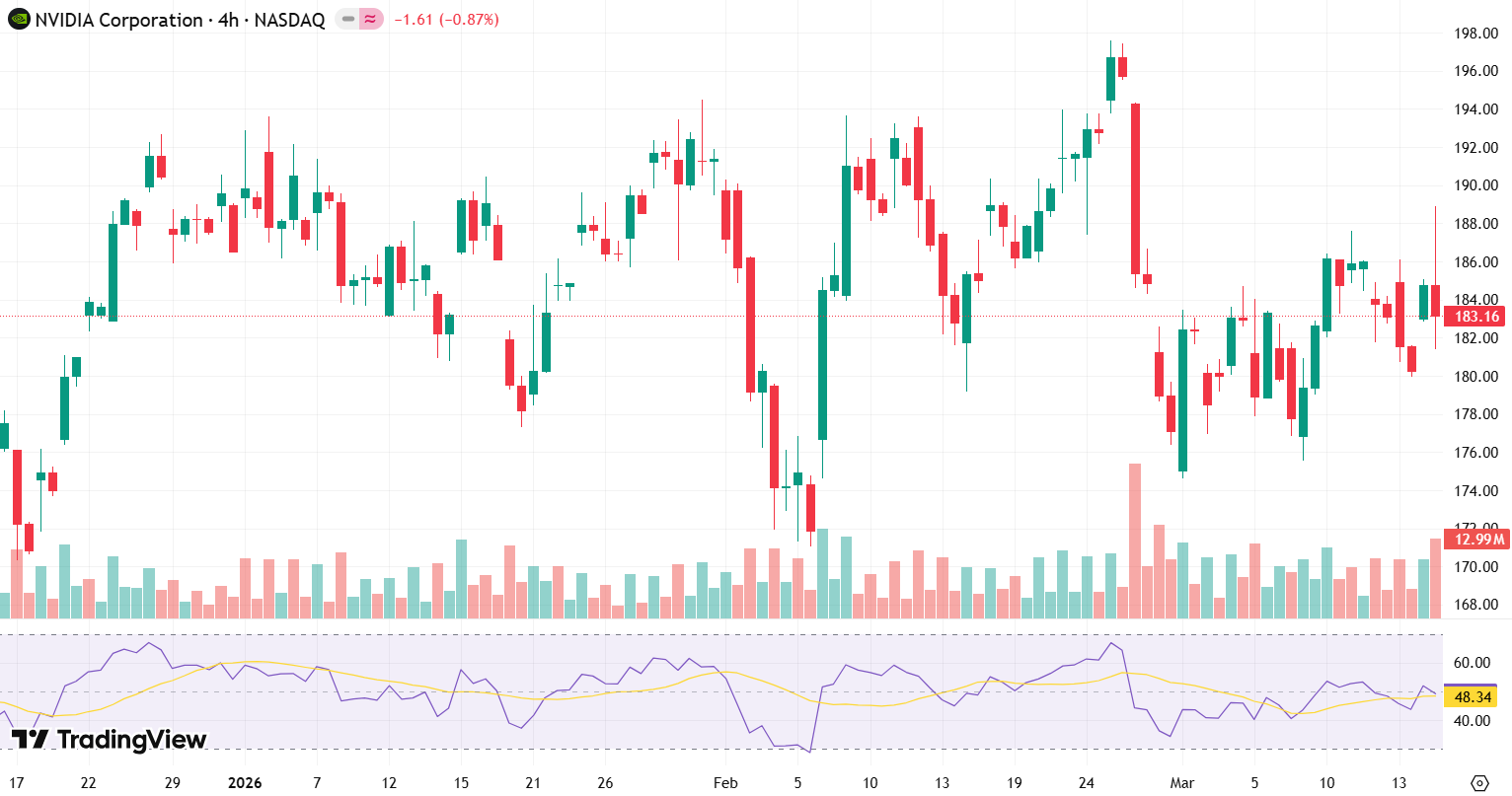
Nvidia shares price performance (January 2026 – March 2026). Source: TradingView.
Volume remains elevated at over 217 million shares. This confirms active institutional participation. This is not a low-liquidity pullback but a controlled rebalancing phase. The key technical level corresponds to $190. This could initiate a momentum leg toward $200–205. On the downside, a break below $180 would expose further declines, where prior demand emerged earlier in March.
Rubin platform expands AI stack beyond GPUs
Nvidia unveiled the Vera Rubin platform at GTC with seven new chips in full production. They together form a unified AI infrastructure system. As CEO Jensen Huang described it, the platform represents “a generational leap,” combining “seven breakthrough chips” into one integrated supercomputing architecture. The portfolio includes compute, networking, inference, and data processing. This implies a shift away from standalone GPUs toward a fully orchestrated AI stack.
The seven chips include the Vera CPU, Rubin GPU, NVLink 6 Switch, ConnectX-9 SuperNIC, BlueField-4 DPU, Spectrum-6 Ethernet switch, and the Groq 3 LPU. All of them target a specific bottleneck in AI workloads. At the core is the NVL72 configuration, which links 72 Rubin GPUs with 36 Vera CPUs via NVLink 6. This configuration improves efficiency in training large mixture-of-experts models.
Adoption signals are strong across the ecosystem. Major cloud providers including AWS, Google Cloud, Microsoft Azure, and Oracle are preparing Rubin-based offerings. At the same time, hardware partners such as Dell, HPE, Lenovo, Cisco, and Supermicro aim to deploy compatible systems. This broad alignment reinforces Nvidia’s transition into a full-stack AI infrastructure provider.
Price outlook hinges on breakout confirmation
In the near term, Nvidia is likely to remain in a consolidation phase between $180 and $190. The market is transitioning from speculative trading to validation of forward growth expectations tied to Rubin and AI demand.
The bullish scenario requires a decisive break above $190 with high volume. In that case, the stock could advance toward $200–205 within the next 2–4 weeks, retesting recent highs. This could coincide with positive AI news flow or strong signals from major cloud customers.
ByteDance is expanding its AI infrastructure by deploying Nvidia Blackwell chips in data centers outside China, including a major cluster in Malaysia. The project, involving up to 36,000 B200 chips, highlights rising compute demand for large-scale AI model training and inference.


Latest NVIDIA News




-
 Afghanistan
-
 Albania
-
 Algeria
-
 Angola
-
 Argentina
-
 Armenia
-
 Australia
-
 Austria
-
 Azerbaijan
-
 Bahamas
-
 Bahrain
-
 Bangladesh
-
 Belarus
-
 Belgium
-
 Bolivia
-
 Botswana
-
 Brazil
-
 Brunei
-
 Bulgaria
-
 Cambodia
-
 Cameroon
-
 Canada
-
 Chile
Chile
-
 China
China
-
 Colombia
-
 Congo
Congo
-
 Costa Rica
-
 Cote d'Ivoire
-
 Croatia
-
 Cuba
Cuba
-
 Cyprus
-
 Czechia
-
 DR Congo
-
 Denmark
-
 Dominican Republic
-
 Ecuador
-
 Egypt
Egypt
-
 El Salvador
-
 Estonia
-
 Eswatini
-
 Ethiopia
-
 Finland
-
 France
-
 Georgia
-
 Germany
-
 Ghana
Ghana
-
 Greece
-
 Haiti
Haiti
-
 Hong Kong
-
 Hungary
-
 India
India
-
 Indonesia
-
 Iran, Islamic republic
-
 Iraq
Iraq
-
 Ireland
-
 Israel
-
 Italy
Italy
-
 Jamaica
-
 Japan
Japan
-
 Jordan
-
 Kazakhstan
-
 Kenya
Kenya
-
 Korea
Korea
-
 Kuwait
-
 Kyrgyzstan
-
 Laos
Laos
-
 Latvia
-
 Lebanon
-
 Lesotho
-
 Libya
Libya
-
 Lithuania
-
 Luxembourg
-
 Madagascar
-
 Malaysia
-
 Malta
Malta
-
 Mauritius
-
 Mexico
-
 Moldova
-
 Mongolia
-
 Montenegro
-
 Morocco
-
 Mozambique
-
 Myanmar
-
 Namibia
-
 Nepal
Nepal
-
 Netherlands
-
 New Zealand
-
 Nigeria
-
 North Macedonia
-
 Norway
-
 Oman
Oman
-
 Pakistan
-
 Palestine
-
 Panama
-
 Papua New Guinea
-
 Paraguay
-
 Peru
Peru
-
 Philippines
-
 Poland
-
 Portugal
-
 Puerto Rico
-
 Qatar
Qatar
-
 Reunion
-
 Romania
-
 Rwanda
-
 Saudi Arabia
-
 Serbia
-
 Singapore
-
 Slovakia
-
 Slovenia
-
 Somalia
-
 South Africa
-
 Spain
Spain
-
 Sri Lanka
-
 Sweden
-
 Switzerland
-
 Syria
Syria
-
 Taiwan
-
 Tajikistan
-
 Tanzania
-
 Thailand
-
 Trinidad and Tobago
-
 Tunisia
-
 Turkey
-
 UAE
UAE
-
 Uganda
-
 Ukraine
-
 United Kingdom
-
United States
-
 Uruguay
-
 Uzbekistan
-
 Venezuela
-
 Vietnam
-
 Yemen
Yemen
-
 Zambia
-
 Zimbabwe
- Forex
- Crypto












