


Alphabet has become one of the main beneficiaries of the current AI‑cycle: according to the latest earnings report, revenue grew by about 22% year‑on‑year, to $109.9 billion, while net profit jumped 81% year‑on‑year, with EPS around $5.11, versus expectations of about $2.6—a performance that ranks among the strongest results in the big‑tech sector. Part of this profit surge reflects one‑off and investment‑related effects (such as equity stakes, including in AI start‑ups), yet the operating metrics—especially in Cloud and Search—confirm real structural growth.
The key engine is Google Cloud, whose revenue surged 63% year‑on‑year to $20.03 billion, while the contract backlog topped $460 billion, which the market interprets as a “books‑full” future cash‑flow profile and effectively a second full‑fledged engine alongside advertising. Cloud margins have risen sharply, while Google Search posted revenue growth of about +19%, and its share of search queries in the US has actually strengthened, undermining the core bear thesis that ChatGPT‑like services would kill Google’s search business.
At the same time, AI‑subscription monetization is accelerating: within Google’s ecosystem there are already over 350 million paying users, and Gemini‑powered features are driving higher traffic and expanded ad‑impression volumes. In substance, Google is evolving from a “pure ad‑player” into a full‑stack AI platform—spanning in‑house chips (TPUs), Cloud infrastructure, Search, and enterprise‑scale subscriptions—strengthening its position as one of the key wholesale AI‑infrastructure providers, which competes with Microsoft on flexibility and differs markedly from Nvidia‑centric models.
On the other hand, the massive CAPEX bill—around $180–190 billion in 2026, with indications of further expansion in 2027—alongside the broader AI‑investment boom across big tech (hundreds of billions in aggregate) raises questions about the return on these investments and whether AI‑driven growth will translate into sustainable operating profit or remain a costly “capital‑driven” narrative. A portion of Alphabet’s current earnings stems precisely from investment‑related items (stakes in SpaceX, Anthropic, and others), adding volatility and making the earnings profile “less clean” from a pure operating‑standpoint.
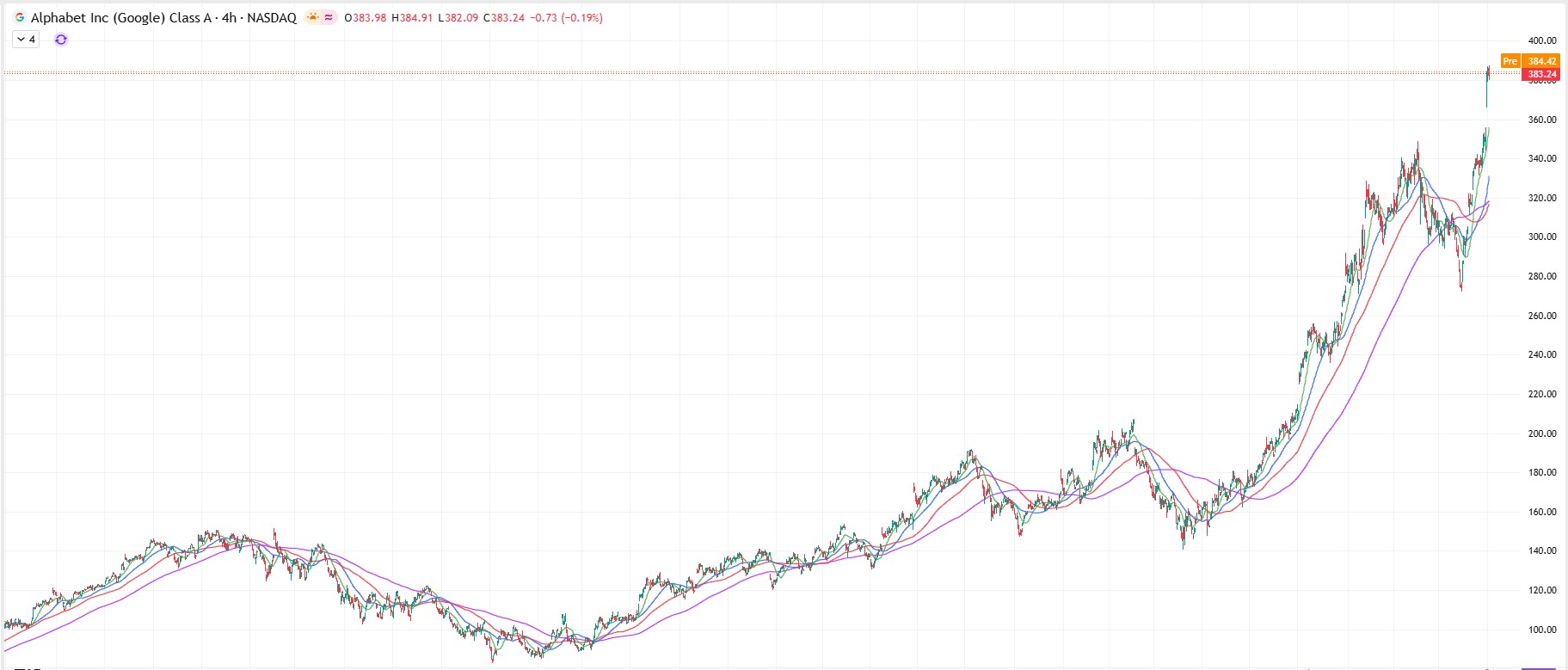
The market has already priced in a lot of good news: Alphabet shares have risen roughly +23% year‑to‑date and around +135% over the past 12 months, which increases the risk of consolidation or a sharper pullback in the event of the first noticeable disappointment in AI‑ROI or a macro shock. Overall, GOOGL currently looks like one of the strongest AI exposures in big tech, but no longer a cheap one: the base case points to consolidation in the $350–400 range, with a bullish scenario pushing toward $420–460 and a bearish one allowing a retreat to $300–330 if spending ramps up and AI optimism weakens.
Previously I noted that Google hits new highs as earnings provide strong support, and in yesterday’s session the stock closed very close to its recent high, yet the lack of further progress by bulls could eventually trigger the liquidation of long positions.










-
 Afghanistan
-
 Albania
-
 Algeria
-
 Angola
-
 Argentina
-
 Armenia
-
 Australia
-
 Austria
-
 Azerbaijan
-
 Bahamas
-
 Bahrain
-
 Bangladesh
-
 Belarus
-
 Belgium
-
 Bolivia
-
 Botswana
-
 Brazil
-
 Brunei
-
 Bulgaria
-
 Cambodia
-
 Cameroon
-
 Canada
-
 Chile
Chile
-
 China
China
-
 Colombia
-
 Congo
Congo
-
 Costa Rica
-
 Cote d'Ivoire
-
 Croatia
-
 Cuba
Cuba
-
 Cyprus
-
 Czechia
-
 DR Congo
-
 Denmark
-
 Dominican Republic
-
 Ecuador
-
 Egypt
Egypt
-
 El Salvador
-
 Estonia
-
 Eswatini
-
 Ethiopia
-
 Finland
-
 France
-
 Georgia
-
 Germany
-
 Ghana
Ghana
-
 Greece
-
 Haiti
Haiti
-
 Hong Kong
-
 Hungary
-
 India
India
-
 Indonesia
-
 Iran, Islamic republic
-
 Iraq
Iraq
-
 Ireland
-
 Israel
-
 Italy
Italy
-
 Jamaica
-
 Japan
Japan
-
 Jordan
-
 Kazakhstan
-
 Kenya
Kenya
-
 Korea
Korea
-
 Kuwait
-
 Kyrgyzstan
-
 Laos
Laos
-
 Latvia
-
 Lebanon
-
 Lesotho
-
 Libya
Libya
-
 Lithuania
-
 Luxembourg
-
 Madagascar
-
 Malaysia
-
 Malta
Malta
-
 Mauritius
-
 Mexico
-
 Moldova
-
 Mongolia
-
 Montenegro
-
 Morocco
-
 Mozambique
-
 Myanmar
-
 Namibia
-
 Nepal
Nepal
-
 Netherlands
-
 New Zealand
-
 Nigeria
-
 North Macedonia
-
 Norway
-
 Oman
Oman
-
 Pakistan
-
 Palestine
-
 Panama
-
 Papua New Guinea
-
 Paraguay
-
 Peru
Peru
-
 Philippines
-
 Poland
-
 Portugal
-
 Puerto Rico
-
 Qatar
Qatar
-
 Reunion
-
 Romania
-
 Rwanda
-
 Saudi Arabia
-
 Serbia
-
 Singapore
-
 Slovakia
-
 Slovenia
-
 Somalia
-
 South Africa
-
 Spain
Spain
-
 Sri Lanka
-
 Sweden
-
 Switzerland
-
 Syria
Syria
-
 Taiwan
-
 Tajikistan
-
 Tanzania
-
 Thailand
-
 Trinidad and Tobago
-
 Tunisia
-
 Turkey
-
 UAE
UAE
-
 Uganda
-
 Ukraine
-
 United Kingdom
-
United States
-
 Uruguay
-
 Uzbekistan
-
 Venezuela
-
 Vietnam
-
 Yemen
Yemen
-
 Zambia
-
 Zimbabwe
- Forex
- Crypto












