

Apple shares declined noticeably following its annual WWDC 2026 conference. Over two trading sessions, the company lost roughly $25 per share in market value, with the stock falling more than 3% on Tuesday — its steepest daily decline since February.
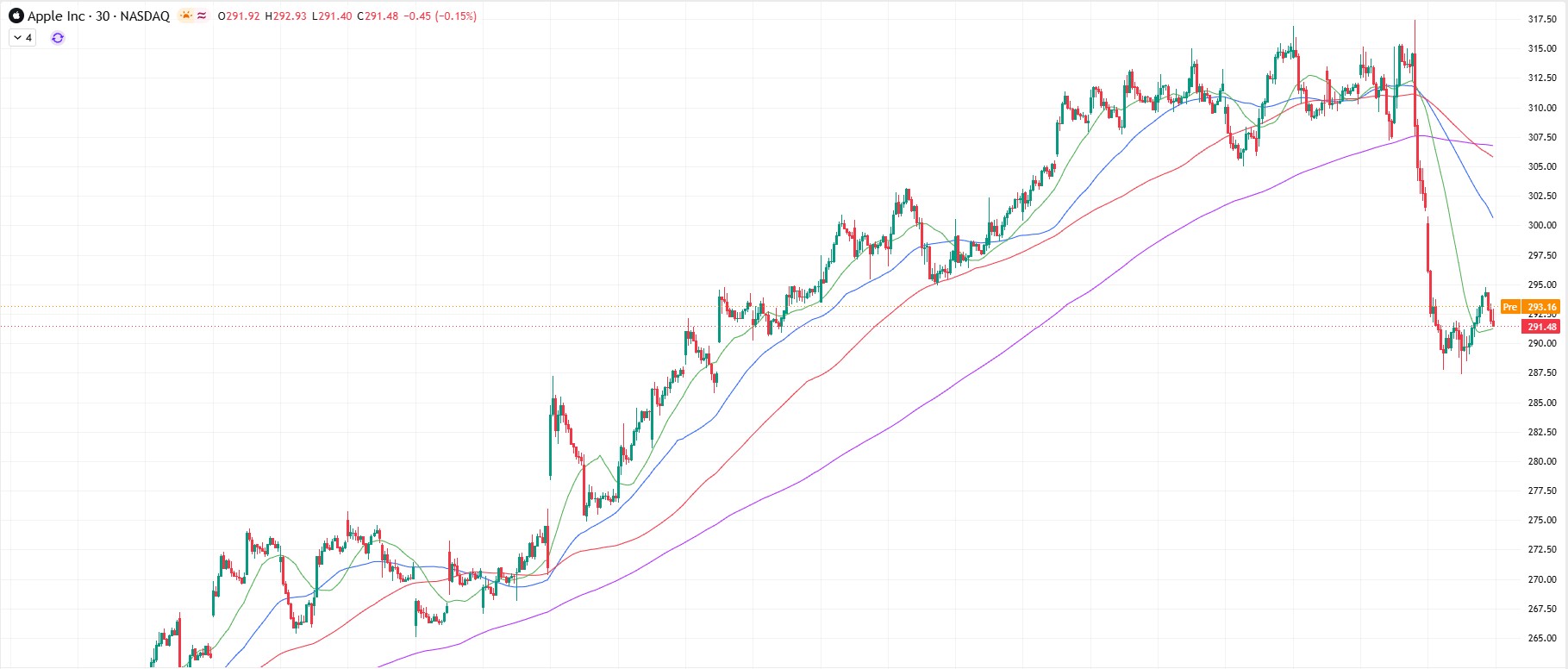
Apple unveiled its full-fledged Siri AI assistant and iOS 27, but the announcements failed to impress investors. The market largely interpreted the event as a classic "sell-the-news" reaction: after rallying to around $317 ahead of the conference, Apple shares closed at $301.54 (-1.89%) and then extended losses to $290.55 (-3.64%).
Fundamentals: record revenue and share buybacks
From a fundamental perspective, Apple continues to deliver strong results. In the second quarter of fiscal 2026, revenue increased 16.6% year-over-year to $112.0 billion, exceeding the consensus estimate of $109.46 billion. Earnings per share came in at $2.01, up from $1.65 a year earlier and above the forecast of $1.95. iPhone revenue reached $56.99 billion (+21.7% YoY), while Mac sales rose 5.7% to $8.40 billion. The board of directors approved a 4% dividend increase to $0.27 per share and authorized a new $100 billion share repurchase program.
Analyst outlook and price targets
Like most analysts, I maintain a bullish view on Apple, with a price target range of $300–$316, implying upside potential of approximately 5%–17%. On June 9, 2026, Morgan Stanley reiterated its "Overweight" rating and $360 price target, representing potential upside of 23%. Goldman Sachs continues to rate the stock "Buy" with a $330 target, while JPMorgan raised its target to $315 and maintained an "Overweight" rating. Wedbush also reaffirmed its "Outperform" rating with a $340 target. Analysts generally see Apple's new AI capabilities as a potential driver of future device sales, although skepticism remains regarding the timeline for Siri AI deployment.
Reasons for the recent decline and long-term outlook
The main factors behind the recent sell-off include investor skepticism about Apple's AI strategy relative to competitors such as Google Gemini 3, uncertainty surrounding the rollout schedule for Siri AI, and concerns that the announcements may not be compelling enough to drive a major iPhone upgrade cycle. Additional risks include ongoing weakness in China and the potential impact of tariffs on Apple's cost structure.
Nevertheless, the company's long-term fundamentals remain solid. Growth in the Services segment (+13.9% to $30.01 billion), a resilient gross margin of approximately 48%, and a massive share buyback program continue to support the company's valuation. The current decline appears to be a short-term correction driven by a reassessment of AI expectations rather than any deterioration in Apple's operating performance.
Near-term outlook
The pullback in AAPL from support around the $288 level is currently capped by resistance near $295. Therefore, the risk of a downside break below support and a move toward the $285–$280 range remains elevated, as I previously noted in Apple continues to decline as capex weighs on the stock. A successful breakout above resistance would open the way for a recovery toward the $300–$305 area.











-
 Afghanistan
-
 Albania
-
 Algeria
-
 Angola
-
 Argentina
-
 Armenia
-
 Australia
-
 Austria
-
 Azerbaijan
-
 Bahamas
-
 Bahrain
-
 Bangladesh
-
 Belarus
-
 Belgium
-
 Bolivia
-
 Botswana
-
 Brazil
-
 Brunei
-
 Bulgaria
-
 Cambodia
-
 Cameroon
-
 Canada
-
 Chile
Chile
-
 China
China
-
 Colombia
-
 Congo
Congo
-
 Costa Rica
-
 Cote d'Ivoire
-
 Croatia
-
 Cuba
Cuba
-
 Cyprus
-
 Czechia
-
 DR Congo
-
 Denmark
-
 Dominican Republic
-
 Ecuador
-
 Egypt
Egypt
-
 El Salvador
-
 Estonia
-
 Eswatini
-
 Ethiopia
-
 Finland
-
 France
-
 Georgia
-
 Germany
-
 Ghana
Ghana
-
 Greece
-
 Haiti
Haiti
-
 Hong Kong
-
 Hungary
-
 India
India
-
 Indonesia
-
 Iran, Islamic republic
-
 Iraq
Iraq
-
 Ireland
-
 Israel
-
 Italy
Italy
-
 Jamaica
-
 Japan
Japan
-
 Jordan
-
 Kazakhstan
-
 Kenya
Kenya
-
 Korea
Korea
-
 Kuwait
-
 Kyrgyzstan
-
 Laos
Laos
-
 Latvia
-
 Lebanon
-
 Lesotho
-
 Libya
Libya
-
 Lithuania
-
 Luxembourg
-
 Madagascar
-
 Malaysia
-
 Malta
Malta
-
 Mauritius
-
 Mexico
-
 Moldova
-
 Mongolia
-
 Montenegro
-
 Morocco
-
 Mozambique
-
 Myanmar
-
 Namibia
-
 Nepal
Nepal
-
 Netherlands
-
 New Zealand
-
 Nigeria
-
 North Macedonia
-
 Norway
-
 Oman
Oman
-
 Pakistan
-
 Palestine
-
 Panama
-
 Papua New Guinea
-
 Paraguay
-
 Peru
Peru
-
 Philippines
-
 Poland
-
 Portugal
-
 Puerto Rico
-
 Qatar
Qatar
-
 Reunion
-
 Romania
-
 Rwanda
-
 Saudi Arabia
-
 Serbia
-
 Singapore
-
 Slovakia
-
 Slovenia
-
 Somalia
-
 South Africa
-
 Spain
Spain
-
 Sri Lanka
-
 Sweden
-
 Switzerland
-
 Syria
Syria
-
 Taiwan
-
 Tajikistan
-
 Tanzania
-
 Thailand
-
 Trinidad and Tobago
-
 Tunisia
-
 Turkey
-
 UAE
UAE
-
 Uganda
-
 Ukraine
-
 United Kingdom
-
United States
-
 Uruguay
-
 Uzbekistan
-
 Venezuela
-
 Vietnam
-
 Yemen
Yemen
-
 Zambia
-
 Zimbabwe
- Forex
- Crypto












