
Intel's relative strength faces key test
Intel has shown surprising resilience amid the broader sell-off in the technology sector. Despite the Nasdaq falling more than 2%, Intel shares managed to recover part of their losses and outperform many of their semiconductor peers.
One of the few positive signals for Intel came from Bank of America, whose analysts included Intel and Micron among the potential beneficiaries of continued growth in semiconductor demand and AI infrastructure spending.
As a result, Intel shares recovered more than 6.8% from their intraday lows and ultimately closed down 4.8%, significantly outperforming sector leader Nvidia.
A major test awaits Intel today. After the market closes on June 24, Micron will release its quarterly earnings report. Any signs of slowing demand could trigger profit-taking across the entire semiconductor sector.
At the same time, even strong results may not be enough to guarantee a continuation of the rally.
Bull trap risks emerge below support
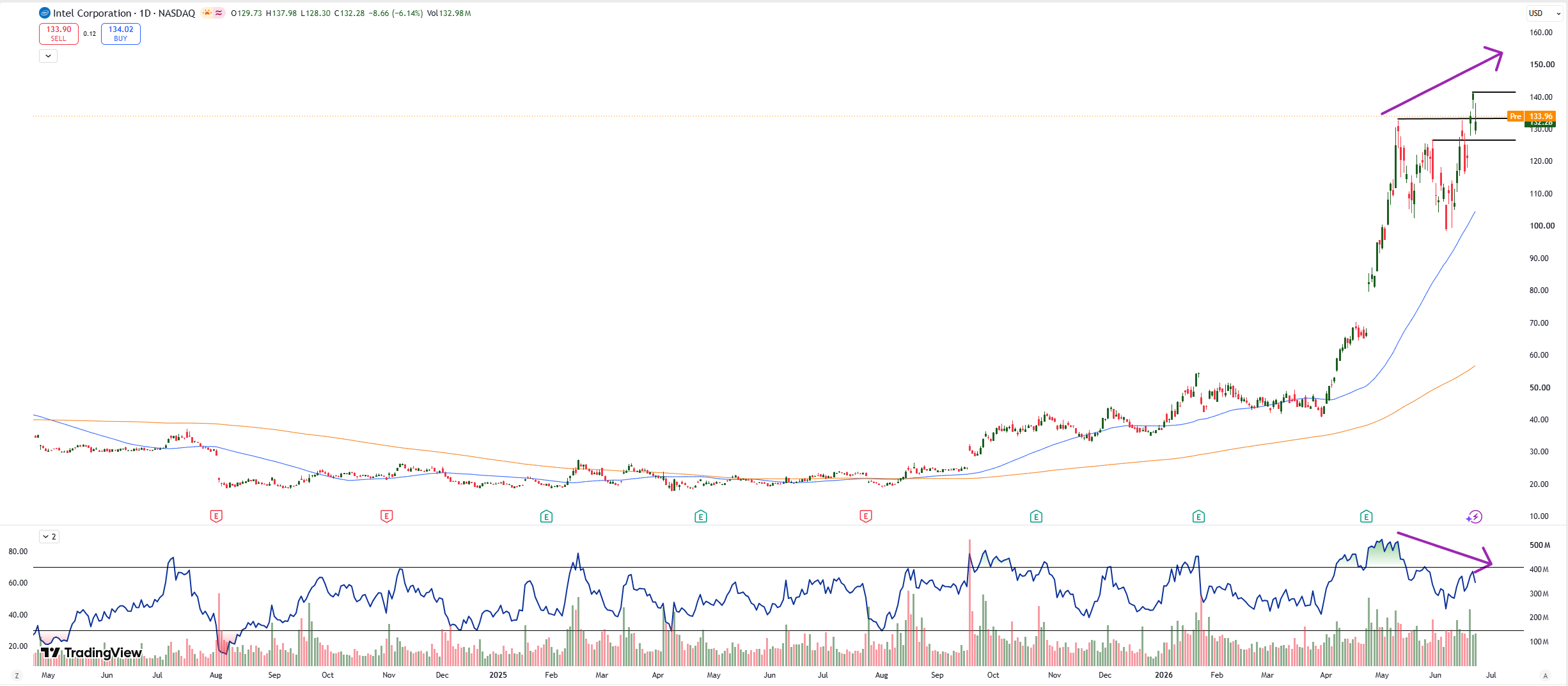
Intel has fully played out the scenario outlined in our previous analysis. After testing the upper boundary of its “Bullish Flag” pattern, the stock moved decisively toward new all-time highs. However, the recent sell-off in AI-related stocks has slowed that momentum.
The key level to watch is $132.75. If the stock opens above this support level, the bullish momentum is likely to continue. However, an opening and close below this level during the regular trading session would increase the risk of a correction, as a potential “Bull Trap” would begin to form.
Investors should also pay attention to the RSI (14). The indicator has formed a bearish divergence, although historically Intel has often reacted to this signal with a significant time lag.
Intel's momentum faces a key test
Today's Micron earnings report could significantly influence sentiment across the semiconductor industry and determine the direction of Intel shares over the coming weeks.
If the results confirm that demand for AI infrastructure remains strong, Intel could receive an additional boost to continue its rally. Otherwise, even the stock's relative strength may prove insufficient to protect it from a broader correction across the semiconductor sector.






-
 Afghanistan
-
 Albania
-
 Algeria
-
 Angola
-
 Argentina
-
 Armenia
-
 Australia
-
 Austria
-
 Azerbaijan
-
 Bahamas
-
 Bahrain
-
 Bangladesh
-
 Belarus
-
 Belgium
-
 Bolivia
-
 Botswana
-
 Brazil
-
 Brunei
-
 Bulgaria
-
 Cambodia
-
 Cameroon
-
 Canada
-
 Chile
Chile
-
 China
China
-
 Colombia
-
 Congo
Congo
-
 Costa Rica
-
 Cote d'Ivoire
-
 Croatia
-
 Cuba
Cuba
-
 Cyprus
-
 Czechia
-
 DR Congo
-
 Denmark
-
 Dominican Republic
-
 Ecuador
-
 Egypt
Egypt
-
 El Salvador
-
 Estonia
-
 Eswatini
-
 Ethiopia
-
 Finland
-
 France
-
 Georgia
-
 Germany
-
 Ghana
Ghana
-
 Greece
-
 Haiti
Haiti
-
 Hong Kong
-
 Hungary
-
 India
India
-
 Indonesia
-
 Iran, Islamic republic
-
 Iraq
Iraq
-
 Ireland
-
 Israel
-
 Italy
Italy
-
 Jamaica
-
 Japan
Japan
-
 Jordan
-
 Kazakhstan
-
 Kenya
Kenya
-
 Korea
Korea
-
 Kuwait
-
 Kyrgyzstan
-
 Laos
Laos
-
 Latvia
-
 Lebanon
-
 Lesotho
-
 Libya
Libya
-
 Lithuania
-
 Luxembourg
-
 Madagascar
-
 Malaysia
-
 Malta
Malta
-
 Mauritius
-
 Mexico
-
 Moldova
-
 Mongolia
-
 Montenegro
-
 Morocco
-
 Mozambique
-
 Myanmar
-
 Namibia
-
 Nepal
Nepal
-
 Netherlands
-
 New Zealand
-
 Nigeria
-
 North Macedonia
-
 Norway
-
 Oman
Oman
-
 Pakistan
-
 Palestine
-
 Panama
-
 Papua New Guinea
-
 Paraguay
-
 Peru
Peru
-
 Philippines
-
 Poland
-
 Portugal
-
 Puerto Rico
-
 Qatar
Qatar
-
 Reunion
-
 Romania
-
 Rwanda
-
 Saudi Arabia
-
 Serbia
-
 Singapore
-
 Slovakia
-
 Slovenia
-
 Somalia
-
 South Africa
-
 Spain
Spain
-
 Sri Lanka
-
 Sweden
-
 Switzerland
-
 Syria
Syria
-
 Taiwan
-
 Tajikistan
-
 Tanzania
-
 Thailand
-
 Trinidad and Tobago
-
 Tunisia
-
 Turkey
-
 UAE
UAE
-
 Uganda
-
 Ukraine
-
 United Kingdom
-
United States
-
 Uruguay
-
 Uzbekistan
-
 Venezuela
-
 Vietnam
-
 Yemen
Yemen
-
 Zambia
-
 Zimbabwe
- Forex
- Crypto











