
Nvidia stock drops 2.7% as AI trade reverses sharply

As of September 3, Nvidia stock is trading at $169.56, down 2.7% in the last 24 hours. This recent decline marks a significant shift in the technical setup, with the stock closing below its 50-day moving average for the first time since May.
Highlights
- Nvidia closed below its 50-day moving average for the first time since May, signaling a shift in short-term momentum.
- The stock has lost over $340 billion in market cap amid cooling AI enthusiasm and rising competition.
- Key support lies at $160, with a break lower potentially triggering a deeper retracement toward $145.
Nvidia’s year-to-date rally was driven by powerful bullish momentum, particularly after a golden cross formed in early 2025 when the 50-day moving average rose above the 200-day. That move pushed shares to fresh all-time highs near $200. However, the recent pullback has eroded a substantial portion of those gains. The current price now sits just above the next critical support zone around $160. If that level fails to hold, the chart opens up to a deeper retracement toward the $145 range, where the 100-day moving average currently resides.
Volume has surged during the recent selloff, with over 230 million shares traded intraday—a sign that institutional participation is contributing to the drawdown. This also suggests the selling may not yet be exhausted. On the upside, any move above the $171–$175 resistance range could signal a recovery and bring back short-term buyers. Technical indicators such as RSI and MACD have both turned lower, confirming waning momentum.
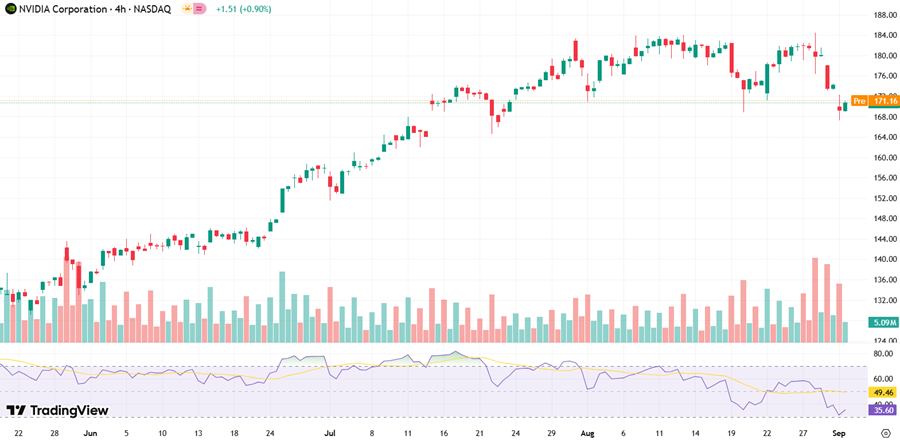
Nvidia stock price dynamics (June 2025 - September 2025). Source: TradingView
Adding to the technical weakness, Nvidia has also formed a bearish engulfing pattern on the daily chart, which often precedes further downside, especially when accompanied by high volume. This candlestick pattern, combined with the breakdown below the 50-day moving average, reinforces the probability of a continued correction. Additionally, the Bollinger Bands have begun to widen, indicating increased volatility and the potential for sharper price swings in the coming sessions. These signals suggest that unless Nvidia quickly reclaims the $171 level, momentum traders may continue to unwind positions.
AI optimism cools as market awaits next catalyst
Nvidia’s decline is not isolated but reflects a broader reassessment of the high-growth AI trade that has powered the stock’s ascent over the past 18 months. In just four days, Nvidia lost more than $340 billion in market capitalization, a stark reversal for a stock that had recently been the poster child of the generative AI boom. Investors are beginning to question whether current valuations still make sense in light of an increasingly crowded AI chip landscape and growing macroeconomic uncertainty.
Additionally, global competitive dynamics are beginning to weigh on sentiment. China’s advances in AI chip development and intensifying U.S.–China trade tensions are undermining confidence in Nvidia’s unchallenged dominance. Despite blowout earnings in recent quarters, including second-quarter results that beat even the highest estimates, the stock reaction has been muted. This reflects a market that has priced in not just strong growth but perfection.
The upcoming product cycle tied to the Blackwell chip family could be a decisive factor in reversing sentiment. Nvidia bulls are banking on significant performance and efficiency gains to reinforce the company’s leadership in data center and AI training segments. However, the burden of proof is rising, and even positive announcements may not be enough to push the stock back to its highs without a clear acceleration in earnings or new market penetration.
Consolidation or deeper retracement ahead
In the short term, Nvidia is likely to remain range-bound between $160 and $175. This range reflects a technical pause zone, where buyers and sellers are both active. Should the stock bounce convincingly above $175, it would suggest that dip-buyers are reasserting control, potentially paving the way for a move back toward the $190–$200 zone. However, this would likely require a combination of strong corporate guidance, improved macro sentiment, or new AI product momentum.
On the downside, a decisive breakdown below $160 would open the door to more aggressive selling. A drop to the $145–$150 range is plausible if institutional confidence continues to erode, particularly if yields stay elevated or earnings guidance disappoints. This would represent a 15%–20% correction from recent highs but could set the stage for a more sustainable long-term base.
Nvidia posted record Q2 results with $46.7 billion in revenue and strong Q3 guidance, along with a $60 billion stock buyback, reinforcing confidence in AI-driven growth. However, shares dipped post-earnings as data center revenue narrowly missed expectations, raising concerns about potential slowing momentum in its core AI segment.








-
 Afghanistan
-
 Albania
-
 Algeria
-
 Angola
-
 Argentina
-
 Armenia
-
 Australia
-
 Austria
-
 Azerbaijan
-
 Bahamas
-
 Bahrain
-
 Bangladesh
-
 Belarus
-
 Belgium
-
 Bolivia
-
 Botswana
-
 Brazil
-
 Brunei
-
 Bulgaria
-
 Cambodia
-
 Cameroon
-
 Canada
-
 Chile
Chile
-
 China
China
-
 Colombia
-
 Congo
Congo
-
 Costa Rica
-
 Cote d'Ivoire
-
 Croatia
-
 Cuba
Cuba
-
 Cyprus
-
 Czechia
-
 DR Congo
-
 Denmark
-
 Dominican Republic
-
 Ecuador
-
 Egypt
Egypt
-
 El Salvador
-
 Estonia
-
 Eswatini
-
 Ethiopia
-
 Finland
-
 France
-
 Georgia
-
 Germany
-
 Ghana
Ghana
-
 Greece
-
 Haiti
Haiti
-
 Hong Kong
-
 Hungary
-
 India
India
-
 Indonesia
-
 Iran, Islamic republic
-
 Iraq
Iraq
-
 Ireland
-
 Israel
-
 Italy
Italy
-
 Jamaica
-
 Japan
Japan
-
 Jordan
-
 Kazakhstan
-
 Kenya
Kenya
-
 Korea
Korea
-
 Kuwait
-
 Kyrgyzstan
-
 Laos
Laos
-
 Latvia
-
 Lebanon
-
 Lesotho
-
 Libya
Libya
-
 Lithuania
-
 Luxembourg
-
 Madagascar
-
 Malaysia
-
 Malta
Malta
-
 Mauritius
-
 Mexico
-
 Moldova
-
 Mongolia
-
 Montenegro
-
 Morocco
-
 Mozambique
-
 Myanmar
-
 Namibia
-
 Nepal
Nepal
-
 Netherlands
-
 New Zealand
-
 Nigeria
-
 North Macedonia
-
 Norway
-
 Oman
Oman
-
 Pakistan
-
 Palestine
-
 Panama
-
 Papua New Guinea
-
 Paraguay
-
 Peru
Peru
-
 Philippines
-
 Poland
-
 Portugal
-
 Puerto Rico
-
 Qatar
Qatar
-
 Reunion
-
 Romania
-
 Rwanda
-
 Saudi Arabia
-
 Serbia
-
 Singapore
-
 Slovakia
-
 Slovenia
-
 Somalia
-
 South Africa
-
 Spain
Spain
-
 Sri Lanka
-
 Sweden
-
 Switzerland
-
 Syria
Syria
-
 Taiwan
-
 Tajikistan
-
 Tanzania
-
 Thailand
-
 Trinidad and Tobago
-
 Tunisia
-
 Turkey
-
 UAE
UAE
-
 Uganda
-
 Ukraine
-
 United Kingdom
-
United States
-
 Uruguay
-
 Uzbekistan
-
 Venezuela
-
 Vietnam
-
 Yemen
Yemen
-
 Zambia
-
 Zimbabwe
- Forex
- Crypto











