
Meta shares slide to $627 as LeCun exit deepens investor concerns over AI transition

Meta Platforms Inc. (NASDAQ: META) fell to around $627 on Tuesday, extending its multi-week decline after Chief AI Scientist Yann LeCun announced plans to leave the company and launch his own startup. The move, coming amid a broader selloff in big tech, has amplified investor anxiety over Meta’s long-term AI direction and leadership stability.
Highlights
- Meta falls to $627 as Chief AI Scientist Yann LeCun announces departure.
- Stock breaks key trendline after losing nearly 20% from October highs.
- Investors reassess Meta’s AI strategy under new leadership.
The stock has now dropped nearly 20% from its October highs, marking its steepest correction since the summer.
Leadership shift and market reaction
LeCun, one of the founding figures in deep learning, had led Meta’s core AI research for nearly a decade. His exit comes as CEO Mark Zuckerberg pushes ahead with a sweeping restructuring of the company’s AI operations through its newly formed Superintelligence Labs. The transition places Alexandr Wang, former Scale AI CEO, at the helm of Meta’s next-generation AI initiatives — a move seen as bold but risky.
Analysts suggest the timing of LeCun’s departure has rattled confidence in Meta’s execution capabilities. The company’s AI roadmap was already under scrutiny following heavy capital commitments and rising operating expenses. With Meta planning to invest an estimated $600 billion in U.S. infrastructure over the next three years, investors are questioning how such aggressive spending aligns with near-term profitability.
Technical breakdown and market structure
From a technical perspective, Meta’s chart has shifted decisively bearish. The stock broke below its multi-month ascending trendline and key moving averages, including the 20-, 50-, and 100-day EMAs, which now cluster as resistance between $674 and $706. The 200-day EMA at $676 marks the former support zone that triggered the current selloff.
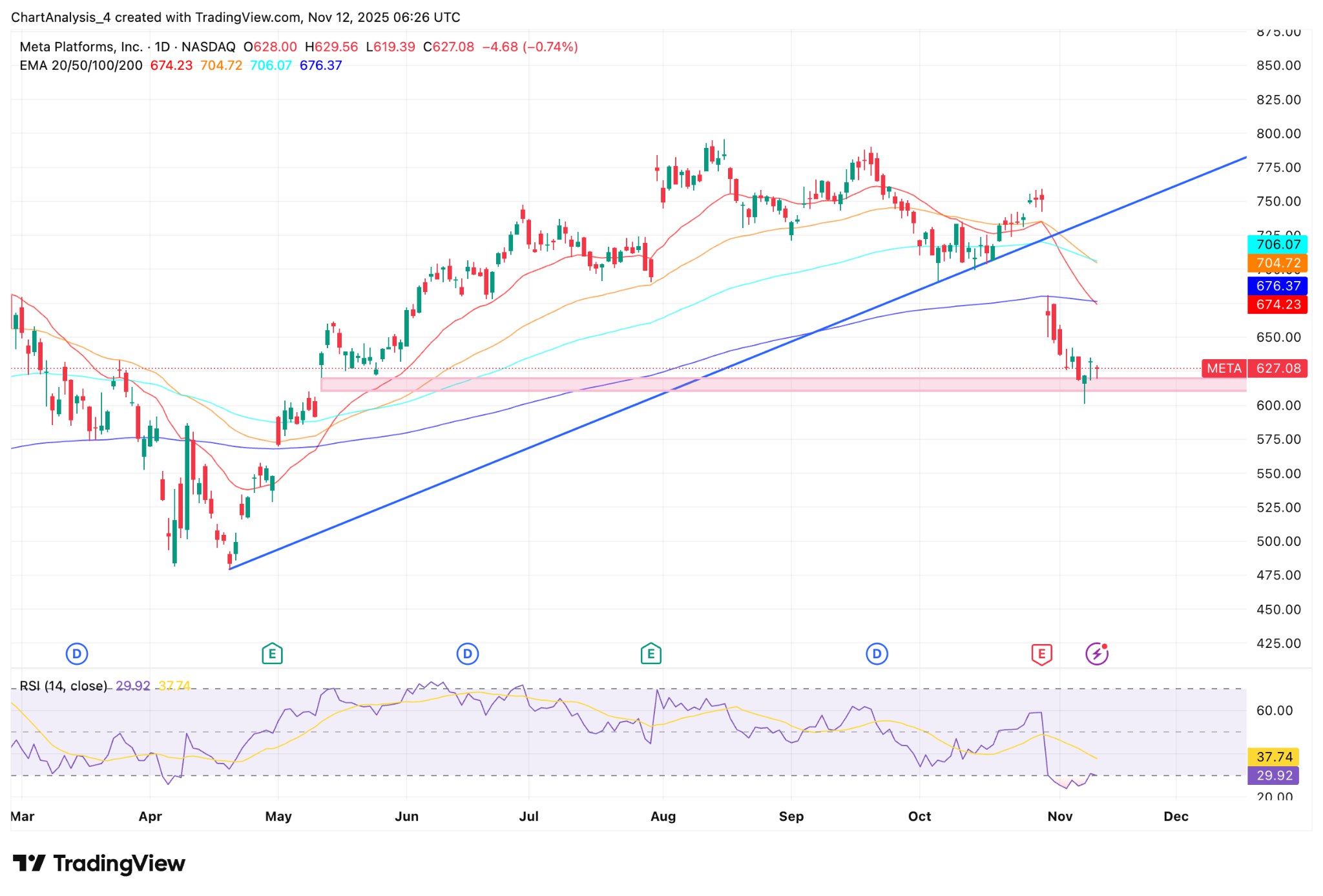
Meta stock price dynamics (Source: TradingView)
Price action shows consolidation between $620 and $600, coinciding with a prior accumulation range from May. Bulls have defended the zone so far, though the reaction remains tentative. A failure to hold $600 could send Meta lower toward $575, and potentially to $540, the level where April’s breakout began.
Momentum indicators reflect exhaustion. The RSI sits near 30, signaling oversold conditions but lacking divergence or volume confirmation for a reversal. For a sustained recovery, the stock would need to close above $650, reclaiming the broken trendline and testing short-term resistance.
Policy backdrop and outlook
Macro sentiment offers limited relief. While markets now price in a 68% probability of a 25-basis-point Federal Reserve rate cut in December, easing liquidity alone may not offset company-specific uncertainty. Investors remain cautious about Meta’s shifting AI vision, particularly as competition in generative models and infrastructure spending intensifies.
Despite near-term weakness, long-term sentiment toward Meta’s AI ambitions remains mixed rather than outright bearish. The company retains vast computational scale and data resources, but leadership transitions have introduced a perception of execution risk. The coming weeks will reveal whether Meta can stabilize its structure and reassure investors through clarity on cost discipline and innovation focus.
Earlier analysis highlighted Meta’s loss of its ascending channel and the 200-day EMA as pivotal technical signals. That breakdown remains the dominant feature of the current structure. The $600 level now represents the last stronghold for buyers. A recovery above $650 could revive momentum toward $700, but losing $600 risks triggering a deeper correction before the next earnings cycle.









-
 Afghanistan
-
 Albania
-
 Algeria
-
 Angola
-
 Argentina
-
 Armenia
-
 Australia
-
 Austria
-
 Azerbaijan
-
 Bahamas
-
 Bahrain
-
 Bangladesh
-
 Belarus
-
 Belgium
-
 Bolivia
-
 Botswana
-
 Brazil
-
 Brunei
-
 Bulgaria
-
 Cambodia
-
 Cameroon
-
 Canada
-
 Chile
Chile
-
 China
China
-
 Colombia
-
 Congo
Congo
-
 Costa Rica
-
 Cote d'Ivoire
-
 Croatia
-
 Cuba
Cuba
-
 Cyprus
-
 Czechia
-
 DR Congo
-
 Denmark
-
 Dominican Republic
-
 Ecuador
-
 Egypt
Egypt
-
 El Salvador
-
 Estonia
-
 Eswatini
-
 Ethiopia
-
 Finland
-
 France
-
 Georgia
-
 Germany
-
 Ghana
Ghana
-
 Greece
-
 Haiti
Haiti
-
 Hong Kong
-
 Hungary
-
 India
India
-
 Indonesia
-
 Iran, Islamic republic
-
 Iraq
Iraq
-
 Ireland
-
 Israel
-
 Italy
Italy
-
 Jamaica
-
 Japan
Japan
-
 Jordan
-
 Kazakhstan
-
 Kenya
Kenya
-
 Korea
Korea
-
 Kuwait
-
 Kyrgyzstan
-
 Laos
Laos
-
 Latvia
-
 Lebanon
-
 Lesotho
-
 Libya
Libya
-
 Lithuania
-
 Luxembourg
-
 Madagascar
-
 Malaysia
-
 Malta
Malta
-
 Mauritius
-
 Mexico
-
 Moldova
-
 Mongolia
-
 Montenegro
-
 Morocco
-
 Mozambique
-
 Myanmar
-
 Namibia
-
 Nepal
Nepal
-
 Netherlands
-
 New Zealand
-
 Nigeria
-
 North Macedonia
-
 Norway
-
 Oman
Oman
-
 Pakistan
-
 Palestine
-
 Panama
-
 Papua New Guinea
-
 Paraguay
-
 Peru
Peru
-
 Philippines
-
 Poland
-
 Portugal
-
 Puerto Rico
-
 Qatar
Qatar
-
 Reunion
-
 Romania
-
 Rwanda
-
 Saudi Arabia
-
 Serbia
-
 Singapore
-
 Slovakia
-
 Slovenia
-
 Somalia
-
 South Africa
-
 Spain
Spain
-
 Sri Lanka
-
 Sweden
-
 Switzerland
-
 Syria
Syria
-
 Taiwan
-
 Tajikistan
-
 Tanzania
-
 Thailand
-
 Trinidad and Tobago
-
 Tunisia
-
 Turkey
-
 UAE
UAE
-
 Uganda
-
 Ukraine
-
 United Kingdom
-
United States
-
 Uruguay
-
 Uzbekistan
-
 Venezuela
-
 Vietnam
-
 Yemen
Yemen
-
 Zambia
-
 Zimbabwe
- Forex
- Crypto












