
Gold price forecast: Bulls defend $4,000 as traders brace for Fed minutes and jobs data

Gold traded near $4,090 on Wednesday as the metal extended its rebound from last week’s corrective lows and entered a critical macro window shaped by the upcoming FOMC minutes and Thursday’s labor release. Renewed safe-haven inflows have supported the move, with equities under pressure from valuation concerns and weakness across major tech benchmarks.
Highlights
- Gold trades at $4,090 ahead of FOMC minutes and U.S. labor data.
- Price holds above the $3,998–$4,020 support zone after last week’s decline.
- Unemployment claims rise, lifting December cut odds despite Fed caution.
Rising unemployment claims — now at their highest in two months — and continued claims edging toward 1.9 million have added a mild boost to rate-cut expectations, though policymakers continue to push back against any aggressive easing narrative. These crosscurrents have left the metal highly reactive to macro signals, with traders closely watching whether the Fed’s messaging aligns with recent labor softness or reasserts a restrictive stance heading into December.
Gold stabilizes above key Fibonacci support as buyers defend the trend
The daily chart shows gold holding firmly above the $3,998–$4,020 zone, a crucial band that aligns with the 0.236 Fibonacci retracement and the latest Parabolic SAR pivot. This region has served as the first major demand area since the sharp rejection from $4,380, and buyers have repeatedly stepped in as price approached the lower boundary. The structure signals that the broader uptrend remains intact despite short-term volatility.
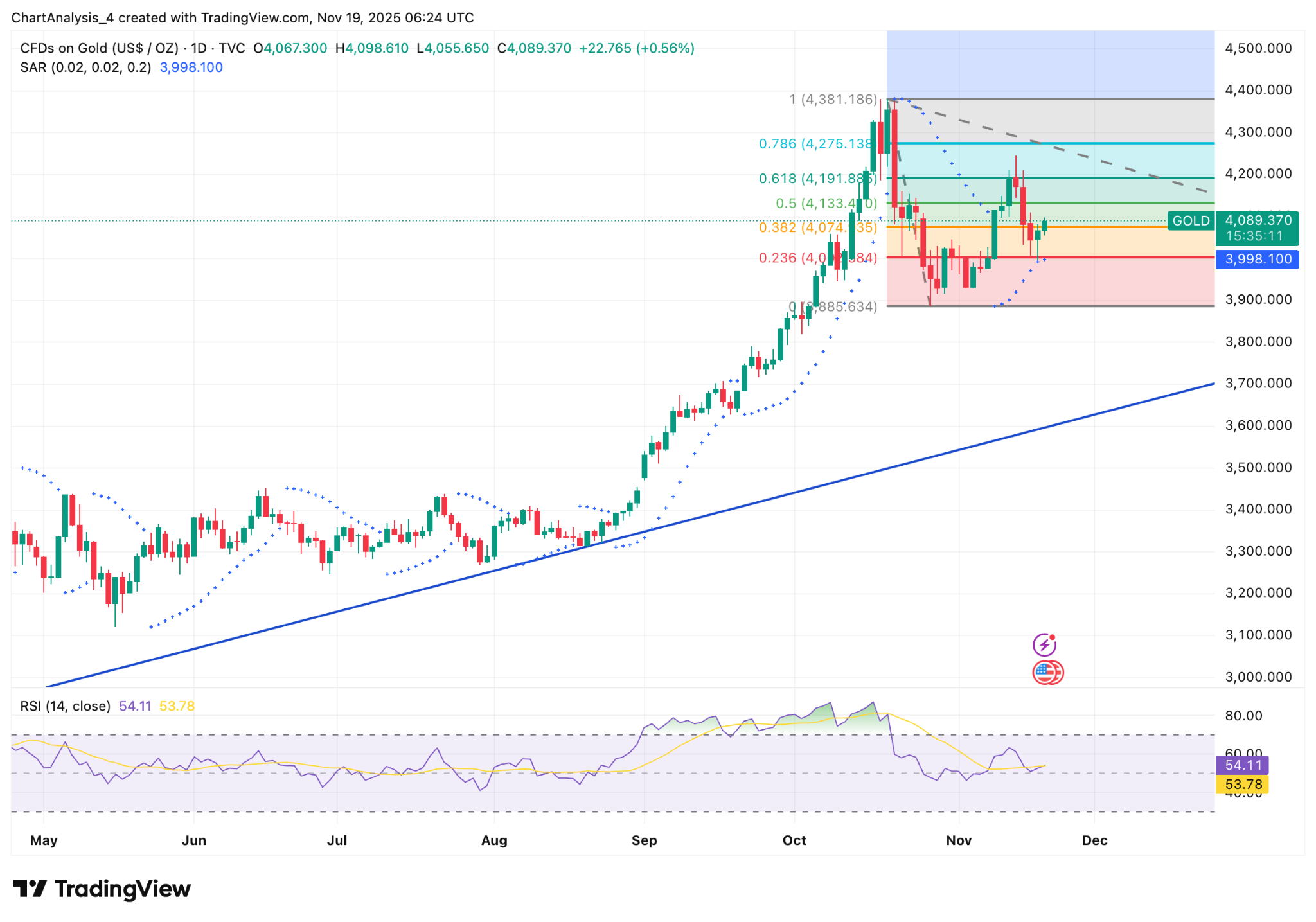
Gold price dynamics (Source: TradingView)
Momentum has also shown signs of improvement, with RSI recovering to 54, shifting back into neutral-positive territory without approaching overheated conditions. That balance has allowed gold to rebound while avoiding the momentum excess that fueled the early-November pullback.
The immediate challenge lies at the mid-Fibonacci levels. The $4,133–$4,192 zone — representing the 0.5 and 0.618 retracements — has rejected price twice in the past several sessions. This region also intersects with the broken descending trendline, creating a dense supply pocket. A decisive close above $4,200 remains the key trigger for restoring bullish continuation and reopening the path toward $4,275 and the $4,380 peak.
Until then, gold remains trapped inside a compressed range where macro headlines dictate direction. Equity markets are trading defensively as stretched tech valuations and sector-wide uncertainty drive repositioning, helping to anchor bullion during corrective swings.
Macro catalysts to determine whether gold breaks higher or retests mid-$3,900s
The next move hinges on the tone of the FOMC minutes and incoming labor data. If policymakers maintain the recent “slow and cautious” stance on future easing, gold could stay bid above $4,000 as traders solidify expectations for a gradual shift in 2025. A softer labor print would likely reinforce that trajectory, giving gold further room to stabilize and attempt another test of the $4,133–$4,192 band.
A hawkish shift, however, paired with a firm jobs report, could send gold back toward the $3,955–$3,900 region. This band marks the lower edge of the current corrective zone and sits atop the structural base from which the last major leg of the rally began. A loss of this region would invite a deeper retracement and challenge the integrity of the broader uptrend.
For now, the structure remains constructive as long as buyers defend the $3,998 pivot. The market is tightly coiled, volatility is suppressed, and gold’s next major move will likely follow directly from Wednesday’s and Thursday’s macro releases.
In earlier analysis, we noted that gold’s resilience above the $4,000 region was pivotal to maintaining the broader trend, even as mid-Fibonacci levels acted as stiff resistance. This week’s rebound confirms that dynamic, with the metal holding the lower demand zone while remaining capped by the same $4,133–$4,192 cluster.


Latest Gold News







-
 Afghanistan
-
 Albania
-
 Algeria
-
 Angola
-
 Argentina
-
 Armenia
-
 Australia
-
 Austria
-
 Azerbaijan
-
 Bahamas
-
 Bahrain
-
 Bangladesh
-
 Belarus
-
 Belgium
-
 Bolivia
-
 Botswana
-
 Brazil
-
 Brunei
-
 Bulgaria
-
 Cambodia
-
 Cameroon
-
 Canada
-
 Chile
Chile
-
 China
China
-
 Colombia
-
 Congo
Congo
-
 Costa Rica
-
 Cote d'Ivoire
-
 Croatia
-
 Cuba
Cuba
-
 Cyprus
-
 Czechia
-
 DR Congo
-
 Denmark
-
 Dominican Republic
-
 Ecuador
-
 Egypt
Egypt
-
 El Salvador
-
 Estonia
-
 Eswatini
-
 Ethiopia
-
 Finland
-
 France
-
 Georgia
-
 Germany
-
 Ghana
Ghana
-
 Greece
-
 Haiti
Haiti
-
 Hong Kong
-
 Hungary
-
 India
India
-
 Indonesia
-
 Iran, Islamic republic
-
 Iraq
Iraq
-
 Ireland
-
 Israel
-
 Italy
Italy
-
 Jamaica
-
 Japan
Japan
-
 Jordan
-
 Kazakhstan
-
 Kenya
Kenya
-
 Korea
Korea
-
 Kuwait
-
 Kyrgyzstan
-
 Laos
Laos
-
 Latvia
-
 Lebanon
-
 Lesotho
-
 Libya
Libya
-
 Lithuania
-
 Luxembourg
-
 Madagascar
-
 Malaysia
-
 Malta
Malta
-
 Mauritius
-
 Mexico
-
 Moldova
-
 Mongolia
-
 Montenegro
-
 Morocco
-
 Mozambique
-
 Myanmar
-
 Namibia
-
 Nepal
Nepal
-
 Netherlands
-
 New Zealand
-
 Nigeria
-
 North Macedonia
-
 Norway
-
 Oman
Oman
-
 Pakistan
-
 Palestine
-
 Panama
-
 Papua New Guinea
-
 Paraguay
-
 Peru
Peru
-
 Philippines
-
 Poland
-
 Portugal
-
 Puerto Rico
-
 Qatar
Qatar
-
 Reunion
-
 Romania
-
 Rwanda
-
 Saudi Arabia
-
 Serbia
-
 Singapore
-
 Slovakia
-
 Slovenia
-
 Somalia
-
 South Africa
-
 Spain
Spain
-
 Sri Lanka
-
 Sweden
-
 Switzerland
-
 Syria
Syria
-
 Taiwan
-
 Tajikistan
-
 Tanzania
-
 Thailand
-
 Trinidad and Tobago
-
 Tunisia
-
 Turkey
-
 UAE
UAE
-
 Uganda
-
 Ukraine
-
 United Kingdom
-
United States
-
 Uruguay
-
 Uzbekistan
-
 Venezuela
-
 Vietnam
-
 Yemen
Yemen
-
 Zambia
-
 Zimbabwe
- Forex
- Crypto











