
Gold price forecast: XAU slips toward $4,000 as four-day pullback tests key support zone

Gold extended its decline for a fourth straight session on Tuesday, trading near $4,011 per ounce as the metal confronts a sharp shift in rate-cut expectations and heightened uncertainty ahead of major U.S. economic releases. The retreat marks the first meaningful cooling phase after a powerful multi-month rally that lifted prices into the $4,300 region.
Highlights
- Gold trades near $4,011 after a four-day slide into a key support band.
- Metal tests the 0.382 Fibonacci level at $4,074, with $4,000 acting as pivotal short-term support.
- Probability of a December Fed rate cut drops from 60% to 43%, weighing on metals.
The current pullback reflects both a recalibration of Federal Reserve expectations and a pause in gold’s steep rally since summer. With traders awaiting long-delayed U.S. data releases, the market is reassessing whether the latest correction signals a trend shift or a routine retracement in an otherwise durable uptrend.
Technical pressure builds as gold tests pivotal retracement levels
Gold’s daily chart shows a decline aligned almost exactly with Fibonacci retracements drawn from the $3,685 swing low to the recent $4,381 peak. Gold is now testing the 0.382 level at $4,074, historically a decisive zone in trending markets. A sustained break beneath this threshold would expose the 0.236 region around $4,000, which overlaps with Tuesday’s intraday low.
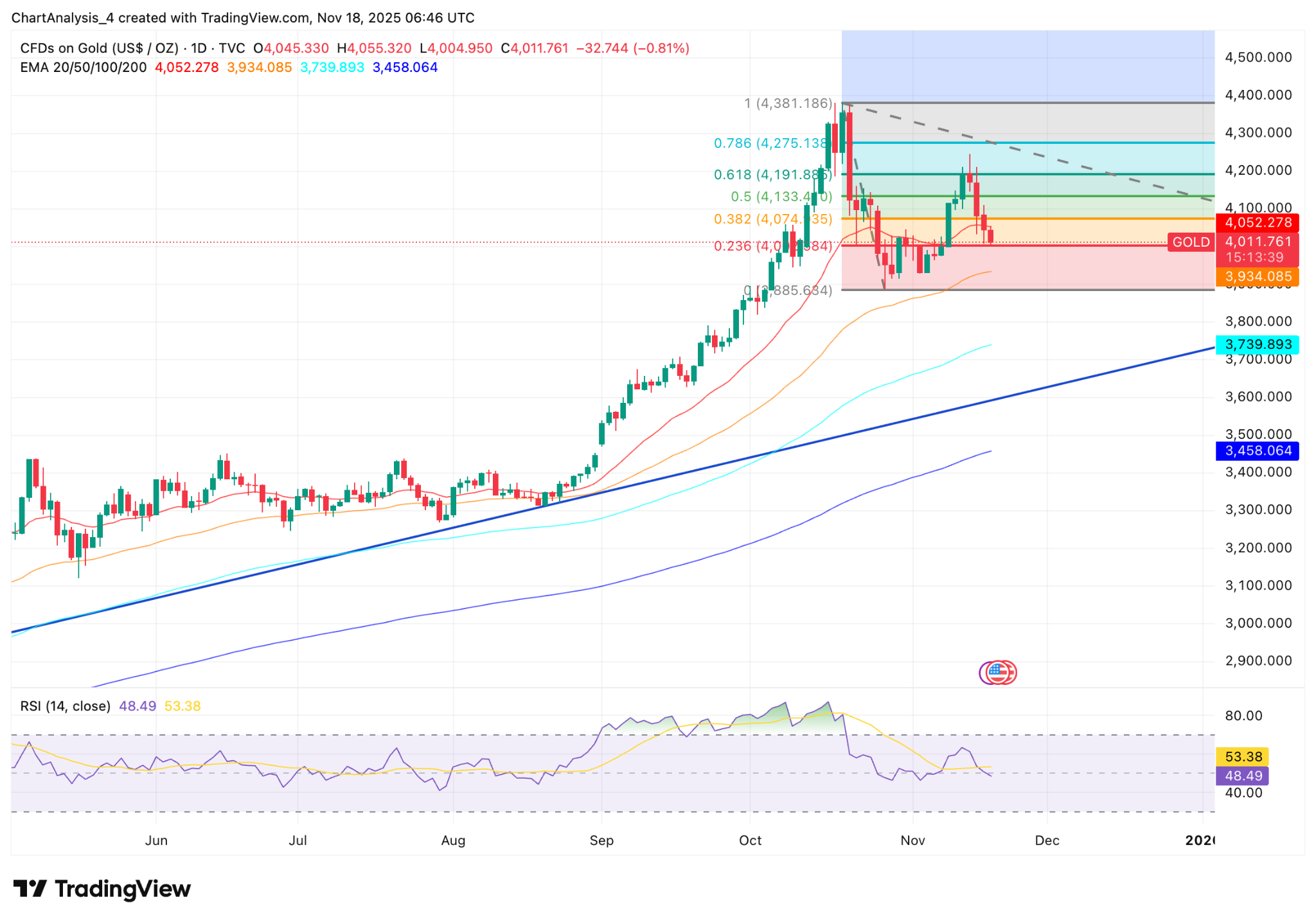
Gold price dynamics (Source: TradingView)
That makes the $4,000 to $4,074 range a high-stakes support area. A defense of this band would keep the retracement contained, but a clean breakdown would broaden the correction and risk a slide toward the 50-day EMA near $3,934.
Gold’s rejection last week from the $4,191 to $4,275 region also reinforces the presence of supply. That area corresponds with the 0.618 and 0.786 retracement cluster, both of which attracted aggressive selling. Price is now sitting on the 20-day EMA at $4,052, a moving average that supported every leg higher from August through October. A close below it would shift short-term momentum in favor of bears for the first time in weeks.
Momentum indicators point to continued cooling. The RSI has dropped to 48, firmly below the midline and suggesting buyers have lost near-term control. Unlike previous declines, the RSI is not oversold, indicating that the correction may still have more room if selling intensifies.
Macro uncertainty challenges gold’s rally narrative
Traders are now navigating a rare macro vacuum. With the U.S. government newly reopened, major economic data calendars were delayed for weeks, leaving markets without fresh insight into labor strength, inflation pressures, or consumer activity. In the absence of data, expectations for aggressive 2025 rate cuts drifted higher. This week’s return of scheduled releases is now forcing a reset.
Fed Vice Chair Philip Jefferson warned that policymakers remain cautious about cutting too early. The market has reacted swiftly, with the probability of a December rate cut falling from 60 percent to 43 percent, pushing Treasury yields and the dollar higher. Those shifts typically pressure metals, especially during periods of recalibrating monetary expectations.
Still, the longer-term chart suggests gold remains comfortably within its broader uptrend. The metal continues to trade above the 100-day EMA at $3,739 and the 200-day EMA at $3,458, both of which have provided reliable structural support throughout the year. Unless gold breaks beneath the 50-day average and falls toward the $3,850 to $3,900 region, the medium-term trend remains intact.
The next sessions will determine whether gold’s slide stabilizes or extends into a more pronounced unwind. Reclaiming levels above $4,074 would restore momentum and allow price to retest the $4,133 to $4,191 region. A move through that band would re-open the path toward $4,275, a level that capped last week’s rally. Conversely, a clean break below $4,000 would expose the 50-day EMA and signal a deeper correction ahead of major risk catalysts.
Outlook as traders await key data releases
Gold’s trajectory hinges on upcoming U.S. jobs data and Federal Reserve minutes, which will determine whether markets continue shifting toward a slower path of monetary easing. If these releases point to cooling economic conditions, the recent pullback may turn into a buying opportunity. If they reinforce sticky inflation or resilient labor strength, the metal could face continued turbulence as yields rise.
In earlier discussions, we highlighted gold’s decisive move through the $4,300 region and its alignment with a strong long-term trend supported by rising EMAs. Today’s pullback reflects the same dynamic we noted then — gold tends to retrace toward short-term averages before resuming its broader ascent, making the current $4,000 zone a familiar battleground for buyers.


Latest Gold News







-
 Afghanistan
-
 Albania
-
 Algeria
-
 Angola
-
 Argentina
-
 Armenia
-
 Australia
-
 Austria
-
 Azerbaijan
-
 Bahamas
-
 Bahrain
-
 Bangladesh
-
 Belarus
-
 Belgium
-
 Bolivia
-
 Botswana
-
 Brazil
-
 Brunei
-
 Bulgaria
-
 Cambodia
-
 Cameroon
-
 Canada
-
 Chile
Chile
-
 China
China
-
 Colombia
-
 Congo
Congo
-
 Costa Rica
-
 Cote d'Ivoire
-
 Croatia
-
 Cuba
Cuba
-
 Cyprus
-
 Czechia
-
 DR Congo
-
 Denmark
-
 Dominican Republic
-
 Ecuador
-
 Egypt
Egypt
-
 El Salvador
-
 Estonia
-
 Eswatini
-
 Ethiopia
-
 Finland
-
 France
-
 Georgia
-
 Germany
-
 Ghana
Ghana
-
 Greece
-
 Haiti
Haiti
-
 Hong Kong
-
 Hungary
-
 India
India
-
 Indonesia
-
 Iran, Islamic republic
-
 Iraq
Iraq
-
 Ireland
-
 Israel
-
 Italy
Italy
-
 Jamaica
-
 Japan
Japan
-
 Jordan
-
 Kazakhstan
-
 Kenya
Kenya
-
 Korea
Korea
-
 Kuwait
-
 Kyrgyzstan
-
 Laos
Laos
-
 Latvia
-
 Lebanon
-
 Lesotho
-
 Libya
Libya
-
 Lithuania
-
 Luxembourg
-
 Madagascar
-
 Malaysia
-
 Malta
Malta
-
 Mauritius
-
 Mexico
-
 Moldova
-
 Mongolia
-
 Montenegro
-
 Morocco
-
 Mozambique
-
 Myanmar
-
 Namibia
-
 Nepal
Nepal
-
 Netherlands
-
 New Zealand
-
 Nigeria
-
 North Macedonia
-
 Norway
-
 Oman
Oman
-
 Pakistan
-
 Palestine
-
 Panama
-
 Papua New Guinea
-
 Paraguay
-
 Peru
Peru
-
 Philippines
-
 Poland
-
 Portugal
-
 Puerto Rico
-
 Qatar
Qatar
-
 Reunion
-
 Romania
-
 Rwanda
-
 Saudi Arabia
-
 Serbia
-
 Singapore
-
 Slovakia
-
 Slovenia
-
 Somalia
-
 South Africa
-
 Spain
Spain
-
 Sri Lanka
-
 Sweden
-
 Switzerland
-
 Syria
Syria
-
 Taiwan
-
 Tajikistan
-
 Tanzania
-
 Thailand
-
 Trinidad and Tobago
-
 Tunisia
-
 Turkey
-
 UAE
UAE
-
 Uganda
-
 Ukraine
-
 United Kingdom
-
United States
-
 Uruguay
-
 Uzbekistan
-
 Venezuela
-
 Vietnam
-
 Yemen
Yemen
-
 Zambia
-
 Zimbabwe
- Forex
- Crypto











