

Martin Marietta Materials stock rises around 3.5% as oversold bounce triggers short covering

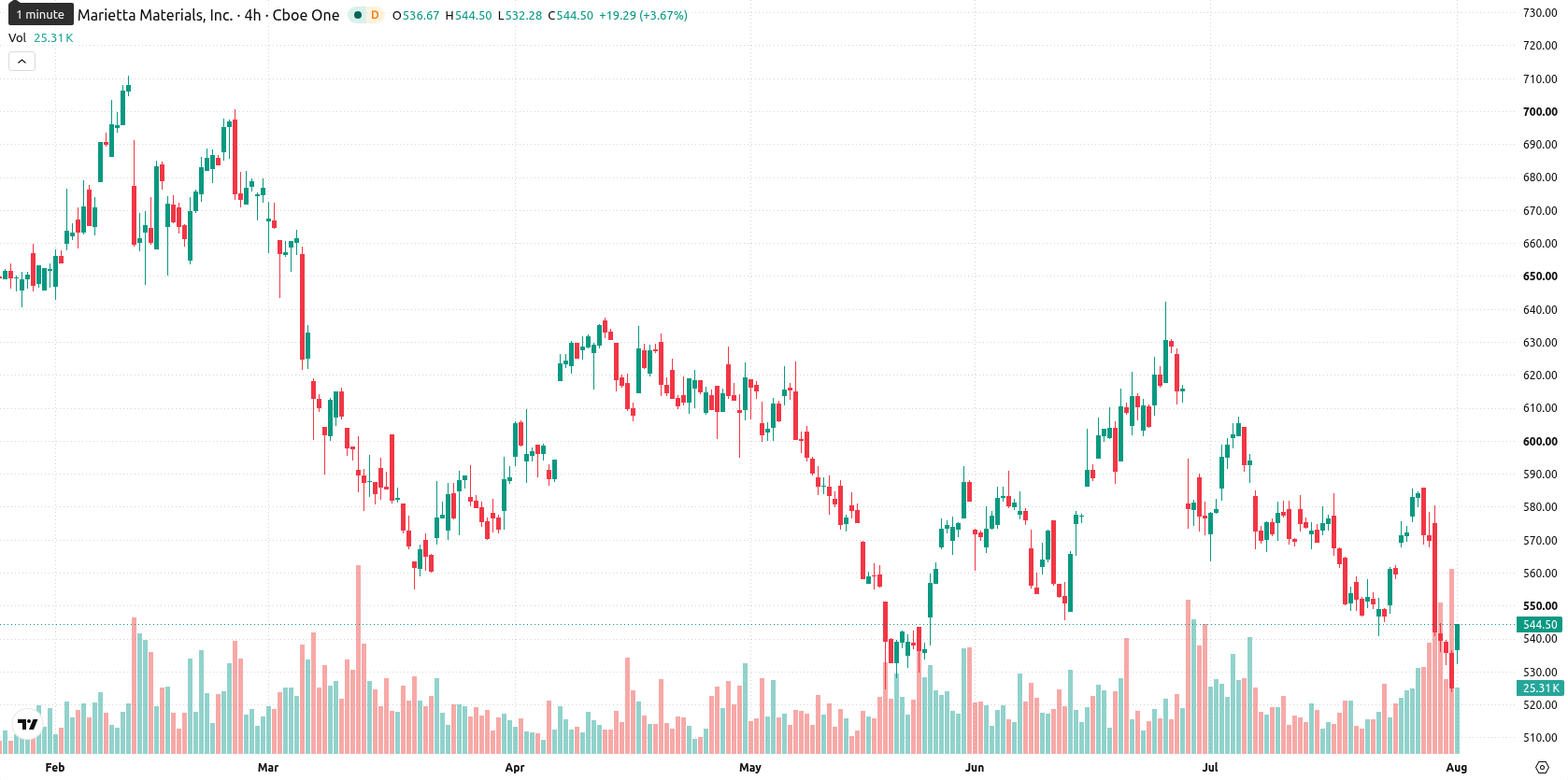
Martin Marietta Materials, Inc. (MLM) surged 3.54% in an oversold bounce, fueled by persistent technical pressure that triggered short covering and an intraday rally. The move higher contradicts the broader picture, as the stock remains trapped below key moving averages and underlying momentum signals continue to point to a bearish and oversold structure.
 515.70
522.02
Highlights
- Martin Marietta Materials remains under pressure as it trades below key short- and long-term moving averages, confirming a bearish technical outlook.
- Technical momentum is weak and most indicators signal oversold conditions, suggesting the current upward move is likely an oversold bounce.
- Expected trading range for the next five days is $511.72 to $575.72, with a high probability of a downward move unless the $565.98 resistance is broken.
Bearish technical barriers persist as momentum signals reinforce seller control
MLM is trading below the 20-day ($565.98), 50-day ($574.86), and 200-day ($611.53) moving averages, highlighting ongoing pressure from sellers and a bearish setup in both medium- and long-term trends. The nearest resistance stands at $565.98, with support seen at the recent intraday high of $542.11. Momentum indicators stay weak, as the MACD remains on a sell signal and the ADX shows limited directional strength at 14.31. The RSI at 35.92 and CCI at -194.5 provide a clear oversold reading, reinforced by the Stochastic RSI at 0 and a bearish Bull/Bear Power (BBP), with sellers dominating intraday momentum. Despite gaining $18.58 or 3.54% in the latest session with an upside gap and volatility of 1.85%, price action still occurs within a persistently bearish technical structure.
Earlier, analysts noted that long-term structural factors and fundamental market dynamics were key to assessing the outlook for major transportation and infrastructure-linked assets. The persistent bearish technical structure for Martin Marietta Materials now highlights the need to monitor for any decisive breaks above or below the established trading range, as a move beyond these levels could set the next directional trend.






Latest Martin Marietta Materials News





-
 Afghanistan
-
 Albania
-
 Algeria
-
 Angola
-
 Argentina
-
 Armenia
-
 Australia
-
 Austria
-
 Azerbaijan
-
 Bahamas
-
 Bahrain
-
 Bangladesh
-
 Belarus
-
 Belgium
-
 Bolivia
-
 Botswana
-
 Brazil
-
 Brunei
-
 Bulgaria
-
 Cambodia
-
 Cameroon
-
 Canada
-
 Chile
-
 China
-
 Colombia
-
 Congo
-
 Costa Rica
-
 Cote d'Ivoire
-
 Croatia
-
 Cuba
-
 Cyprus
-
 Czechia
-
 DR Congo
-
 Denmark
-
 Dominican Republic
-
 Ecuador
-
 Egypt
-
 El Salvador
-
 Estonia
-
 Eswatini
-
 Ethiopia
-
 Finland
-
 France
-
 Georgia
-
 Germany
-
 Ghana
-
 Greece
-
 Haiti
-
 Hong Kong
-
 Hungary
-
 India
-
 Indonesia
-
 Iran, Islamic republic
-
 Iraq
-
 Ireland
-
 Israel
-
 Italy
-
 Jamaica
-
 Japan
-
 Jordan
-
 Kazakhstan
-
 Kenya
-
 Korea
-
 Kuwait
-
 Kyrgyzstan
-
 Laos
-
 Latvia
-
 Lebanon
-
 Lesotho
-
 Libya
-
 Lithuania
-
 Luxembourg
-
 Madagascar
-
 Malaysia
-
 Malta
-
 Mauritius
-
 Mexico
-
 Moldova
-
 Mongolia
-
 Montenegro
-
 Morocco
-
 Mozambique
-
 Myanmar
-
 Namibia
-
 Nepal
-
 Netherlands
-
 New Zealand
-
 Nigeria
-
 North Macedonia
-
 Norway
-
 Oman
-
 Pakistan
-
 Palestine
-
 Panama
-
 Papua New Guinea
-
 Paraguay
-
 Peru
-
 Philippines
-
 Poland
-
 Portugal
-
 Puerto Rico
-
 Qatar
-
 Reunion
-
 Romania
-
 Rwanda
-
 Saudi Arabia
-
 Serbia
-
 Singapore
-
 Slovakia
-
 Slovenia
-
 Somalia
-
 South Africa
-
 Spain
-
 Sri Lanka
-
 Sweden
-
 Switzerland
-
 Syria
-
 Taiwan
-
 Tajikistan
-
 Tanzania
-
 Thailand
-
 Trinidad and Tobago
-
 Tunisia
-
 Turkey
-
 UAE
-
 Uganda
-
 Ukraine
-
 United Kingdom
-
United States
-
 Uruguay
-
 Uzbekistan
-
 Venezuela
-
 Vietnam
-
 Yemen
-
 Zambia
-
 Zimbabwe
- Forex
- Crypto












