


Atlassian Corp Plc (TEAM) fell 3.62% today as intraday technical pressure and a downside gap weighed on price action. The move looks limited, with Atlassian maintaining a bullish structure by trading above its 20-day, 50-day, and 200-day moving averages.
 223.70
223.70
223.70
Highlights
- Shares of Atlassian are trading above key moving averages, maintaining a bullish price structure across all trend durations.
- Technical momentum indicators show persistent buy signals but warn of overbought conditions, with intraday volatility at 3.27%.
- Trading range for the next five sessions is projected at $169.75 to $204.55, with over 80% probability of further upside.
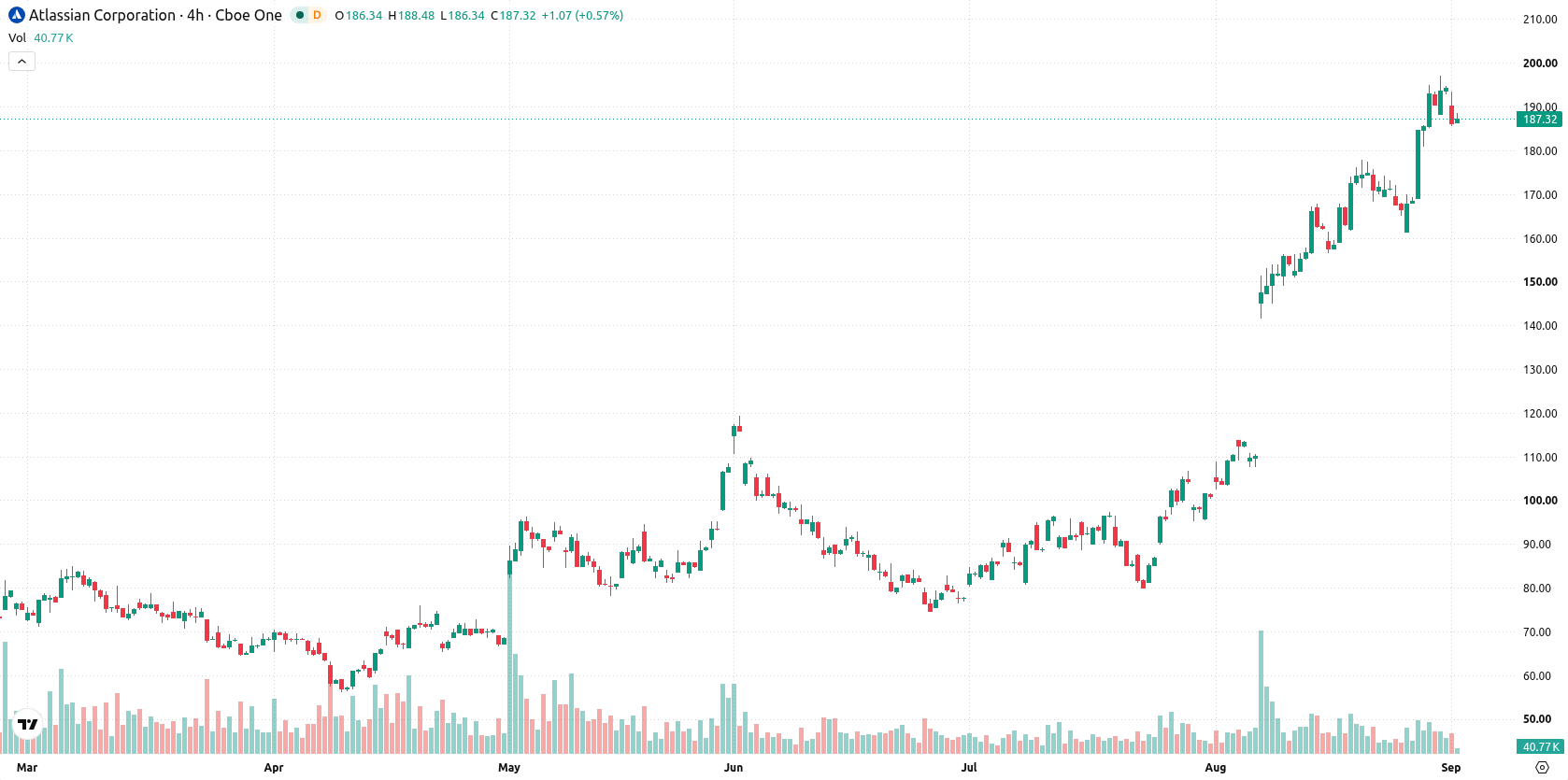
Bullish multi-timeframe momentum as overbought signals intensify
Atlassian is trading above its 20-day ($159.55), 50-day ($117.11), and 200-day ($108.51) moving averages, indicating the stock retains a bullish structure across short-, medium-, and long-term trends. The near-term ceiling stands at $187.51, with the floor in focus at $169.75, as longer-term alignment remains bullish. Momentum remains strong as both the Moving Average Convergence Divergence (MACD) and Average Directional Index (ADX) point to a buy scenario. The Relative Strength Index (RSI) at 80 and Commodity Channel Index (CCI) at 131.62 both signal overbought conditions, while the Stochastic RSI is neutral. Bull/Bear Power (BBP) shows buyers dominating intraday momentum and also reflects overbought territory. The Awesome Oscillator (AO) supports the positive trend. The stock is trading at $187.15 after a daily decline of $7.02 or 3.62%, opening to a downside gap of about $3.59 (1.85%). Price is near the session low, with intraday volatility at 3.27%. Intraday momentum signals have yet to trigger profit-taking, but local pressure has built after the open.
Earlier, analysts noted that regulatory risks and changing dynamics in the AI sector could introduce volatility for software and technology providers. With Atlassian maintaining a bullish trend despite today's downside gap, traders should closely monitor the $187.51 breakout level for a potential move toward the upper volatility band.





Latest Atlassian News






-
 Afghanistan
-
 Albania
-
 Algeria
-
 Angola
-
 Argentina
-
 Armenia
-
 Australia
-
 Austria
-
 Azerbaijan
-
 Bahamas
-
 Bahrain
-
 Bangladesh
-
 Belarus
-
 Belgium
-
 Bolivia
-
 Botswana
-
 Brazil
-
 Brunei
-
 Bulgaria
-
 Cambodia
-
 Cameroon
-
 Canada
-
 Chile
Chile
-
 China
China
-
 Colombia
-
 Congo
Congo
-
 Costa Rica
-
 Cote d'Ivoire
-
 Croatia
-
 Cuba
Cuba
-
 Cyprus
-
 Czechia
-
 DR Congo
-
 Denmark
-
 Dominican Republic
-
 Ecuador
-
 Egypt
Egypt
-
 El Salvador
-
 Estonia
-
 Eswatini
-
 Ethiopia
-
 Finland
-
 France
-
 Georgia
-
 Germany
-
 Ghana
Ghana
-
 Greece
-
 Haiti
Haiti
-
 Hong Kong
-
 Hungary
-
 India
India
-
 Indonesia
-
 Iran, Islamic republic
-
 Iraq
Iraq
-
 Ireland
-
 Israel
-
 Italy
Italy
-
 Jamaica
-
 Japan
Japan
-
 Jordan
-
 Kazakhstan
-
 Kenya
Kenya
-
 Korea
Korea
-
 Kuwait
-
 Kyrgyzstan
-
 Laos
Laos
-
 Latvia
-
 Lebanon
-
 Lesotho
-
 Libya
Libya
-
 Lithuania
-
 Luxembourg
-
 Madagascar
-
 Malaysia
-
 Malta
Malta
-
 Mauritius
-
 Mexico
-
 Moldova
-
 Mongolia
-
 Montenegro
-
 Morocco
-
 Mozambique
-
 Myanmar
-
 Namibia
-
 Nepal
Nepal
-
 Netherlands
-
 New Zealand
-
 Nigeria
-
 North Macedonia
-
 Norway
-
 Oman
Oman
-
 Pakistan
-
 Palestine
-
 Panama
-
 Papua New Guinea
-
 Paraguay
-
 Peru
Peru
-
 Philippines
-
 Poland
-
 Portugal
-
 Puerto Rico
-
 Qatar
Qatar
-
 Reunion
-
 Romania
-
 Rwanda
-
 Saudi Arabia
-
 Serbia
-
 Singapore
-
 Slovakia
-
 Slovenia
-
 Somalia
-
 South Africa
-
 Spain
Spain
-
 Sri Lanka
-
 Sweden
-
 Switzerland
-
 Syria
Syria
-
 Taiwan
-
 Tajikistan
-
 Tanzania
-
 Thailand
-
 Trinidad and Tobago
-
 Tunisia
-
 Turkey
-
 UAE
UAE
-
 Uganda
-
 Ukraine
-
 United Kingdom
-
United States
-
 Uruguay
-
 Uzbekistan
-
 Venezuela
-
 Vietnam
-
 Yemen
Yemen
-
 Zambia
-
 Zimbabwe
- Forex
- Crypto












