


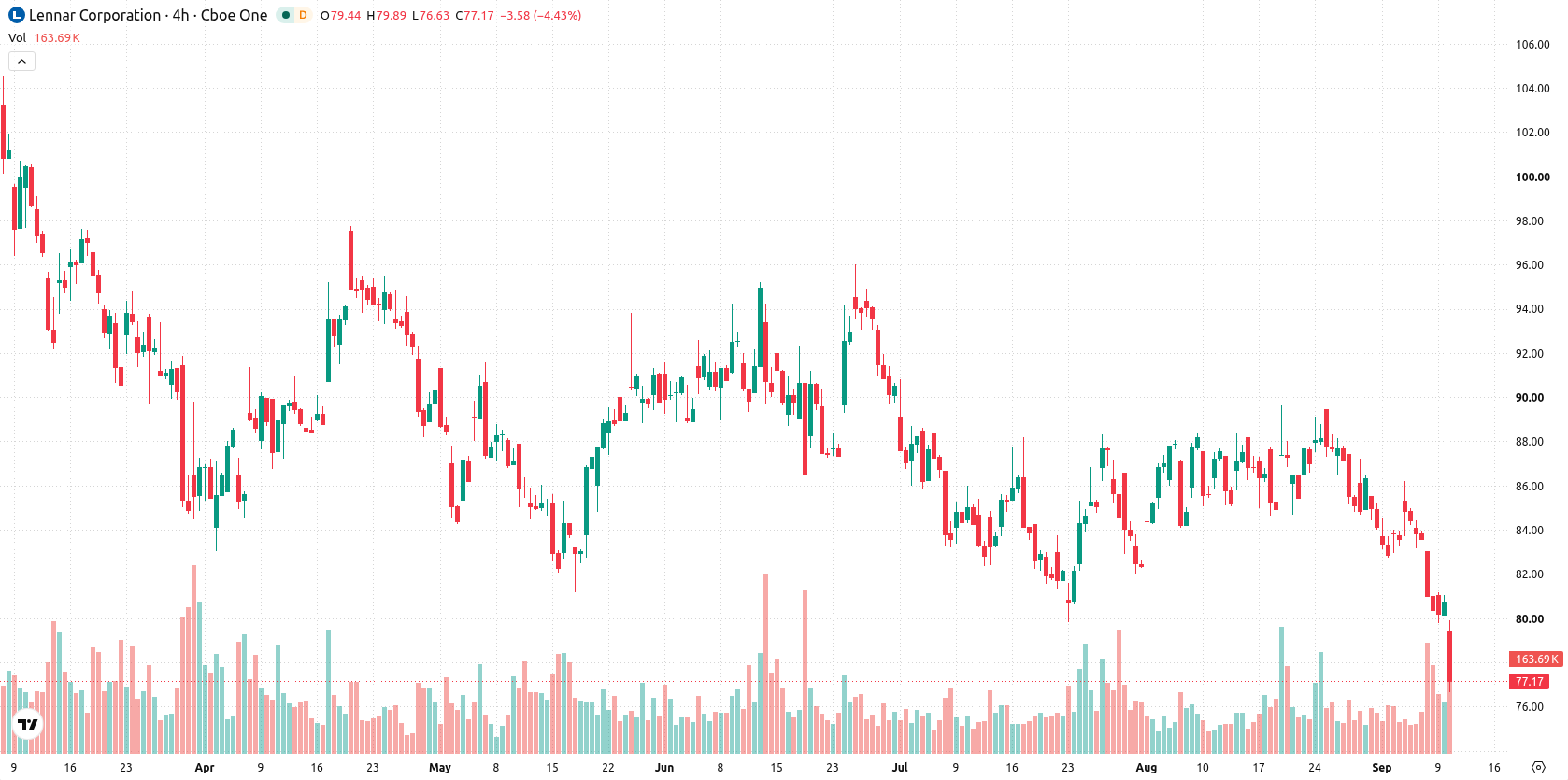
Lennar Corporation (LEN) dropped 4.39% as persistent weakness in the U.S. housing market and a decline in profit margins continue to weigh on sentiment. The downside move is reinforced by the stock's sustained trading below its key moving averages, signaling ongoing selling pressure.
 88.11
88.11
Highlights
- Lennar stock hit a 52-week low as Q2 FY26 earnings showed revenue of $7.94 billion and gross margin contracted to 15.4%.
- Management continued share buybacks and kept the annual dividend intact for 49 consecutive years, with a 2.49% forward yield.
- Shares of Lennar trade below key moving averages with negative momentum signals and are expected to range from $74.9 to $79.53 in the coming sessions.
Yearly low reached as earnings and prices deteriorate
Lennar recorded a 52-week low ahead of its upcoming Q3 2026 earnings report scheduled for September 16, 2026. In Q2 FY26, the company reported $7.94 billion in revenue and $304.77 million in earnings, with a trailing EPS of $6.38 and gross profit margin falling to 15.4% from 18.2% a year earlier. Management continued share buybacks and maintained its annual dividend for the 49th consecutive year with a forward yield at 2.49%. The stock is down year-to-date, accompanied by a 6% decline in average selling prices and challenging housing market conditions.
Sustained bearish momentum persists below key averages
LEN is trading below its 20-day, 50-day, and 200-day moving averages ($85.25, $85.26, $98.01), indicating consistent selling pressure over multiple timeframes. The price is approaching support at $76.63, with resistance set at $79.53. Momentum signals remain negative, as both the MACD and RSI call for continued sell action. The RSI is at 39.23, and both the Stochastic RSI and CCI show oversold conditions, reflecting short-term downside exhaustion. The ADX indicates a weak trend, while the Bull/Bear Power is negative and the Awesome Oscillator confirms prevailing bearish momentum.
Previously it was reported that Lennar was under sustained bearish pressure due to revenue declines, institutional selling, and persistently weak technical signals. The latest developments reaffirm this negative outlook, with traders advised to closely monitor the $74.90 support as a potential trigger for accelerated downside risk in the near term.









-
 Afghanistan
-
 Albania
-
 Algeria
-
 Angola
-
 Argentina
-
 Armenia
-
 Australia
-
 Austria
-
 Azerbaijan
-
 Bahamas
-
 Bahrain
-
 Bangladesh
-
 Belarus
-
 Belgium
-
 Bolivia
-
 Botswana
-
 Brazil
-
 Brunei
-
 Bulgaria
-
 Cambodia
-
 Cameroon
-
 Canada
-
 Chile
-
 China
-
 Colombia
-
 Congo
-
 Costa Rica
-
 Cote d'Ivoire
-
 Croatia
-
 Cuba
-
 Cyprus
-
 Czechia
-
 DR Congo
-
 Denmark
-
 Dominican Republic
-
 Ecuador
-
 Egypt
-
 El Salvador
-
 Estonia
-
 Eswatini
-
 Ethiopia
-
 Finland
-
 France
-
 Georgia
-
 Germany
-
 Ghana
-
 Greece
-
 Haiti
-
 Hong Kong
-
 Hungary
-
 India
-
 Indonesia
-
 Iran, Islamic republic
-
 Iraq
-
 Ireland
-
 Israel
-
 Italy
-
 Jamaica
-
 Japan
-
 Jordan
-
 Kazakhstan
-
 Kenya
-
 Korea
-
 Kuwait
-
 Kyrgyzstan
-
 Laos
-
 Latvia
-
 Lebanon
-
 Lesotho
-
 Libya
-
 Lithuania
-
 Luxembourg
-
 Madagascar
-
 Malaysia
-
 Malta
-
 Mauritius
-
 Mexico
-
 Moldova
-
 Mongolia
-
 Montenegro
-
 Morocco
-
 Mozambique
-
 Myanmar
-
 Namibia
-
 Nepal
-
 Netherlands
-
 New Zealand
-
 Nigeria
-
 North Macedonia
-
 Norway
-
 Oman
-
 Pakistan
-
 Palestine
-
 Panama
-
 Papua New Guinea
-
 Paraguay
-
 Peru
-
 Philippines
-
 Poland
-
 Portugal
-
 Puerto Rico
-
 Qatar
-
 Reunion
-
 Romania
-
 Rwanda
-
 Saudi Arabia
-
 Serbia
-
 Singapore
-
 Slovakia
-
 Slovenia
-
 Somalia
-
 South Africa
-
 Spain
-
 Sri Lanka
-
 Sweden
-
 Switzerland
-
 Syria
-
 Taiwan
-
 Tajikistan
-
 Tanzania
-
 Thailand
-
 Trinidad and Tobago
-
 Tunisia
-
 Turkey
-
 UAE
-
 Uganda
-
 Ukraine
-
 United Kingdom
-
United States
-
 Uruguay
-
 Uzbekistan
-
 Venezuela
-
 Vietnam
-
 Yemen
-
 Zambia
-
 Zimbabwe
- Forex
- Crypto












