

$18.17 resistance test: Can Core Scientific stock break higher?

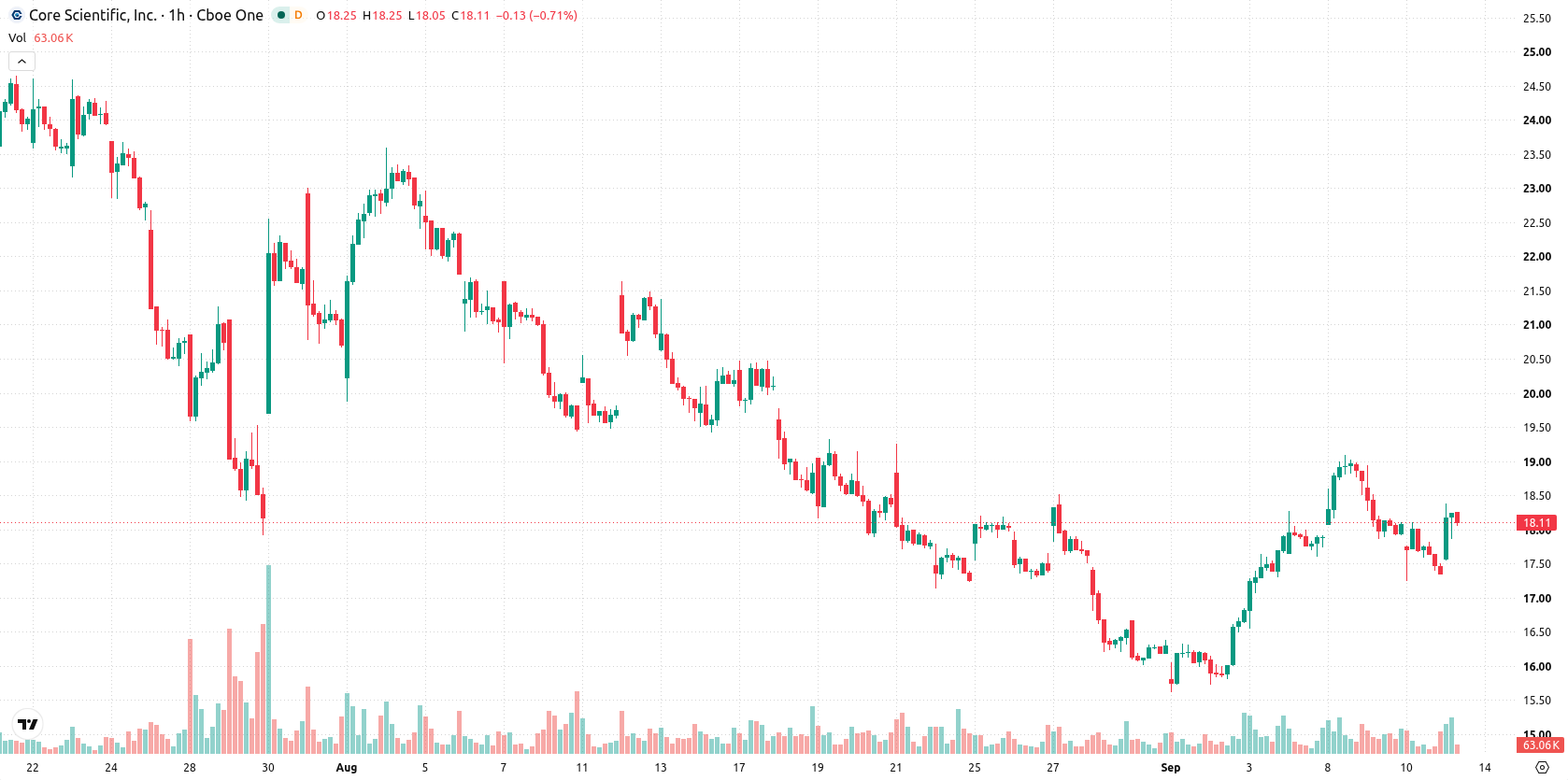
Core Scientific (CORZ) stock is trading at $18.11, marking a 4.27% increase for the day. The price is now positioned below its short-term moving average but remains above a medium-term average, reflecting mixed underlying momentum.
 13.63
15.01
Highlights
- CORZ/USD trades below its short-term average but maintains a medium-term bullish structure above the 50-period level.
- Momentum indicators are mixed with oscillators in oversold territory and seller signals dominating the chart setup.
- Price rose 4.27% to $18.11, with a forecast range of $17.29 to $18.93 and a 62% probability for further upside.
Diverging moving averages and oversold signals highlight bearish pressure
On the hourly chart, CORZ remains below the MA-20 while still above the MA-50, indicating divergence between short- and medium-term levels. The daily chart shows the stock is under the longer-term MA-200, with the Ichimoku Kijun at $18.17 acting as immediate resistance. Momentum indicators present a mixed view: MACD and ADX are neutral, but RSI is in the sell zone at 38.96. Both Stoch RSI and CCI are in oversold territory, suggesting that ongoing intraday selling could be overextended. Bull/Bear Power signals seller dominance, confirmed by an Awesome Oscillator sell signal.
Upside favored amid range trade and key resistance test
In the short term, the expected trading corridor is between $17.29 and $18.93. Probabilities favor further upside moves at 62%, with a 38% chance of downside moves. The base case is for price to consolidate within this range, while a break above the $18.17 Kijun resistance would signal a bullish scenario. Renewed selling could push the stock back toward the lower end of the projected range.
Previously it was reported that Core Scientific was experiencing sustained downside momentum with a risk of further declines, driven by negative technical signals. The current setup introduces a mixed backdrop, with conflicting momentum indicators and shifting moving average alignment, making the $18.17 Kijun level a pivotal resistance to monitor for a potential breakout.










-
 Afghanistan
-
 Albania
-
 Algeria
-
 Angola
-
 Argentina
-
 Armenia
-
 Australia
-
 Austria
-
 Azerbaijan
-
 Bahamas
-
 Bahrain
-
 Bangladesh
-
 Belarus
-
 Belgium
-
 Bolivia
-
 Botswana
-
 Brazil
-
 Brunei
-
 Bulgaria
-
 Cambodia
-
 Cameroon
-
 Canada
-
 Chile
-
 China
-
 Colombia
-
 Congo
-
 Costa Rica
-
 Cote d'Ivoire
-
 Croatia
-
 Cuba
-
 Cyprus
-
 Czechia
-
 DR Congo
-
 Denmark
-
 Dominican Republic
-
 Ecuador
-
 Egypt
-
 El Salvador
-
 Estonia
-
 Eswatini
-
 Ethiopia
-
 Finland
-
 France
-
 Georgia
-
 Germany
-
 Ghana
-
 Greece
-
 Haiti
-
 Hong Kong
-
 Hungary
-
 India
-
 Indonesia
-
 Iran, Islamic republic
-
 Iraq
-
 Ireland
-
 Israel
-
 Italy
-
 Jamaica
-
 Japan
-
 Jordan
-
 Kazakhstan
-
 Kenya
-
 Korea
-
 Kuwait
-
 Kyrgyzstan
-
 Laos
-
 Latvia
-
 Lebanon
-
 Lesotho
-
 Libya
-
 Lithuania
-
 Luxembourg
-
 Madagascar
-
 Malaysia
-
 Malta
-
 Mauritius
-
 Mexico
-
 Moldova
-
 Mongolia
-
 Montenegro
-
 Morocco
-
 Mozambique
-
 Myanmar
-
 Namibia
-
 Nepal
-
 Netherlands
-
 New Zealand
-
 Nigeria
-
 North Macedonia
-
 Norway
-
 Oman
-
 Pakistan
-
 Palestine
-
 Panama
-
 Papua New Guinea
-
 Paraguay
-
 Peru
-
 Philippines
-
 Poland
-
 Portugal
-
 Puerto Rico
-
 Qatar
-
 Reunion
-
 Romania
-
 Rwanda
-
 Saudi Arabia
-
 Serbia
-
 Singapore
-
 Slovakia
-
 Slovenia
-
 Somalia
-
 South Africa
-
 Spain
-
 Sri Lanka
-
 Sweden
-
 Switzerland
-
 Syria
-
 Taiwan
-
 Tajikistan
-
 Tanzania
-
 Thailand
-
 Trinidad and Tobago
-
 Tunisia
-
 Turkey
-
 UAE
-
 Uganda
-
 Ukraine
-
 United Kingdom
-
United States
-
 Uruguay
-
 Uzbekistan
-
 Venezuela
-
 Vietnam
-
 Yemen
-
 Zambia
-
 Zimbabwe
- Forex
- Crypto












