

Dutch Bros stock selloff near $40.32 support: Downside targets to watch

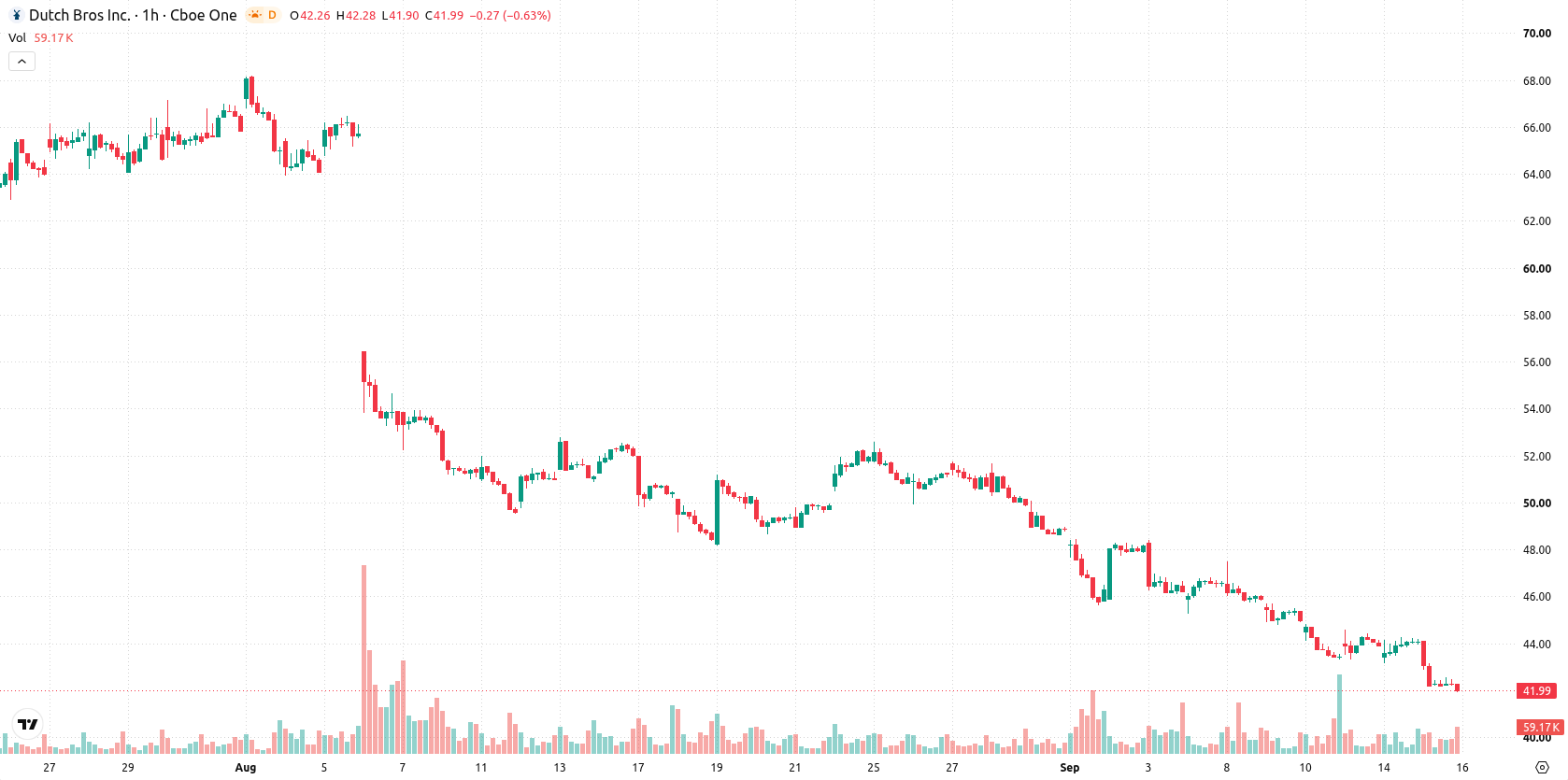
Dutch Bros (BROS) stock is trading at $41.98 after falling 4.72% on the session, closing near the session’s low. The stock remains below its key moving averages, indicating persistent selling momentum throughout the day.
 37.37
36.00
Highlights
- Shares of Dutch Bros fell 4.72% to $41.98, closing near the intraday low on high volatility.
- The stock trades below major moving averages with all momentum signals showing sellers have short-, medium-, and long-term control.
- Expected trading range for coming sessions is $40.32 to $43.64 with a 79% likelihood of continued decline and low reversal probability.
Bearish momentum confirmed as technical signals remain oversold
On the technical front, BROS is positioned below the MA-20 at $43.38, the MA-50 at $44.58, and the MA-200 at $56.93, confirming a consistently bearish alignment across key timeframes. Immediate resistance is identified at the Ichimoku Kijun level of $43.25. Momentum indicators are heavily skewed to the downside: MACD and ADX signal ongoing seller dominance, RSI is deeply oversold at 24.53, and both Stochastic RSI and CCI remain in oversold zones. Intraday, Bull/Bear Power highlights seller control, while the Awesome Oscillator further confirms a negative bias.
Downside risks elevated as volatility drives range-bound outlook
For the short term, BROS is projected to trade within a range of $40.32 to $43.64, reflecting prevailing high volatility. There is a 21% probability of an upside reversal, but the likelihood of continued downward price action stands at 79%. A sideways scenario within these boundaries is the baseline expectation, while any decisive break above $43.25 could trigger a short-term bullish attempt, with a drop below $40.32 opening the way to further declines.
Earlier, analysts noted that Dutch Bros exhibited persistent bearish momentum and elevated downside risk, driven by sustained selling pressure. The current analysis strengthens this outlook with deeper oversold readings and volatility, highlighting $40.32 as the key level to monitor for potential further declines.






Latest Dutch Bros News




-
 Afghanistan
-
 Albania
-
 Algeria
-
 Angola
-
 Argentina
-
 Armenia
-
 Australia
-
 Austria
-
 Azerbaijan
-
 Bahamas
-
 Bahrain
-
 Bangladesh
-
 Belarus
-
 Belgium
-
 Bolivia
-
 Botswana
-
 Brazil
-
 Brunei
-
 Bulgaria
-
 Cambodia
-
 Cameroon
-
 Canada
-
 Chile
-
 China
-
 Colombia
-
 Congo
-
 Costa Rica
-
 Cote d'Ivoire
-
 Croatia
-
 Cuba
-
 Cyprus
-
 Czechia
-
 DR Congo
-
 Denmark
-
 Dominican Republic
-
 Ecuador
-
 Egypt
-
 El Salvador
-
 Estonia
-
 Eswatini
-
 Ethiopia
-
 Finland
-
 France
-
 Georgia
-
 Germany
-
 Ghana
-
 Greece
-
 Haiti
-
 Hong Kong
-
 Hungary
-
 India
-
 Indonesia
-
 Iran, Islamic republic
-
 Iraq
-
 Ireland
-
 Israel
-
 Italy
-
 Jamaica
-
 Japan
-
 Jordan
-
 Kazakhstan
-
 Kenya
-
 Korea
-
 Kuwait
-
 Kyrgyzstan
-
 Laos
-
 Latvia
-
 Lebanon
-
 Lesotho
-
 Libya
-
 Lithuania
-
 Luxembourg
-
 Madagascar
-
 Malaysia
-
 Malta
-
 Mauritius
-
 Mexico
-
 Moldova
-
 Mongolia
-
 Montenegro
-
 Morocco
-
 Mozambique
-
 Myanmar
-
 Namibia
-
 Nepal
-
 Netherlands
-
 New Zealand
-
 Nigeria
-
 North Macedonia
-
 Norway
-
 Oman
-
 Pakistan
-
 Palestine
-
 Panama
-
 Papua New Guinea
-
 Paraguay
-
 Peru
-
 Philippines
-
 Poland
-
 Portugal
-
 Puerto Rico
-
 Qatar
-
 Reunion
-
 Romania
-
 Rwanda
-
 Saudi Arabia
-
 Serbia
-
 Singapore
-
 Slovakia
-
 Slovenia
-
 Somalia
-
 South Africa
-
 Spain
-
 Sri Lanka
-
 Sweden
-
 Switzerland
-
 Syria
-
 Taiwan
-
 Tajikistan
-
 Tanzania
-
 Thailand
-
 Trinidad and Tobago
-
 Tunisia
-
 Turkey
-
 UAE
-
 Uganda
-
 Ukraine
-
 United Kingdom
-
United States
-
 Uruguay
-
 Uzbekistan
-
 Venezuela
-
 Vietnam
-
 Yemen
-
 Zambia
-
 Zimbabwe
- Forex
- Crypto












