

UAVS rallies as buyers gain short-term control in current range

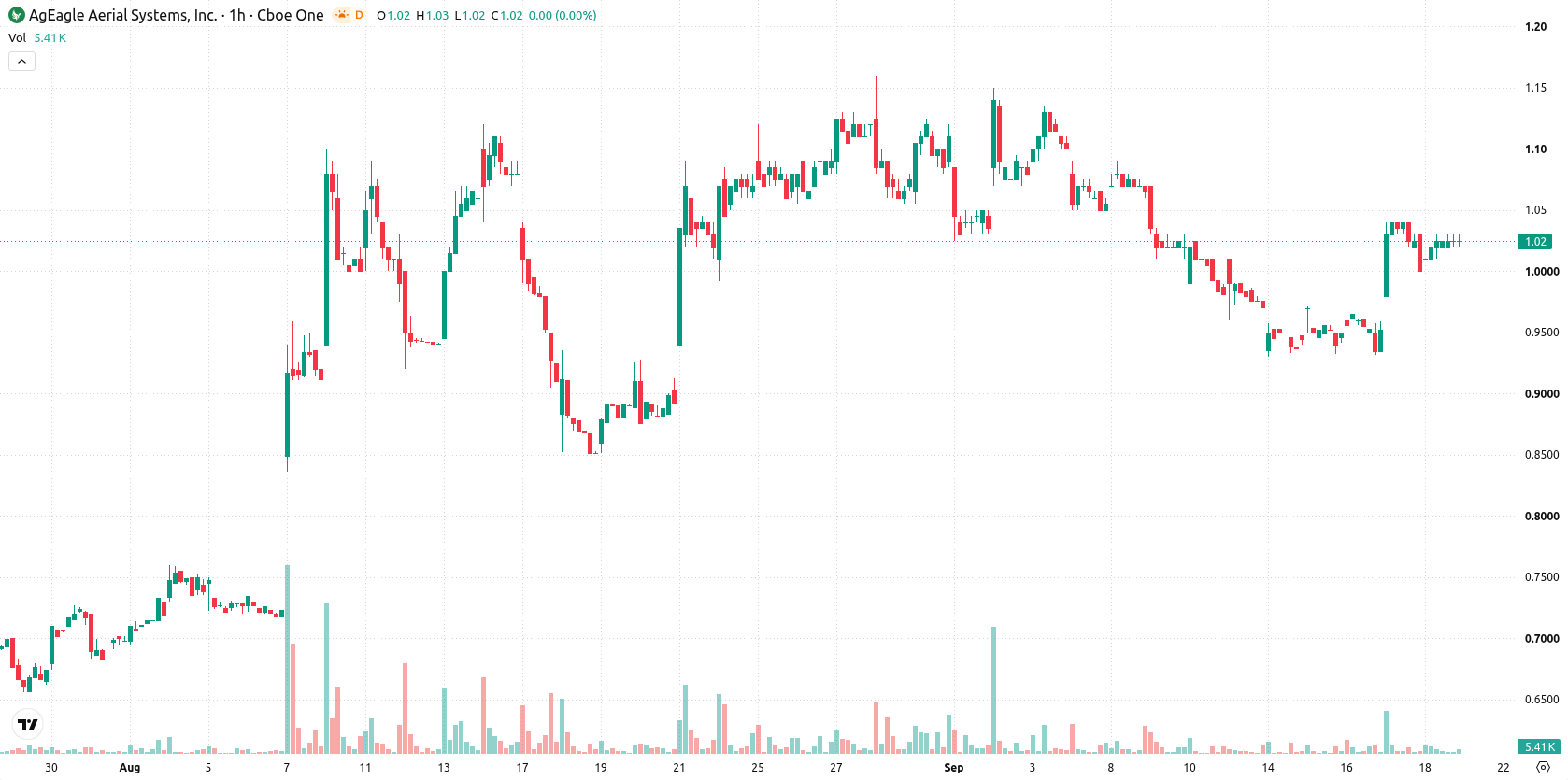
AgEagle Aerial Systems (UAVS) stock is trading at $1.02, up 2% on the day. The price is positioned above its key short- and mid-term moving averages, indicating ongoing upward momentum in the shorter timeframes.
 0.3000
0.3092
Highlights
- AgEagle Aerial Systems stock is trading above short- and mid-term moving averages but remains below the long-term level, indicating lingering seller pressure.
- Momentum indicators such as MACD and ADX are on Buy signals, with buyers dominating intraday action, while oscillators are neutral.
- AgEagle Aerial Systems stock trades at $1.02, up 2% for the day, with price expected in a $0.97 to $1.07 range in the next few sessions.
Buy signals strengthen as daily resistance contains advance
On the technical front, UAVS is currently above the MA-20 and MA-50 on the hourly chart but remains just below the MA-200 on the daily timeframe. Immediate support is anchored at the Ichimoku Kijun level of $0.99. MACD and ADX both display Buy signals, while RSI reads 58.94, also aligning with a positive stance. Stoch RSI and CCI both register neutral readings, which tempers enthusiasm for a rapid move, and Bull/Bear Power suggests buyers have the intraday edge.
Sideways trend expected as upside break risk increases
Looking ahead, the price is expected to remain within a $0.97 to $1.07 range over the next few sessions, reflecting typical volatility for this stock. The probability of an upward move is rated very high, while a decline remains a low-probability scenario. Baseline expectations suggest a sideways trend; a break above resistance would open a path toward the upper end of the range, while a failure at $0.99 support could see UAVS test the lower forecast boundary.
Earlier, analysts noted that AgEagle Aerial Systems was exhibiting a pattern of mixed technical momentum and consolidating within a defined trading range. The current data reinforces this view by confirming a sideways scenario, with immediate attention needed on the $0.99 support level as a key inflection point for near-term direction.






Latest EagleNXT News



-
 Afghanistan
-
 Albania
-
 Algeria
-
 Angola
-
 Argentina
-
 Armenia
-
 Australia
-
 Austria
-
 Azerbaijan
-
 Bahamas
-
 Bahrain
-
 Bangladesh
-
 Belarus
-
 Belgium
-
 Bolivia
-
 Botswana
-
 Brazil
-
 Brunei
-
 Bulgaria
-
 Cambodia
-
 Cameroon
-
 Canada
-
 Chile
-
 China
-
 Colombia
-
 Congo
-
 Costa Rica
-
 Cote d'Ivoire
-
 Croatia
-
 Cuba
-
 Cyprus
-
 Czechia
-
 DR Congo
-
 Denmark
-
 Dominican Republic
-
 Ecuador
-
 Egypt
-
 El Salvador
-
 Estonia
-
 Eswatini
-
 Ethiopia
-
 Finland
-
 France
-
 Georgia
-
 Germany
-
 Ghana
-
 Greece
-
 Haiti
-
 Hong Kong
-
 Hungary
-
 India
-
 Indonesia
-
 Iran, Islamic republic
-
 Iraq
-
 Ireland
-
 Israel
-
 Italy
-
 Jamaica
-
 Japan
-
 Jordan
-
 Kazakhstan
-
 Kenya
-
 Korea
-
 Kuwait
-
 Kyrgyzstan
-
 Laos
-
 Latvia
-
 Lebanon
-
 Lesotho
-
 Libya
-
 Lithuania
-
 Luxembourg
-
 Madagascar
-
 Malaysia
-
 Malta
-
 Mauritius
-
 Mexico
-
 Moldova
-
 Mongolia
-
 Montenegro
-
 Morocco
-
 Mozambique
-
 Myanmar
-
 Namibia
-
 Nepal
-
 Netherlands
-
 New Zealand
-
 Nigeria
-
 North Macedonia
-
 Norway
-
 Oman
-
 Pakistan
-
 Palestine
-
 Panama
-
 Papua New Guinea
-
 Paraguay
-
 Peru
-
 Philippines
-
 Poland
-
 Portugal
-
 Puerto Rico
-
 Qatar
-
 Reunion
-
 Romania
-
 Rwanda
-
 Saudi Arabia
-
 Serbia
-
 Singapore
-
 Slovakia
-
 Slovenia
-
 Somalia
-
 South Africa
-
 Spain
-
 Sri Lanka
-
 Sweden
-
 Switzerland
-
 Syria
-
 Taiwan
-
 Tajikistan
-
 Tanzania
-
 Thailand
-
 Trinidad and Tobago
-
 Tunisia
-
 Turkey
-
 UAE
-
 Uganda
-
 Ukraine
-
 United Kingdom
-
United States
-
 Uruguay
-
 Uzbekistan
-
 Venezuela
-
 Vietnam
-
 Yemen
-
 Zambia
-
 Zimbabwe
- Forex
- Crypto












