

Boeing shares technical analysis: Recovery attempts target $199.39 resistance

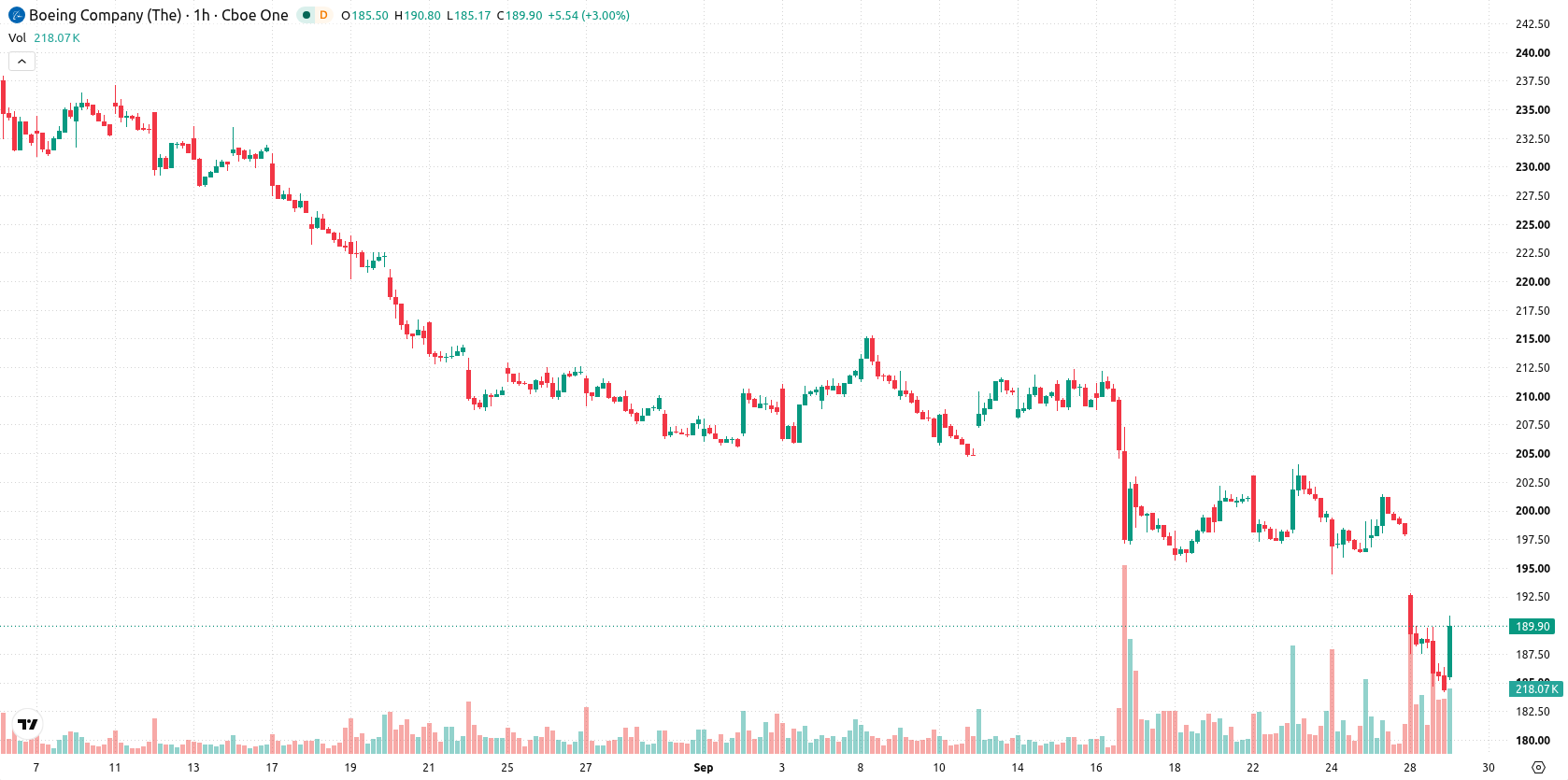
Boeing (BA) stock is trading at $190.45, closing up 3.29% for the day. The stock remains below its key moving averages, reflecting ongoing pressure from recent volatility.
 173.81
186.59
Highlights
- The FAA postponed Boeing's 737 Max 10 certification process to September 28, 2026 due to an ongoing software investigation.
- This delay directly impacts Boeing's growth outlook by deferring new product deliveries and increasing future revenue uncertainty.
- Boeing stock trades below key moving averages, with downside momentum dominating and an expected $181 to $199.39 range in coming days.
Growth outlook pressured as FAA postpones 737 Max 10 certification
The Federal Aviation Administration postponed the certification process for Boeing's 737 Max 10 on September 28, 2026, citing an ongoing investigation into a software issue in the aircraft’s automated navigation systems, according to Gurufocus. This regulatory delay directly impacts Boeing’s near-term growth prospects by pushing back new product deliveries and injecting heightened uncertainty around future revenues. Boeing's publicly acknowledged software problem has also intensified regulatory scrutiny for both the Max 7 and Max 10 models, magnifying investor concern over program execution and certification timing.
Seller momentum persists as key resistance reinforces downside risks
BA/USD closed at $190.45 after testing volatile intraday highs. Technically, the stock remains below the MA-20 at $193.77, MA-50 at $197.08, and MA-200 at $221.01, while the Ichimoku Kijun at $193.16 acts as immediate resistance. Downside pressure is confirmed by negative momentum across RSI, MACD, and ADX, with oversold signals from RSI, Stoch RSI, CCI, and Bull/Bear Power. The Awesome Oscillator reinforces this bearish bias, indicating continued seller dominance on an intraday basis.
Downside risk prevails as reversal depends on key resistance break
Looking ahead to the next 2–3 trading days, BA/USD is expected to trade within a volatility band of $181 to $199.39. The probability of further downside exceeds upside at 58% versus 42%. The baseline scenario anticipates price stabilization in a sideways corridor; a sustained bullish reversal requires a close above the $193.16 resistance, while a move below support at $181 would likely trigger further declines.
Previously it was reported that persistent regulatory scrutiny and technical headwinds surrounding Boeing's 737 MAX models had reinforced a negative outlook for the stock. The latest developments underscore that downside risk remains elevated, with traders advised to monitor for a decisive move below the $181 support as a trigger for renewed weakness.










-
 Afghanistan
-
 Albania
-
 Algeria
-
 Angola
-
 Argentina
-
 Armenia
-
 Australia
-
 Austria
-
 Azerbaijan
-
 Bahamas
-
 Bahrain
-
 Bangladesh
-
 Belarus
-
 Belgium
-
 Bolivia
-
 Botswana
-
 Brazil
-
 Brunei
-
 Bulgaria
-
 Cambodia
-
 Cameroon
-
 Canada
-
 Chile
-
 China
-
 Colombia
-
 Congo
-
 Costa Rica
-
 Cote d'Ivoire
-
 Croatia
-
 Cuba
-
 Cyprus
-
 Czechia
-
 DR Congo
-
 Denmark
-
 Dominican Republic
-
 Ecuador
-
 Egypt
-
 El Salvador
-
 Estonia
-
 Eswatini
-
 Ethiopia
-
 Finland
-
 France
-
 Georgia
-
 Germany
-
 Ghana
-
 Greece
-
 Haiti
-
 Hong Kong
-
 Hungary
-
 India
-
 Indonesia
-
 Iran, Islamic republic
-
 Iraq
-
 Ireland
-
 Israel
-
 Italy
-
 Jamaica
-
 Japan
-
 Jordan
-
 Kazakhstan
-
 Kenya
-
 Korea
-
 Kuwait
-
 Kyrgyzstan
-
 Laos
-
 Latvia
-
 Lebanon
-
 Lesotho
-
 Libya
-
 Lithuania
-
 Luxembourg
-
 Madagascar
-
 Malaysia
-
 Malta
-
 Mauritius
-
 Mexico
-
 Moldova
-
 Mongolia
-
 Montenegro
-
 Morocco
-
 Mozambique
-
 Myanmar
-
 Namibia
-
 Nepal
-
 Netherlands
-
 New Zealand
-
 Nigeria
-
 North Macedonia
-
 Norway
-
 Oman
-
 Pakistan
-
 Palestine
-
 Panama
-
 Papua New Guinea
-
 Paraguay
-
 Peru
-
 Philippines
-
 Poland
-
 Portugal
-
 Puerto Rico
-
 Qatar
-
 Reunion
-
 Romania
-
 Rwanda
-
 Saudi Arabia
-
 Serbia
-
 Singapore
-
 Slovakia
-
 Slovenia
-
 Somalia
-
 South Africa
-
 Spain
-
 Sri Lanka
-
 Sweden
-
 Switzerland
-
 Syria
-
 Taiwan
-
 Tajikistan
-
 Tanzania
-
 Thailand
-
 Trinidad and Tobago
-
 Tunisia
-
 Turkey
-
 UAE
-
 Uganda
-
 Ukraine
-
 United Kingdom
-
United States
-
 Uruguay
-
 Uzbekistan
-
 Venezuela
-
 Vietnam
-
 Yemen
-
 Zambia
-
 Zimbabwe
- Forex
- Crypto












