

Quantum Computing stock forecast: Consolidation likely as price holds below long-term trend

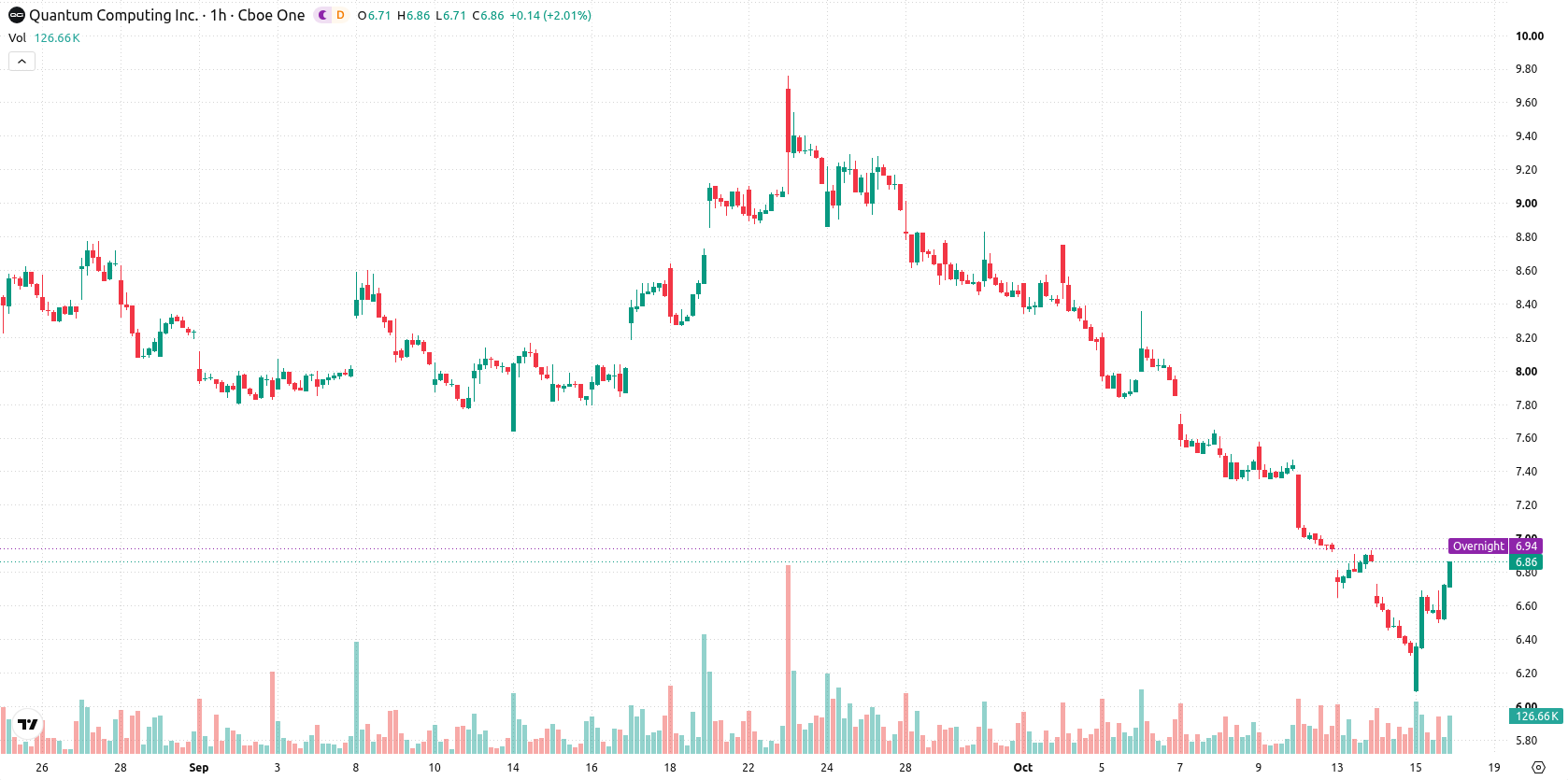
Quantum Computing Inc. (QUBT) stock is trading at $6.84, up 8.31% on the day. The price sits above its key short-term moving averages while remaining under longer-term trend markers.
 6.81
7.37
6.81
7.37
Highlights
- QUBT/USD surged 8.31% to $6.84 today, closing near the daily high during a volatile session.
- Technical indicator signals are mixed, with short-term buyers active intraday but momentum weak in the medium and long term.
- The expected price range for the next 2 to 3 trading days is $6.20 to $7.48, with a 55% probability of a downside move.
Mixed intraday buying amid technical resistance and momentum split
On the hourly chart, QUBT is positioned above its MA-20 but below the MA-50, with the price also trading beneath the MA-200 on the daily timeframe. The Ichimoku Kijun is set at $6.56, forming immediate support. Momentum readings are mixed: MACD and ADX both indicate selling pressure, while RSI is neutral-bullish at 53.6, the CCI is in buy territory, and Stochastic RSI signals an overbought state. Bull/Bear Power favors buyers on the intraday, yet the Awesome Oscillator remains neutral. These mixed signals reflect short-term buying attempts against a backdrop of lingering medium- and long-term weaknesses.
Consolidation outlook as downside risks marginally outweigh upside
In the next two to three trading days, QUBT is expected to consolidate within a $6.20 to $7.48 range, consistent with its typical volatility band. The probability of a downside move slightly outweighs upward continuation at 55% versus 45%. A break above $7.48 would open a bullish scenario, while sustained trading below $6.56 and a slip under $6.20 could accelerate corrective pressure in the near term.
Earlier, analysts noted that the quantum computing sector holds significant long-term growth potential, despite technical hurdles and uncertainty around commercial adoption. In the near term, QUBT traders should monitor the $6.56 support level, as a move below it could signal further downside risks beyond the current volatility range.





Latest Quantum Computing News





-
 Afghanistan
-
 Albania
-
 Algeria
-
 Angola
-
 Argentina
-
 Armenia
-
 Australia
-
 Austria
-
 Azerbaijan
-
 Bahamas
-
 Bahrain
-
 Bangladesh
-
 Belarus
-
 Belgium
-
 Bolivia
-
 Botswana
-
 Brazil
-
 Brunei
-
 Bulgaria
-
 Cambodia
-
 Cameroon
-
 Canada
-
 Chile
Chile
-
 China
China
-
 Colombia
-
 Congo
Congo
-
 Costa Rica
-
 Cote d'Ivoire
-
 Croatia
-
 Cuba
Cuba
-
 Cyprus
-
 Czechia
-
 DR Congo
-
 Denmark
-
 Dominican Republic
-
 Ecuador
-
 Egypt
Egypt
-
 El Salvador
-
 Estonia
-
 Eswatini
-
 Ethiopia
-
 Finland
-
 France
-
 Georgia
-
 Germany
-
 Ghana
Ghana
-
 Greece
-
 Haiti
Haiti
-
 Hong Kong
-
 Hungary
-
 India
India
-
 Indonesia
-
 Iran, Islamic republic
-
 Iraq
Iraq
-
 Ireland
-
 Israel
-
 Italy
Italy
-
 Jamaica
-
 Japan
Japan
-
 Jordan
-
 Kazakhstan
-
 Kenya
Kenya
-
 Korea
Korea
-
 Kuwait
-
 Kyrgyzstan
-
 Laos
Laos
-
 Latvia
-
 Lebanon
-
 Lesotho
-
 Libya
Libya
-
 Lithuania
-
 Luxembourg
-
 Madagascar
-
 Malaysia
-
 Malta
Malta
-
 Mauritius
-
 Mexico
-
 Moldova
-
 Mongolia
-
 Montenegro
-
 Morocco
-
 Mozambique
-
 Myanmar
-
 Namibia
-
 Nepal
Nepal
-
 Netherlands
-
 New Zealand
-
 Nigeria
-
 North Macedonia
-
 Norway
-
 Oman
Oman
-
 Pakistan
-
 Palestine
-
 Panama
-
 Papua New Guinea
-
 Paraguay
-
 Peru
Peru
-
 Philippines
-
 Poland
-
 Portugal
-
 Puerto Rico
-
 Qatar
Qatar
-
 Reunion
-
 Romania
-
 Rwanda
-
 Saudi Arabia
-
 Serbia
-
 Singapore
-
 Slovakia
-
 Slovenia
-
 Somalia
-
 South Africa
-
 Spain
Spain
-
 Sri Lanka
-
 Sweden
-
 Switzerland
-
 Syria
Syria
-
 Taiwan
-
 Tajikistan
-
 Tanzania
-
 Thailand
-
 Trinidad and Tobago
-
 Tunisia
-
 Turkey
-
 UAE
UAE
-
 Uganda
-
 Ukraine
-
 United Kingdom
-
United States
-
 Uruguay
-
 Uzbekistan
-
 Venezuela
-
 Vietnam
-
 Yemen
Yemen
-
 Zambia
-
 Zimbabwe
- Forex
- Crypto












