

Goodyear Tire & Rubber stock drops nearly 4% after weakness below all major moving averages signals bearish outlook

Goodyear Tire & Rubber Co (GT) dropped 3.67% today as oversold momentum and persistent selling pressure dominated trading, with no new corporate news to offset the decline. The down move is supported by continued weakness below major moving averages and a broadly bearish technical setup.
 4.50
4.52
Highlights
- Shares of Goodyear Tire & Rubber are trading below key moving averages, indicating a strong bearish trend across all timeframes.
- Momentum and volatility indicators confirm persistent selling pressure, with the stock closing near the daily low at $4.14 after a 3.67% decline.
- Over the next five trading days, the stock is projected to trade in a $3.95 to $4.33 range with a high probability of downward movement.
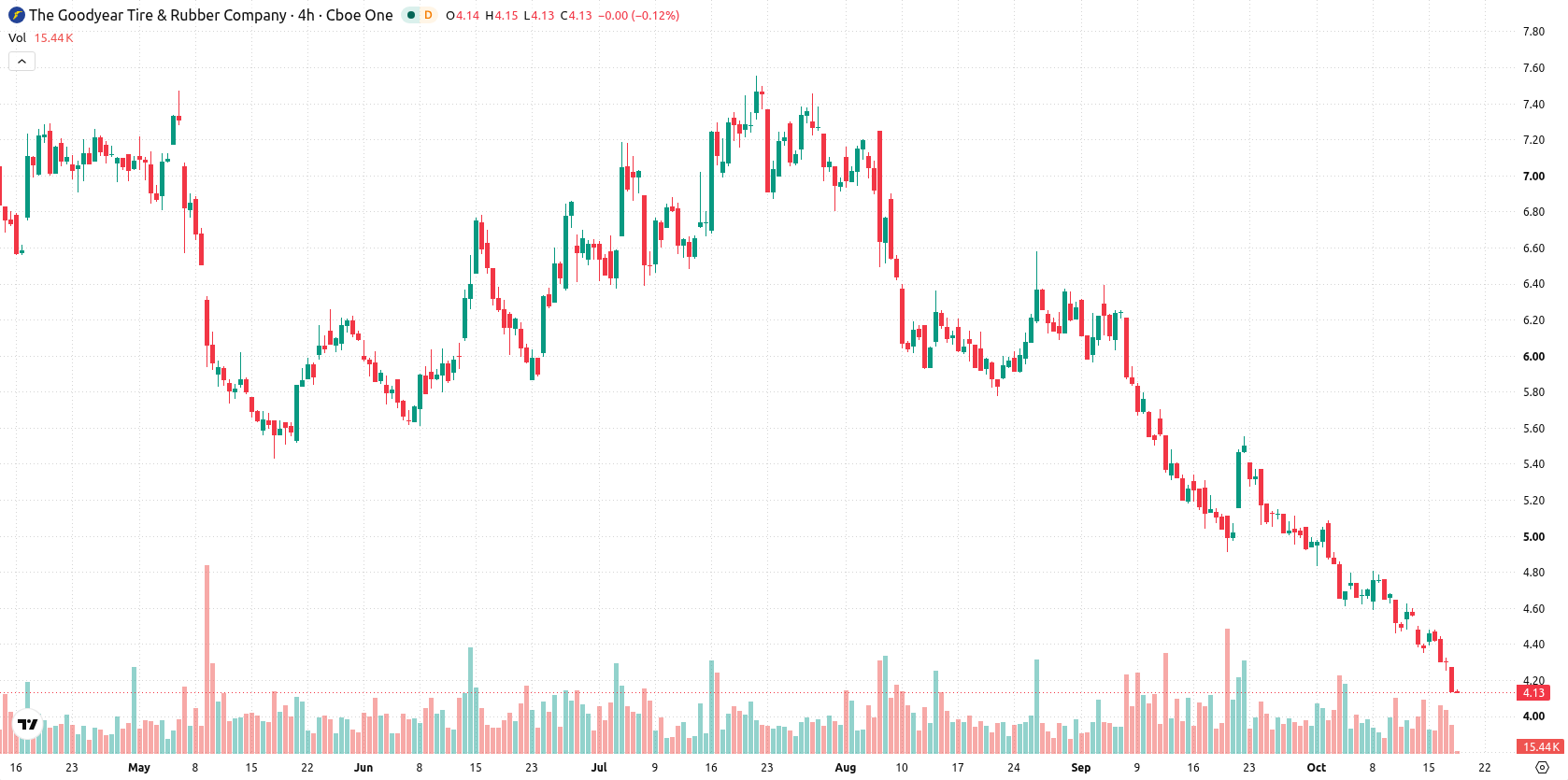
Bearish momentum persists as all timeframes face technical resistance
Goodyear Tire & Rubber is trading below its 20-day, 50-day, and 200-day moving averages at $4.83, $5.47, and $6.88, respectively, signaling sustained pressure from sellers across all horizons. Immediate resistance stands at $4.25 and support at $3.95, while the 50-day moving average remaining under the 200-day confirms a bearish longer-term trend. Momentum indicators maintain a decisively negative tone: the MACD and ADX both reflect a strong bearish bias. The RSI at 27.66 and CCI at -131.01 indicate oversold conditions, with the Stochastic RSI at 0 reinforcing this state. Bull/Bear Power at -0.19 shows sellers continue to dominate intraday momentum, and the Awesome Oscillator also supports the bearish setup. The stock is trading near the daily low with intraday volatility of 3.14%. Market tone is weak and confirms these bearish momentum signals.
Previously it was reported that Goodyear Tire & Rubber shares remained under sustained downside technical pressure with no clear sign of reversal. The latest price action further strengthens this bearish outlook, with high volatility reinforcing the need for traders to monitor the $3.95 support level as a key downside risk in the near term.






Latest Goodyear Tire & Rubber Co News




-
 Afghanistan
-
 Albania
-
 Algeria
-
 Angola
-
 Argentina
-
 Armenia
-
 Australia
-
 Austria
-
 Azerbaijan
-
 Bahamas
-
 Bahrain
-
 Bangladesh
-
 Belarus
-
 Belgium
-
 Bolivia
-
 Botswana
-
 Brazil
-
 Brunei
-
 Bulgaria
-
 Cambodia
-
 Cameroon
-
 Canada
-
 Chile
-
 China
-
 Colombia
-
 Congo
-
 Costa Rica
-
 Cote d'Ivoire
-
 Croatia
-
 Cuba
-
 Cyprus
-
 Czechia
-
 DR Congo
-
 Denmark
-
 Dominican Republic
-
 Ecuador
-
 Egypt
-
 El Salvador
-
 Estonia
-
 Eswatini
-
 Ethiopia
-
 Finland
-
 France
-
 Georgia
-
 Germany
-
 Ghana
-
 Greece
-
 Haiti
-
 Hong Kong
-
 Hungary
-
 India
-
 Indonesia
-
 Iran, Islamic republic
-
 Iraq
-
 Ireland
-
 Israel
-
 Italy
-
 Jamaica
-
 Japan
-
 Jordan
-
 Kazakhstan
-
 Kenya
-
 Korea
-
 Kuwait
-
 Kyrgyzstan
-
 Laos
-
 Latvia
-
 Lebanon
-
 Lesotho
-
 Libya
-
 Lithuania
-
 Luxembourg
-
 Madagascar
-
 Malaysia
-
 Malta
-
 Mauritius
-
 Mexico
-
 Moldova
-
 Mongolia
-
 Montenegro
-
 Morocco
-
 Mozambique
-
 Myanmar
-
 Namibia
-
 Nepal
-
 Netherlands
-
 New Zealand
-
 Nigeria
-
 North Macedonia
-
 Norway
-
 Oman
-
 Pakistan
-
 Palestine
-
 Panama
-
 Papua New Guinea
-
 Paraguay
-
 Peru
-
 Philippines
-
 Poland
-
 Portugal
-
 Puerto Rico
-
 Qatar
-
 Reunion
-
 Romania
-
 Rwanda
-
 Saudi Arabia
-
 Serbia
-
 Singapore
-
 Slovakia
-
 Slovenia
-
 Somalia
-
 South Africa
-
 Spain
-
 Sri Lanka
-
 Sweden
-
 Switzerland
-
 Syria
-
 Taiwan
-
 Tajikistan
-
 Tanzania
-
 Thailand
-
 Trinidad and Tobago
-
 Tunisia
-
 Turkey
-
 UAE
-
 Uganda
-
 Ukraine
-
 United Kingdom
-
United States
-
 Uruguay
-
 Uzbekistan
-
 Venezuela
-
 Vietnam
-
 Yemen
-
 Zambia
-
 Zimbabwe
- Forex
- Crypto












