

ARM climbs nearly 5% after intraday rebound with price staying below key averages

Arm Holdings plc (ARM) advanced 4.67% today in an intraday rebound driven by short-term volatility and a lack of fresh fundamental catalysts. The up move looks limited, with price still trading well below all key moving averages.
 179.90
209.26
Highlights
- Arm Holdings stock trades below key moving averages, with prices under significant resistance at $205.59 and support at $179.9.
- Momentum and oscillator indicators confirm prevailing selling pressure, with only short-term readings in a neutral or oversold position.
- Projected 5-day range is $159.77 to $205.59, with a 72% probability of a downward move and baseline expectations for sideways consolidation.
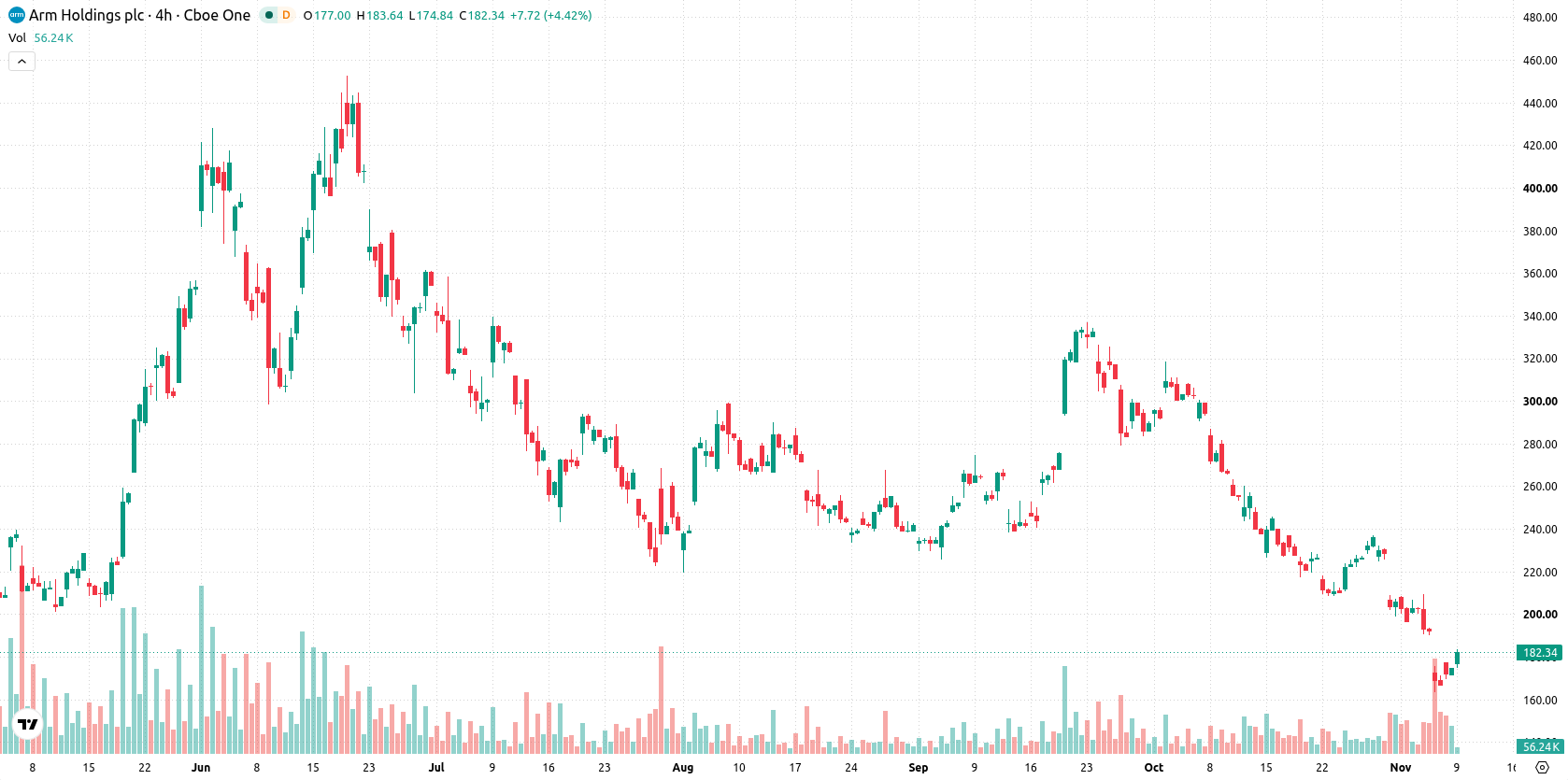
Persistent selling pressure as price holds below key averages
Arm trades well below the 20-, 50-, and 200-day moving averages, with the current price of $182.68 under $218.6 (MA-20), $252.78 (MA-50), and $230.83 (MA-200). This setup signals persistent short-, medium-, and long-term pressure from sellers, even as the MA-50 remains above the MA-200 in a longer-term bullish configuration. Key short-term levels are the resistance at $205.59 and the support at $179.9, with the Ichimoku Kijun at $240.79 confirming extended resistance above. Momentum indicators are mixed. The MACD and ADX both point to selling pressure, while both the RSI and Stochastic RSI are neutral and the CCI is in the oversold zone. BBP is negative, confirming intraday seller dominance. The Awesome Oscillator aligns with a selling trend. Price trades near the session highs with intraday volatility at 2.89%, showing strength toward highs despite conflicting signals from oscillators and ongoing bearish momentum.
Earlier, analysts noted that Arm Holdings' share price has faced sustained downward pressure amid broader portfolio declines and ongoing challenges in SoftBank's AI investment strategy. The present rebound in Arm shares occurs within a context of persistent technical resistance, with $205.59 standing out as a key upside level to monitor for any shift from the prevailing consolidation.











-
 Afghanistan
-
 Albania
-
 Algeria
-
 Angola
-
 Argentina
-
 Armenia
-
 Australia
-
 Austria
-
 Azerbaijan
-
 Bahamas
-
 Bahrain
-
 Bangladesh
-
 Belarus
-
 Belgium
-
 Bolivia
-
 Botswana
-
 Brazil
-
 Brunei
-
 Bulgaria
-
 Cambodia
-
 Cameroon
-
 Canada
-
 Chile
-
 China
-
 Colombia
-
 Congo
-
 Costa Rica
-
 Cote d'Ivoire
-
 Croatia
-
 Cuba
-
 Cyprus
-
 Czechia
-
 DR Congo
-
 Denmark
-
 Dominican Republic
-
 Ecuador
-
 Egypt
-
 El Salvador
-
 Estonia
-
 Eswatini
-
 Ethiopia
-
 Finland
-
 France
-
 Georgia
-
 Germany
-
 Ghana
-
 Greece
-
 Haiti
-
 Hong Kong
-
 Hungary
-
 India
-
 Indonesia
-
 Iran, Islamic republic
-
 Iraq
-
 Ireland
-
 Israel
-
 Italy
-
 Jamaica
-
 Japan
-
 Jordan
-
 Kazakhstan
-
 Kenya
-
 Korea
-
 Kuwait
-
 Kyrgyzstan
-
 Laos
-
 Latvia
-
 Lebanon
-
 Lesotho
-
 Libya
-
 Lithuania
-
 Luxembourg
-
 Madagascar
-
 Malaysia
-
 Malta
-
 Mauritius
-
 Mexico
-
 Moldova
-
 Mongolia
-
 Montenegro
-
 Morocco
-
 Mozambique
-
 Myanmar
-
 Namibia
-
 Nepal
-
 Netherlands
-
 New Zealand
-
 Nigeria
-
 North Macedonia
-
 Norway
-
 Oman
-
 Pakistan
-
 Palestine
-
 Panama
-
 Papua New Guinea
-
 Paraguay
-
 Peru
-
 Philippines
-
 Poland
-
 Portugal
-
 Puerto Rico
-
 Qatar
-
 Reunion
-
 Romania
-
 Rwanda
-
 Saudi Arabia
-
 Serbia
-
 Singapore
-
 Slovakia
-
 Slovenia
-
 Somalia
-
 South Africa
-
 Spain
-
 Sri Lanka
-
 Sweden
-
 Switzerland
-
 Syria
-
 Taiwan
-
 Tajikistan
-
 Tanzania
-
 Thailand
-
 Trinidad and Tobago
-
 Tunisia
-
 Turkey
-
 UAE
-
 Uganda
-
 Ukraine
-
 United Kingdom
-
United States
-
 Uruguay
-
 Uzbekistan
-
 Venezuela
-
 Vietnam
-
 Yemen
-
 Zambia
-
 Zimbabwe
- Forex
- Crypto












