

Palantir stock holds above $162.49 support amid sideways consolidation

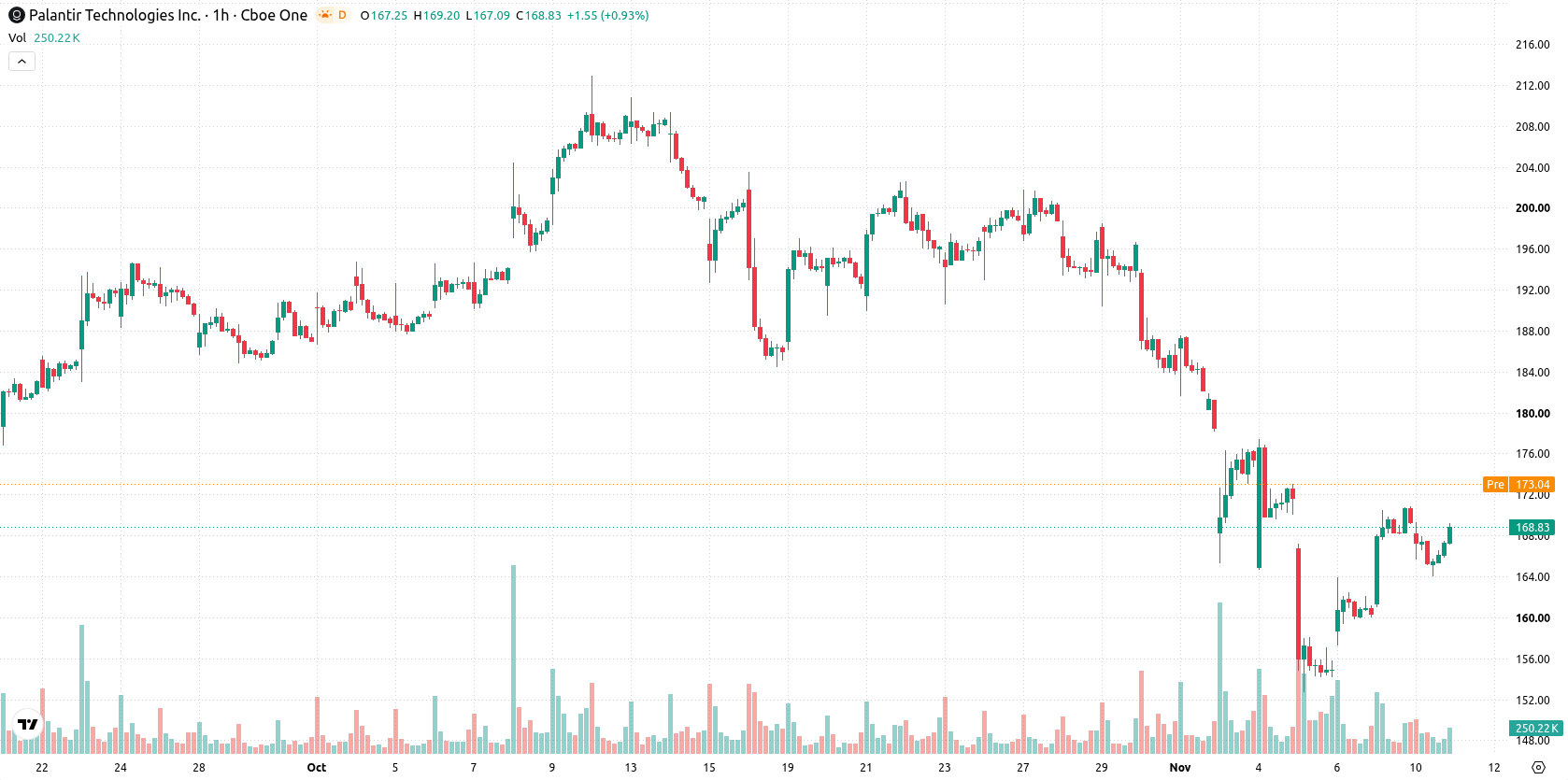
Palantir (PLTR) stock is trading at $169. The price saw a marginal move lower on the day and remains above its key short- and long-term moving averages, but is just under medium-term levels.
 164.75
167.13
Highlights
- Exchange-traded funds added $75.3 million to Palantir stock on November 6, 2026, with 54 funds increasing positions and 19 reducing.
- This influx from institutional investors tightened Palantir's float, providing short-term liquidity and showing broad allocation shifts.
- Palantir shares traded at $169 with mixed technical signals, consolidating in a $158.15 to $179.85 range and a 52% probability of an upward move.
Net ETF inflows tighten float amid institutional accumulation
Exchange-traded funds recorded a significant net inflow into Palantir shares on November 6, 2026, as $75.3 million was added by 54 funds while only 19 reduced their positions, according to Yahoo Finance. This concerted institutional buying indicates a broad-based allocation shift into the stock, which tends to tighten the circulating float and provide short-term liquidity support. Such inflows typically reflect underlying confidence among diverse portfolio managers, even as the market has shown only limited directional movement.
Mixed momentum with intraday buyers as technical boundaries converge
PLTR is currently trading above its MA-20 and MA-200, but remains slightly below the MA-50. The Ichimoku Kijun line at $162.49 acts as the nearest support. Momentum readings are mixed, with MACD in a neutral state and ADX signaling a mild buy bias. Oscillators including RSI, Stoch RSI, and CCI all indicate neutral conditions, while Bull/Bear Power remains positive, highlighting ongoing buyer presence in intraday activity. The Awesome Oscillator is also supportive of a bullish tone, despite moderate overall volatility.
Breakout risk elevated as sideways range persists
Looking forward, PLTR is expected to trade within a range between $158.15 and $179.85 over the coming days, reflecting a typical volatility band relative to current levels. The probability for an upward breakout is slightly higher at 52%, while the downside scenario stands at 48%. The most probable outcome is continued sideways consolidation in this corridor, but any breakout above resistance or drop below immediate support could quickly shift the prevailing trend.
Earlier, analysts noted that Palantir was at a technical crossroads, with consolidation likely as traders weighed institutional flows and evolving support levels. The current analysis reinforces this view, highlighting persistent sideways price action inside a defined trading band, with a potential trend shift likely if price decisively breaches either immediate support or resistance.






Latest Palantir News



-
 Afghanistan
-
 Albania
-
 Algeria
-
 Angola
-
 Argentina
-
 Armenia
-
 Australia
-
 Austria
-
 Azerbaijan
-
 Bahamas
-
 Bahrain
-
 Bangladesh
-
 Belarus
-
 Belgium
-
 Bolivia
-
 Botswana
-
 Brazil
-
 Brunei
-
 Bulgaria
-
 Cambodia
-
 Cameroon
-
 Canada
-
 Chile
-
 China
-
 Colombia
-
 Congo
-
 Costa Rica
-
 Cote d'Ivoire
-
 Croatia
-
 Cuba
-
 Cyprus
-
 Czechia
-
 DR Congo
-
 Denmark
-
 Dominican Republic
-
 Ecuador
-
 Egypt
-
 El Salvador
-
 Estonia
-
 Eswatini
-
 Ethiopia
-
 Finland
-
 France
-
 Georgia
-
 Germany
-
 Ghana
-
 Greece
-
 Haiti
-
 Hong Kong
-
 Hungary
-
 India
-
 Indonesia
-
 Iran, Islamic republic
-
 Iraq
-
 Ireland
-
 Israel
-
 Italy
-
 Jamaica
-
 Japan
-
 Jordan
-
 Kazakhstan
-
 Kenya
-
 Korea
-
 Kuwait
-
 Kyrgyzstan
-
 Laos
-
 Latvia
-
 Lebanon
-
 Lesotho
-
 Libya
-
 Lithuania
-
 Luxembourg
-
 Madagascar
-
 Malaysia
-
 Malta
-
 Mauritius
-
 Mexico
-
 Moldova
-
 Mongolia
-
 Montenegro
-
 Morocco
-
 Mozambique
-
 Myanmar
-
 Namibia
-
 Nepal
-
 Netherlands
-
 New Zealand
-
 Nigeria
-
 North Macedonia
-
 Norway
-
 Oman
-
 Pakistan
-
 Palestine
-
 Panama
-
 Papua New Guinea
-
 Paraguay
-
 Peru
-
 Philippines
-
 Poland
-
 Portugal
-
 Puerto Rico
-
 Qatar
-
 Reunion
-
 Romania
-
 Rwanda
-
 Saudi Arabia
-
 Serbia
-
 Singapore
-
 Slovakia
-
 Slovenia
-
 Somalia
-
 South Africa
-
 Spain
-
 Sri Lanka
-
 Sweden
-
 Switzerland
-
 Syria
-
 Taiwan
-
 Tajikistan
-
 Tanzania
-
 Thailand
-
 Trinidad and Tobago
-
 Tunisia
-
 Turkey
-
 UAE
-
 Uganda
-
 Ukraine
-
 United Kingdom
-
United States
-
 Uruguay
-
 Uzbekistan
-
 Venezuela
-
 Vietnam
-
 Yemen
-
 Zambia
-
 Zimbabwe
- Forex
- Crypto












