

Tesla drops as renewed inflation concerns and rate hike expectations pressure technology sector valuations

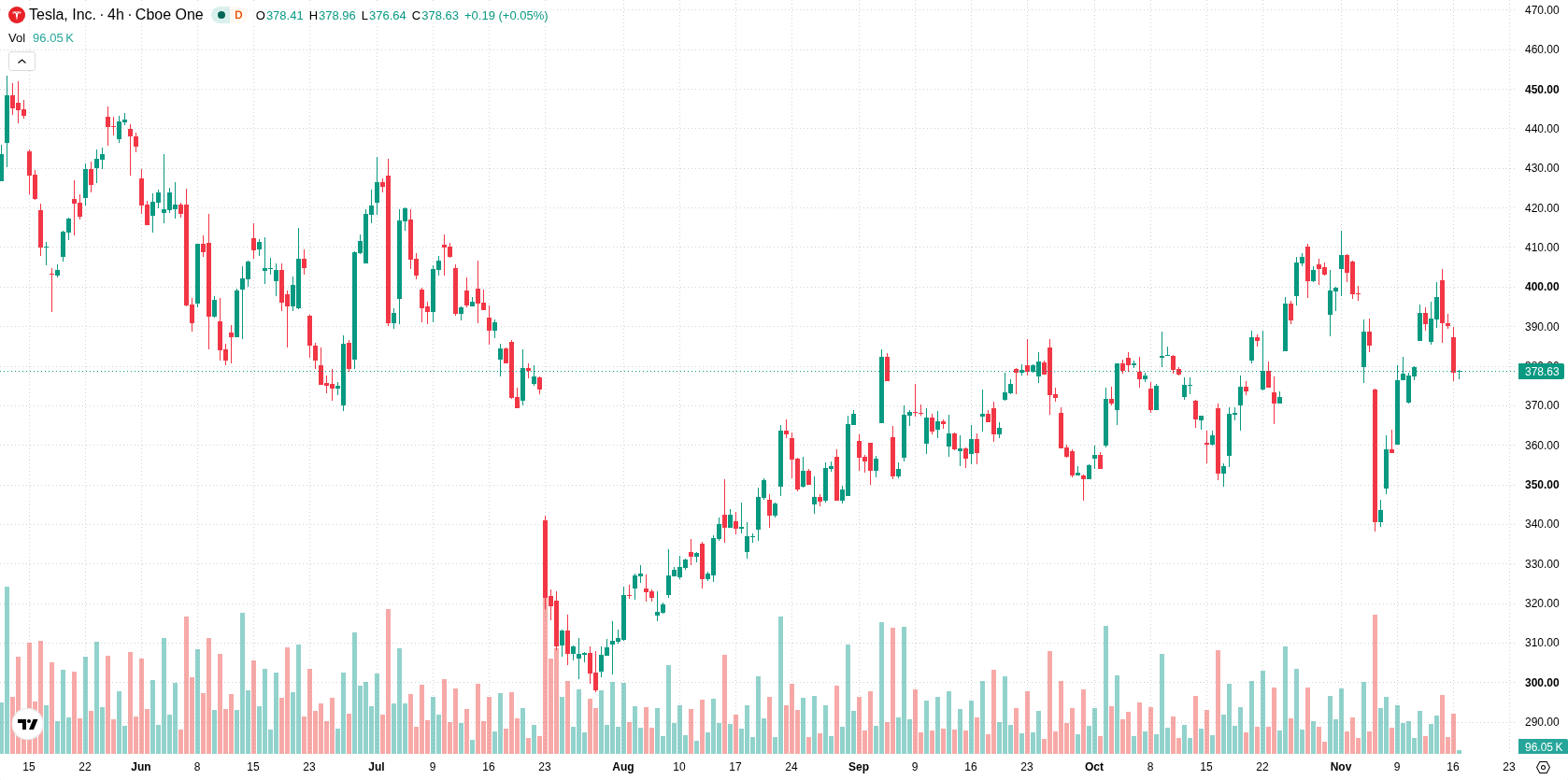
Tesla (TSLA) stock is trading lower at $378.47 during afternoon trade on November 16, 2026, reflecting a sector-wide sell-off driven by renewed inflation worries and expectations of higher interest rates. Rising bond yields have weakened risk appetite and put valuation pressure on growth stocks such as TSLA. Market participants are monitoring inflation data and upcoming Federal Reserve policy decisions for further direction.
 382.68
401.16
Highlights
- Shares of TSLA dropped 3.4% during morning trading on November 16, 2026, as the technology sector experienced widespread selling tied to renewed inflation worries and possible future interest rate hikes.
- Elevated inflation and expectations of increased U.S. rates pressured TSLA stock valuations by making growth shares less attractive relative to higher bond yields.
- TSLA trades below key moving averages with mixed technical indicators, facing support near $376 and resistance around $383, and future moves depend on inflation data and Fed policy signals.
Inflation and rate hike fears spark U.S. tech sector sell-off
According to Investing.com, on November 16, 2026, TSLA saw a 3.4% decline during morning hours as part of a broad sell-off in the technology sector tied to renewed concerns about inflation and the prospect of future interest rate hikes.
This negative reaction reflects how elevated inflation and expectations of higher U.S. interest rates can drive up bond yields, making riskier growth stocks like TSLA less attractive in relative terms and directly pressuring their valuations.
The move in TSLA mirrored wider sector weakness, with macroeconomic factors proving more decisive than any company-specific developments during the session.
TSLA stays trapped between major averages with mixed signals
The current macro environment has TSLA positioned between key daily moving averages, with recent weakness leaving the price below the D1 SMA-200 at $382.67 and under the shorter-term H4 SMA-20 at $381.29.
TSLA remains slightly above the D1 SMA-50 at $374.69 and the H4 Kijun support at $376, while technical signals are mixed—MACD suggests buying momentum but the ADX is neutral, indicating a lack of clear trend strength.
Inflation, Fed policy stance, and a test of $376–$383 determine direction
Continued inflation pressures and tighter Fed policy represent persistent risk for TSLA, with downside capped by support around $376. A recovery toward the resistance zone around $383 would require a shift in the interest rate outlook or improved sector sentiment. Monitoring inflation data and Fed communications will remain key for the next sustained directional move.
Earlier, analysts noted that speculation regarding a potential merger between Tesla and SpaceX was intensifying in prediction markets ahead of key shareholder meetings. Currently, however, Tesla’s price action remains primarily dictated by macroeconomic pressures such as inflation and Federal Reserve policy, making upcoming economic data and central bank communications critical for any sustained shift in direction.











-
 Afghanistan
-
 Albania
-
 Algeria
-
 Angola
-
 Argentina
-
 Armenia
-
 Australia
-
 Austria
-
 Azerbaijan
-
 Bahamas
-
 Bahrain
-
 Bangladesh
-
 Belarus
-
 Belgium
-
 Bolivia
-
 Botswana
-
 Brazil
-
 Brunei
-
 Bulgaria
-
 Cambodia
-
 Cameroon
-
 Canada
-
 Chile
-
 China
-
 Colombia
-
 Congo
-
 Costa Rica
-
 Cote d'Ivoire
-
 Croatia
-
 Cuba
-
 Cyprus
-
 Czechia
-
 DR Congo
-
 Denmark
-
 Dominican Republic
-
 Ecuador
-
 Egypt
-
 El Salvador
-
 Estonia
-
 Eswatini
-
 Ethiopia
-
 Finland
-
 France
-
 Georgia
-
 Germany
-
 Ghana
-
 Greece
-
 Haiti
-
 Hong Kong
-
 Hungary
-
 India
-
 Indonesia
-
 Iran, Islamic republic
-
 Iraq
-
 Ireland
-
 Israel
-
 Italy
-
 Jamaica
-
 Japan
-
 Jordan
-
 Kazakhstan
-
 Kenya
-
 Korea
-
 Kuwait
-
 Kyrgyzstan
-
 Laos
-
 Latvia
-
 Lebanon
-
 Lesotho
-
 Libya
-
 Lithuania
-
 Luxembourg
-
 Madagascar
-
 Malaysia
-
 Malta
-
 Mauritius
-
 Mexico
-
 Moldova
-
 Mongolia
-
 Montenegro
-
 Morocco
-
 Mozambique
-
 Myanmar
-
 Namibia
-
 Nepal
-
 Netherlands
-
 New Zealand
-
 Nigeria
-
 North Macedonia
-
 Norway
-
 Oman
-
 Pakistan
-
 Palestine
-
 Panama
-
 Papua New Guinea
-
 Paraguay
-
 Peru
-
 Philippines
-
 Poland
-
 Portugal
-
 Puerto Rico
-
 Qatar
-
 Reunion
-
 Romania
-
 Rwanda
-
 Saudi Arabia
-
 Serbia
-
 Singapore
-
 Slovakia
-
 Slovenia
-
 Somalia
-
 South Africa
-
 Spain
-
 Sri Lanka
-
 Sweden
-
 Switzerland
-
 Syria
-
 Taiwan
-
 Tajikistan
-
 Tanzania
-
 Thailand
-
 Trinidad and Tobago
-
 Tunisia
-
 Turkey
-
 UAE
-
 Uganda
-
 Ukraine
-
 United Kingdom
-
United States
-
 Uruguay
-
 Uzbekistan
-
 Venezuela
-
 Vietnam
-
 Yemen
-
 Zambia
-
 Zimbabwe
- Forex
- Crypto












