

Will National Grid stock stabilize amid oversold conditions and support pressure?

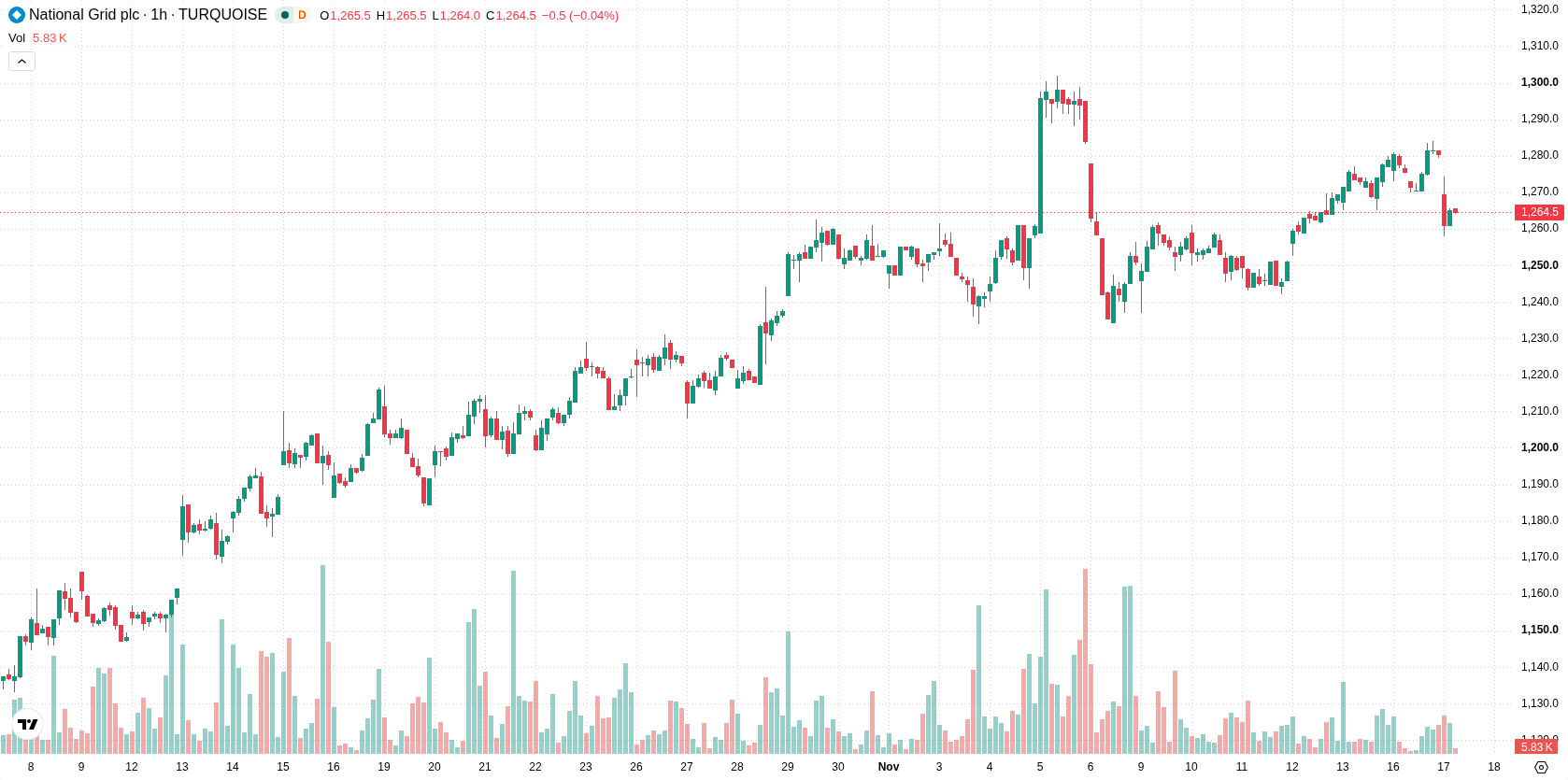
National Grid (NG) stock is trading at GBX1,265.50, marking a decline of 1.17% on the day. The price currently sits below its key short-term average but above its longer-term trend supports, reflecting a period of moderate volatility within its recent range.
 1274.50
1284.50
Highlights
- National Grid announced a £70 billion capital investment plan, establishing priorities for infrastructure upgrades and long-term network reliability.
- Institutional investors continue adjusting their holdings according to Investegate Co., as the stock remains under broader selling pressure.
- Shares of National Grid closed at GBX1,265, down 1.17%, with indicators showing short-term selling pressure but 60% probability of rangebound stabilization between GBX1,246 and GBX1,284 in coming days.
Long-term investment plans and institutional moves shape sentiment
National Grid has outlined a £70 billion capital spending plan, demonstrating a strong commitment to future infrastructure upgrades and the long-term reliability of its network. This planned level of investment gives clarity to the market regarding the company's capital allocation priorities, which can influence sentiment among long-term investors. Additionally, reported changes in holdings, according to Investegate Co., highlight ongoing institutional engagement in the stock, though price action has remained under broader selling pressure.
Conflicted technical signals as sellers dominate momentum
Technically, NG remains below the H1 SMA-20 at GBX1,274 but above both the H1 SMA-50 at GBX1,262 and the D1 SMA-200 at GBX1,240. The Ichimoku Kijun level at GBX1,271 is immediate resistance. Intraday momentum readings are mixed: MACD signals strong buy, while ADX is neutral and RSI is also neutral. Both Stoch RSI and CCI indicate oversold conditions that may point to short-term selling exhaustion. Bull/Bear Power is negative at -7.14, reflecting dominant selling activity, and the Awesome Oscillator is neutral, failing to provide additional directional cues. This backdrop suggests that the short-term technical picture is conflicted, with MACD strength counterbalanced by weak oscillators and ongoing seller dominance.
Directional uncertainty as buyers and sellers vie near resistance
In the short term, NG is expected to trade within a typical volatility band of GBX1,246 to GBX1,284 over the next two to three trading days. With a 60% probability, price stabilization or mild upward movement is favored as both buyers and sellers contest for direction. A sustained break above GBX1,271 (the Kijun resistance) would introduce the potential for gains towards the top of the projected range. Conversely, a decisive fall below GBX1,246 could trigger renewed selling pressure and broaden the downside scenario.
Earlier, analysts noted that despite prevailing downside pressure, National Grid's technical structure was broadly supported by trend alignment and momentum readings, warranting close attention to any shifts. The current analysis adds a differentiated view, highlighting mixed signals across shorter- and longer-term indicators and reaffirming the need to watch for a sustained move above GBX1,271 or below GBX1,246 as signals for the next directional move.






Latest National Grid News




-
 Afghanistan
-
 Albania
-
 Algeria
-
 Angola
-
 Argentina
-
 Armenia
-
 Australia
-
 Austria
-
 Azerbaijan
-
 Bahamas
-
 Bahrain
-
 Bangladesh
-
 Belarus
-
 Belgium
-
 Bolivia
-
 Botswana
-
 Brazil
-
 Brunei
-
 Bulgaria
-
 Cambodia
-
 Cameroon
-
 Canada
-
 Chile
-
 China
-
 Colombia
-
 Congo
-
 Costa Rica
-
 Cote d'Ivoire
-
 Croatia
-
 Cuba
-
 Cyprus
-
 Czechia
-
 DR Congo
-
 Denmark
-
 Dominican Republic
-
 Ecuador
-
 Egypt
-
 El Salvador
-
 Estonia
-
 Eswatini
-
 Ethiopia
-
 Finland
-
 France
-
 Georgia
-
 Germany
-
 Ghana
-
 Greece
-
 Haiti
-
 Hong Kong
-
 Hungary
-
 India
-
 Indonesia
-
 Iran, Islamic republic
-
 Iraq
-
 Ireland
-
 Israel
-
 Italy
-
 Jamaica
-
 Japan
-
 Jordan
-
 Kazakhstan
-
 Kenya
-
 Korea
-
 Kuwait
-
 Kyrgyzstan
-
 Laos
-
 Latvia
-
 Lebanon
-
 Lesotho
-
 Libya
-
 Lithuania
-
 Luxembourg
-
 Madagascar
-
 Malaysia
-
 Malta
-
 Mauritius
-
 Mexico
-
 Moldova
-
 Mongolia
-
 Montenegro
-
 Morocco
-
 Mozambique
-
 Myanmar
-
 Namibia
-
 Nepal
-
 Netherlands
-
 New Zealand
-
 Nigeria
-
 North Macedonia
-
 Norway
-
 Oman
-
 Pakistan
-
 Palestine
-
 Panama
-
 Papua New Guinea
-
 Paraguay
-
 Peru
-
 Philippines
-
 Poland
-
 Portugal
-
 Puerto Rico
-
 Qatar
-
 Reunion
-
 Romania
-
 Rwanda
-
 Saudi Arabia
-
 Serbia
-
 Singapore
-
 Slovakia
-
 Slovenia
-
 Somalia
-
 South Africa
-
 Spain
-
 Sri Lanka
-
 Sweden
-
 Switzerland
-
 Syria
-
 Taiwan
-
 Tajikistan
-
 Tanzania
-
 Thailand
-
 Trinidad and Tobago
-
 Tunisia
-
 Turkey
-
 UAE
-
 Uganda
-
 Ukraine
-
 United Kingdom
-
United States
-
 Uruguay
-
 Uzbekistan
-
 Venezuela
-
 Vietnam
-
 Yemen
-
 Zambia
-
 Zimbabwe
- Forex
- Crypto












