

Shell falls as US inflation surprise and Fed rate hike signals raise oil demand concerns

Shell (SHEL) stock is trading lower, with price action tracking a modest decline on November 17, 2026. A surprise uptick in US inflation and the Federal Reserve's signals of more aggressive rate hikes have influenced global markets, pushing yields higher and raising risks for energy-related equities such as Shell. Traders are watching for additional US inflation data and policy signals from the Fed that could further affect oil prices and Shell's earnings outlook.
 3691.00
3752.00
Highlights
- US consumer prices exceeded forecasts on November 10, 2026, generating warnings from Federal Reserve officials about possible larger rate hikes.
- Prospects of stricter US monetary policy raise concerns over weaker global crude demand and limit Shell stock's earnings potential.
- Momentum signals on Shell stock remain bearish; upward confirmation requires a move above resistance near GBX3,700 with support at GBX3,339.
US inflation surprise drives higher yields and energy sector risks
According to Bloomberg, US consumer prices rose more than expected on November 10, 2026, and Federal Reserve officials warned of potentially more aggressive interest rate hikes in response, which drove US bond yields significantly higher.
The combination of unexpectedly high US inflation and the prospect of further Fed tightening has heightened concerns about slower global economic activity. For a global oil producer like Shell, higher yields and a more restrictive monetary policy environment may weigh on crude demand and, in turn, on the company's operating environment.
These developments represent a key external risk to the energy sector, with the impact from monetary policy changes filtering through oil markets and earnings potential for companies such as Shell.
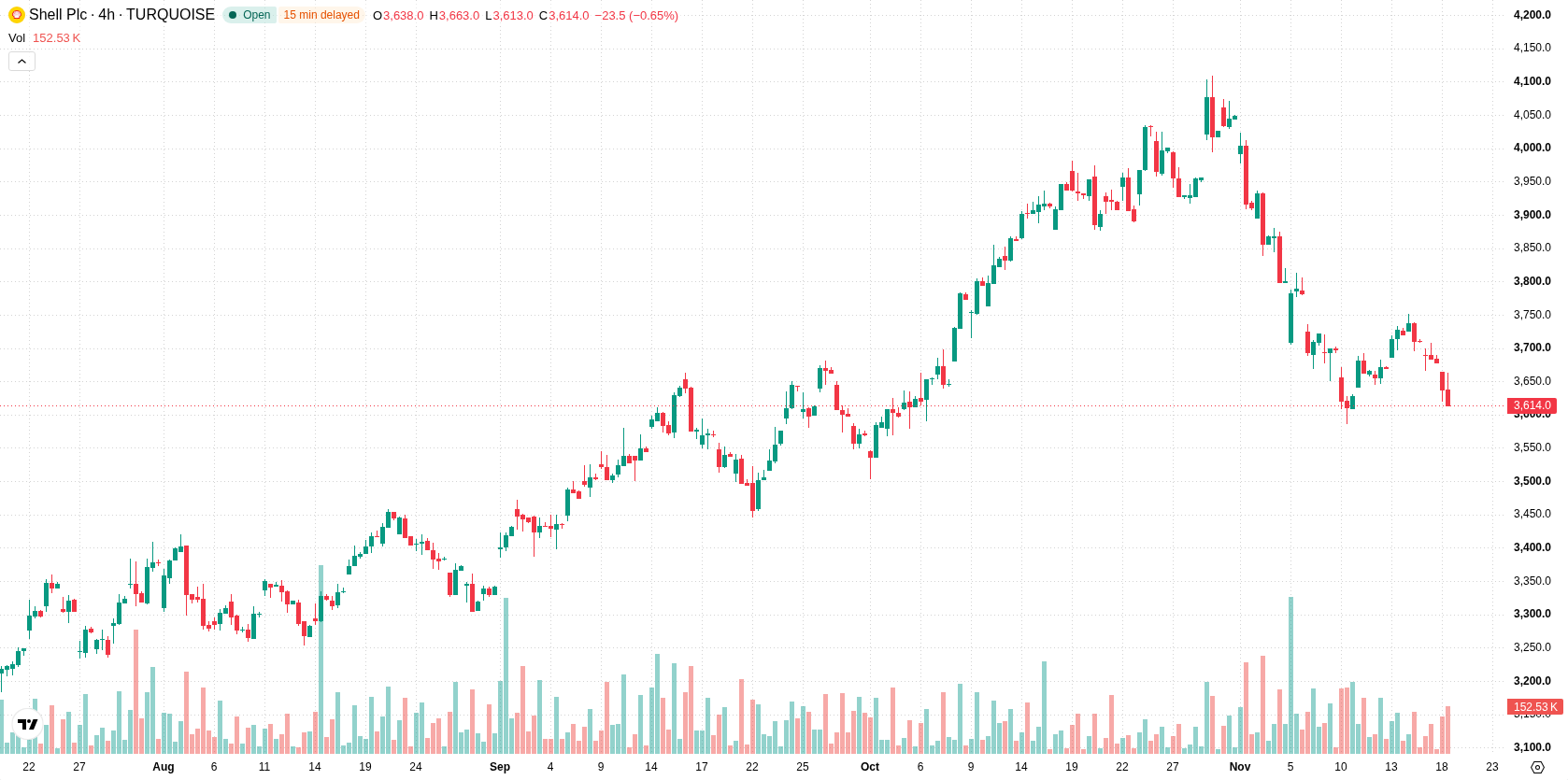
Bearish momentum with mixed moving average signals on 4H chart
Technically, the daily chart shows price remains positioned between key moving averages, with the D1 SMA-50 at GBX3,732 above and the D1 SMA-200 at GBX3,339 below. On the 4H timeframe, price is hovering just under the SMA-20 at GBX3,681 and is encountering resistance near the H4 Kijun at GBX3,699.
Momentum signals are pointing lower, as both MACD and ADX indicate a strong sell environment. Mixed signals from moving averages suggest caution, with no clear confirmation of a sustained directional move at present.
Fed policy and US inflation as triggers for next directional move
The risk of further US rate hikes continues to overshadow the outlook for Shell stock. A decisive move above resistance around GBX3,700 would be required for a positive shift, while support near GBX3,339 remains the key zone for stability. Monitoring incoming US economic data and Fed policy updates will be critical for near-term positioning.
Earlier, analysts noted that Shell stock was exhibiting downside bias amid bearish technical signals, with structural factors such as share cancellations providing only limited support. The current environment adds to these concerns, as heightened US inflation and increasingly hawkish Fed policy have emerged as key macroeconomic risks to monitor for Shell's next move.










-
 Afghanistan
-
 Albania
-
 Algeria
-
 Angola
-
 Argentina
-
 Armenia
-
 Australia
-
 Austria
-
 Azerbaijan
-
 Bahamas
-
 Bahrain
-
 Bangladesh
-
 Belarus
-
 Belgium
-
 Bolivia
-
 Botswana
-
 Brazil
-
 Brunei
-
 Bulgaria
-
 Cambodia
-
 Cameroon
-
 Canada
-
 Chile
-
 China
-
 Colombia
-
 Congo
-
 Costa Rica
-
 Cote d'Ivoire
-
 Croatia
-
 Cuba
-
 Cyprus
-
 Czechia
-
 DR Congo
-
 Denmark
-
 Dominican Republic
-
 Ecuador
-
 Egypt
-
 El Salvador
-
 Estonia
-
 Eswatini
-
 Ethiopia
-
 Finland
-
 France
-
 Georgia
-
 Germany
-
 Ghana
-
 Greece
-
 Haiti
-
 Hong Kong
-
 Hungary
-
 India
-
 Indonesia
-
 Iran, Islamic republic
-
 Iraq
-
 Ireland
-
 Israel
-
 Italy
-
 Jamaica
-
 Japan
-
 Jordan
-
 Kazakhstan
-
 Kenya
-
 Korea
-
 Kuwait
-
 Kyrgyzstan
-
 Laos
-
 Latvia
-
 Lebanon
-
 Lesotho
-
 Libya
-
 Lithuania
-
 Luxembourg
-
 Madagascar
-
 Malaysia
-
 Malta
-
 Mauritius
-
 Mexico
-
 Moldova
-
 Mongolia
-
 Montenegro
-
 Morocco
-
 Mozambique
-
 Myanmar
-
 Namibia
-
 Nepal
-
 Netherlands
-
 New Zealand
-
 Nigeria
-
 North Macedonia
-
 Norway
-
 Oman
-
 Pakistan
-
 Palestine
-
 Panama
-
 Papua New Guinea
-
 Paraguay
-
 Peru
-
 Philippines
-
 Poland
-
 Portugal
-
 Puerto Rico
-
 Qatar
-
 Reunion
-
 Romania
-
 Rwanda
-
 Saudi Arabia
-
 Serbia
-
 Singapore
-
 Slovakia
-
 Slovenia
-
 Somalia
-
 South Africa
-
 Spain
-
 Sri Lanka
-
 Sweden
-
 Switzerland
-
 Syria
-
 Taiwan
-
 Tajikistan
-
 Tanzania
-
 Thailand
-
 Trinidad and Tobago
-
 Tunisia
-
 Turkey
-
 UAE
-
 Uganda
-
 Ukraine
-
 United Kingdom
-
United States
-
 Uruguay
-
 Uzbekistan
-
 Venezuela
-
 Vietnam
-
 Yemen
-
 Zambia
-
 Zimbabwe
- Forex
- Crypto












