

Canopy Growth stock forecast: Downside risk remains high with sellers in control

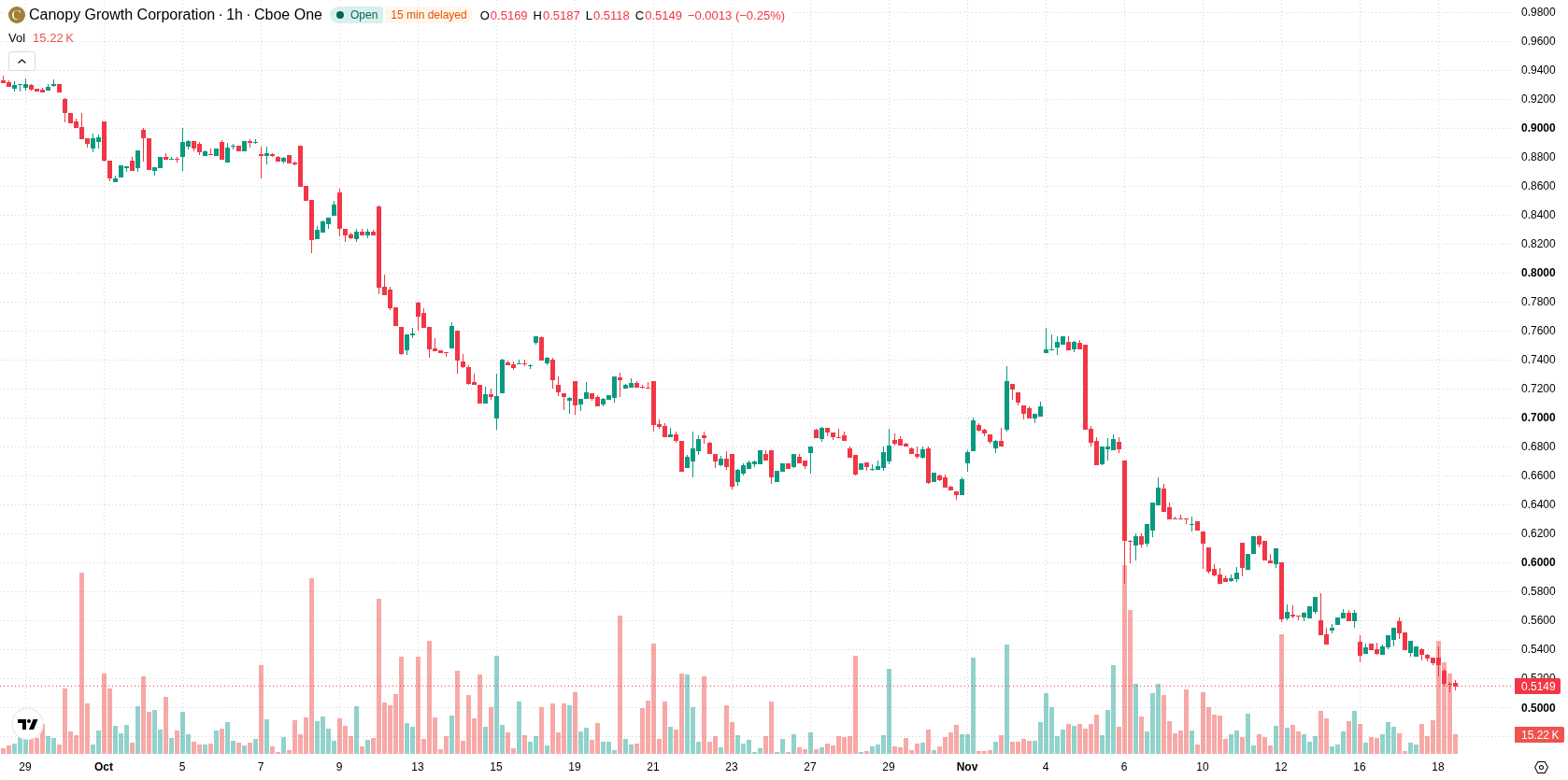
Canopy Growth (CGC) stock is trading at $0.5147 after falling 3% today. The price remains below its key moving averages, with ongoing volatility reflecting continued pressure on the asset.
 0.5071
0.5799
Highlights
- CGC/USD trades below all key moving averages, showing entrenched bearish momentum across multiple timeframes.
- MACD, ADX, and other oscillators confirm sustained selling with oversold readings, but no technical reversal is confirmed.
- Price is expected to range from $0.49 to $0.54 over the next 2 to 3 days, with a very high downside probability unless $0.55 resistance breaks.
Downside momentum persists as oversold signals lack reversal
On the technical side, the H1 SMA-20 stands at $0.54, H1 SMA-50 at $0.57, and the D1 SMA-200 at $0.97, with the price trading below all three levels. The Ichimoku Kijun is set at $0.55, serving as immediate resistance. MACD and ADX both indicate selling momentum, while RSI, Stochastic RSI, and CCI remain in oversold zones, reflecting selling exhaustion and the potential for a rebound but not a confirmed reversal. Bull/Bear Power is marginally negative at -0.01, maintaining seller dominance intraday, and the Awesome Oscillator confirms the prevailing selling trend.
Downside risk prevails as bullish recovery hinges on resistance reclaim
Looking ahead, the expected price range over the next 2–3 trading days is between $0.49 and $0.54. The probability of an upward move is classified as very low, with downside risk remaining very high. The main scenario sees consolidation within this volatility band, with a bullish shift only probable if resistance at $0.55 is reclaimed. A significant bearish scenario could unfold if support at $0.49 is breached.
Earlier, analysts noted that Canopy Growth was facing ongoing downside pressure with a prevailing bearish outlook. The current technical setup reinforces this view, highlighting the importance of the $0.49 support as the key level for traders to monitor amid heightened downside risk.






Latest Canopy Growth News



-
 Afghanistan
-
 Albania
-
 Algeria
-
 Angola
-
 Argentina
-
 Armenia
-
 Australia
-
 Austria
-
 Azerbaijan
-
 Bahamas
-
 Bahrain
-
 Bangladesh
-
 Belarus
-
 Belgium
-
 Bolivia
-
 Botswana
-
 Brazil
-
 Brunei
-
 Bulgaria
-
 Cambodia
-
 Cameroon
-
 Canada
-
 Chile
-
 China
-
 Colombia
-
 Congo
-
 Costa Rica
-
 Cote d'Ivoire
-
 Croatia
-
 Cuba
-
 Cyprus
-
 Czechia
-
 DR Congo
-
 Denmark
-
 Dominican Republic
-
 Ecuador
-
 Egypt
-
 El Salvador
-
 Estonia
-
 Eswatini
-
 Ethiopia
-
 Finland
-
 France
-
 Georgia
-
 Germany
-
 Ghana
-
 Greece
-
 Haiti
-
 Hong Kong
-
 Hungary
-
 India
-
 Indonesia
-
 Iran, Islamic republic
-
 Iraq
-
 Ireland
-
 Israel
-
 Italy
-
 Jamaica
-
 Japan
-
 Jordan
-
 Kazakhstan
-
 Kenya
-
 Korea
-
 Kuwait
-
 Kyrgyzstan
-
 Laos
-
 Latvia
-
 Lebanon
-
 Lesotho
-
 Libya
-
 Lithuania
-
 Luxembourg
-
 Madagascar
-
 Malaysia
-
 Malta
-
 Mauritius
-
 Mexico
-
 Moldova
-
 Mongolia
-
 Montenegro
-
 Morocco
-
 Mozambique
-
 Myanmar
-
 Namibia
-
 Nepal
-
 Netherlands
-
 New Zealand
-
 Nigeria
-
 North Macedonia
-
 Norway
-
 Oman
-
 Pakistan
-
 Palestine
-
 Panama
-
 Papua New Guinea
-
 Paraguay
-
 Peru
-
 Philippines
-
 Poland
-
 Portugal
-
 Puerto Rico
-
 Qatar
-
 Reunion
-
 Romania
-
 Rwanda
-
 Saudi Arabia
-
 Serbia
-
 Singapore
-
 Slovakia
-
 Slovenia
-
 Somalia
-
 South Africa
-
 Spain
-
 Sri Lanka
-
 Sweden
-
 Switzerland
-
 Syria
-
 Taiwan
-
 Tajikistan
-
 Tanzania
-
 Thailand
-
 Trinidad and Tobago
-
 Tunisia
-
 Turkey
-
 UAE
-
 Uganda
-
 Ukraine
-
 United Kingdom
-
United States
-
 Uruguay
-
 Uzbekistan
-
 Venezuela
-
 Vietnam
-
 Yemen
-
 Zambia
-
 Zimbabwe
- Forex
- Crypto












