

Can Microsoft maintain its competitive AI position amid potential U.S. import restrictions on key hardware?

Microsoft (MSFT) stock is trading lower as of November 19, 2026, amid concerns over potential supply chain disruptions affecting its AI infrastructure expansion. The main risk driver is the U.S. government's consideration of a ban on Chinese-made optical transceivers, to which Microsoft has warned of significant operational exposure. Traders are watching for further signals regarding U.S. trade policy changes that could affect MSFT's access to crucial hardware components.
 526.28
527.95
Highlights
- Microsoft warns that a potential U.S. ban on Chinese-made optical transceivers could disrupt AI infrastructure expansion in the U.S.
- Supply chain risk from possible trade restrictions may cause delays or higher costs for Microsoft AI deployments, with operational impact depending on regulatory outcomes.
- Microsoft stock trades below major short-term resistance and technical signals indicate downside risk, with key support around $443 and resistance near $520.
MSFT highlights supply risk from U.S. China trade discussions
According to Investing.com, on November 10, 2026, Microsoft publicly cautioned that a proposed U.S. ban on imports of Chinese-manufactured optical transceivers could put at risk the expansion of artificial intelligence infrastructure in the United States, endangering its ability to remain competitive in domestic AI development.
This warning highlights a direct supply chain risk, as optical transceivers are essential hardware components for building out advanced AI infrastructure. If the U.S. moves forward with restrictive trade measures, MSFT could face delays or higher costs for critical technology inputs, which may impede new AI deployments onshore.
The situation presents an unresolved operational challenge for MSFT, with future regulatory decisions and implementation specifics determining the eventual impact. No additional company-specific counterweights or mitigating factors have been disclosed alongside this warning.
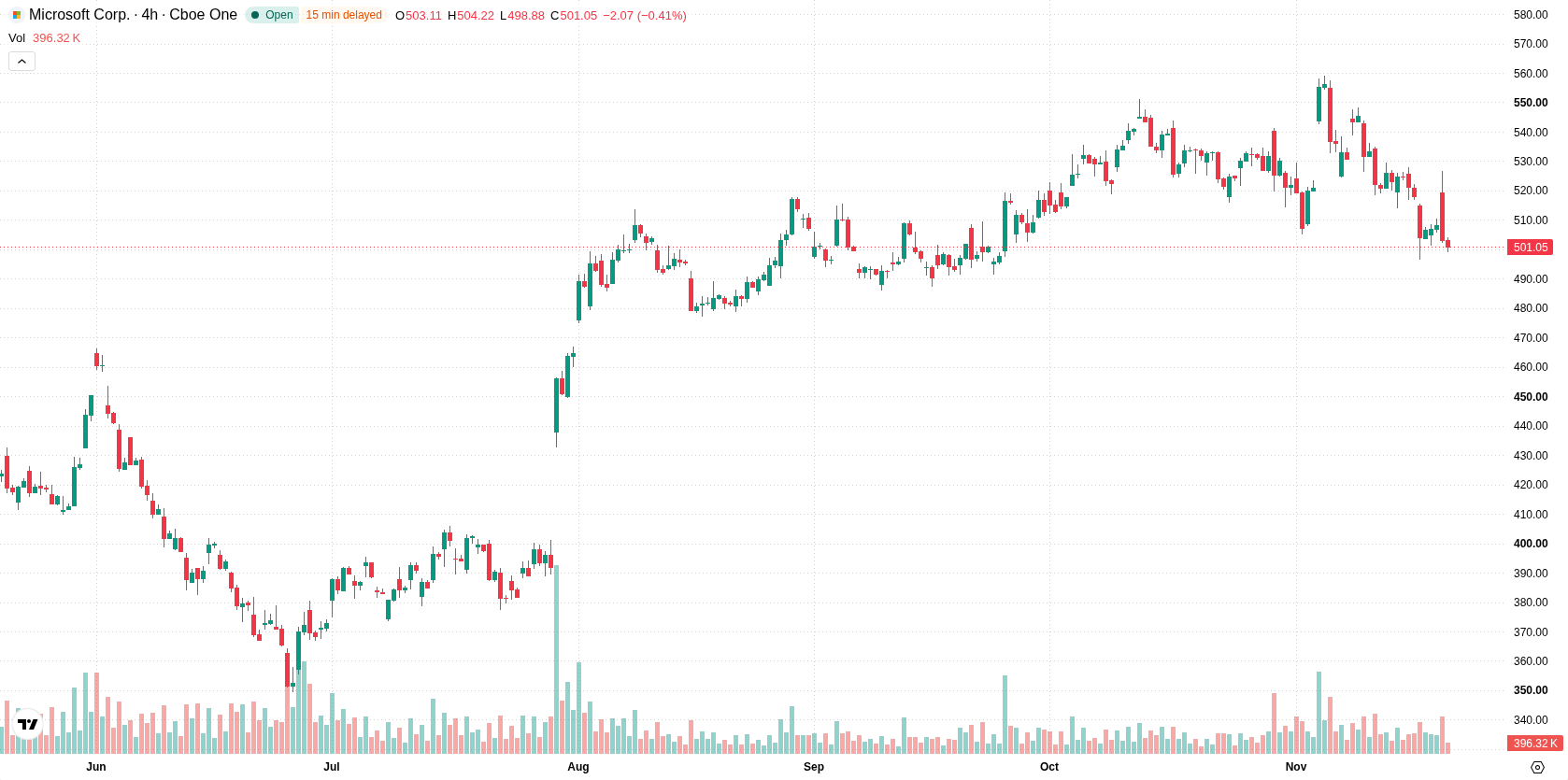
Supply risk continues to weigh; price under main resistance
On the technical side, the 4H chart reflects ongoing macro uncertainty linked to supply chain risks. The price is currently below the D1 SMA-50 at $520.01 and above the D1 SMA-200 at $442.73, with the 4H SMA-20 at $524.1 also acting as overhead resistance.
Momentum signals are weak, as both MACD and ADX indicate sell conditions, and the price is trading below the H4 Ichimoku Kijun resistance at $527.83. This leaves the technical picture tilted toward further downside unless external risk factors ease or support levels hold.
Policy clarity and key support zone to guide next move
Supply chain risk from potential U.S. trade restrictions remains the main external threat for MSFT, until clarity emerges from policymakers. Key support is seen around $443, while resistance to any recovery appears near $520. A confirmed shift in trade posture or a break back above resistance could signal a more stable outlook.
Previously it was reported that Microsoft and NVIDIA expanded their partnership to enhance enterprise AI infrastructure through broader hardware and software integration across cloud and local environments. The renewed supply chain risk from possible U.S. restrictions on Chinese optical transceivers adds a significant operational uncertainty to these expansion plans, with the immediate outlook hinging on future developments in U.S. trade policy.










-
 Afghanistan
-
 Albania
-
 Algeria
-
 Angola
-
 Argentina
-
 Armenia
-
 Australia
-
 Austria
-
 Azerbaijan
-
 Bahamas
-
 Bahrain
-
 Bangladesh
-
 Belarus
-
 Belgium
-
 Bolivia
-
 Botswana
-
 Brazil
-
 Brunei
-
 Bulgaria
-
 Cambodia
-
 Cameroon
-
 Canada
-
 Chile
-
 China
-
 Colombia
-
 Congo
-
 Costa Rica
-
 Cote d'Ivoire
-
 Croatia
-
 Cuba
-
 Cyprus
-
 Czechia
-
 DR Congo
-
 Denmark
-
 Dominican Republic
-
 Ecuador
-
 Egypt
-
 El Salvador
-
 Estonia
-
 Eswatini
-
 Ethiopia
-
 Finland
-
 France
-
 Georgia
-
 Germany
-
 Ghana
-
 Greece
-
 Haiti
-
 Hong Kong
-
 Hungary
-
 India
-
 Indonesia
-
 Iran, Islamic republic
-
 Iraq
-
 Ireland
-
 Israel
-
 Italy
-
 Jamaica
-
 Japan
-
 Jordan
-
 Kazakhstan
-
 Kenya
-
 Korea
-
 Kuwait
-
 Kyrgyzstan
-
 Laos
-
 Latvia
-
 Lebanon
-
 Lesotho
-
 Libya
-
 Lithuania
-
 Luxembourg
-
 Madagascar
-
 Malaysia
-
 Malta
-
 Mauritius
-
 Mexico
-
 Moldova
-
 Mongolia
-
 Montenegro
-
 Morocco
-
 Mozambique
-
 Myanmar
-
 Namibia
-
 Nepal
-
 Netherlands
-
 New Zealand
-
 Nigeria
-
 North Macedonia
-
 Norway
-
 Oman
-
 Pakistan
-
 Palestine
-
 Panama
-
 Papua New Guinea
-
 Paraguay
-
 Peru
-
 Philippines
-
 Poland
-
 Portugal
-
 Puerto Rico
-
 Qatar
-
 Reunion
-
 Romania
-
 Rwanda
-
 Saudi Arabia
-
 Serbia
-
 Singapore
-
 Slovakia
-
 Slovenia
-
 Somalia
-
 South Africa
-
 Spain
-
 Sri Lanka
-
 Sweden
-
 Switzerland
-
 Syria
-
 Taiwan
-
 Tajikistan
-
 Tanzania
-
 Thailand
-
 Trinidad and Tobago
-
 Tunisia
-
 Turkey
-
 UAE
-
 Uganda
-
 Ukraine
-
 United Kingdom
-
United States
-
 Uruguay
-
 Uzbekistan
-
 Venezuela
-
 Vietnam
-
 Yemen
-
 Zambia
-
 Zimbabwe
- Forex
- Crypto












