

Nvidia shares fall with China’s countermeasure threat raising risks for Asia market access

Nvidia (NVDA) stock is trading lower at $145, down 3.95% as of November 19, 2026. The decline follows renewed geopolitical tensions after China threatened countermeasures in response to U.S. draft rules tightening semiconductor export controls. Investors are monitoring for further policy escalations that could directly affect Nvidia's access to Asian markets and its global supply chain.
 158.12
166.45
Highlights
- China opposes new U.S. semiconductor export curbs and threatens countermeasures, introducing risk to Nvidia's Asia operations and supply chain.
- Risks to Nvidia's Asian market access are material but do not amount to a total loss of regional business.
- Nvidia stock trades below key moving averages with technicals indicating sustained bearish momentum and downside risk unless it reclaims resistance near 179.
China threatens countermeasures over U.S. chip export controls
According to CNBC, on November 17, 2026, China strongly opposed recent U.S. draft regulations tightening export controls on advanced semiconductors and threatened to take countermeasures, warning of potential disruption to global supply chains.
This escalation introduces the risk of retaliatory actions by China that could disrupt Nvidia's manufacturing, logistics, or regional partnerships, potentially reducing the company's access to the Asian semiconductor market. Such disruptions may translate into headwinds for Nvidia's growth in upcoming quarters.
However, CNBC also noted that while these geopolitical headwinds are expected to produce challenges for Nvidia's growth, the company's presence in the Asia market will not be entirely eliminated. The impact is thus seen as a material risk rather than a complete loss of Asian business channels.
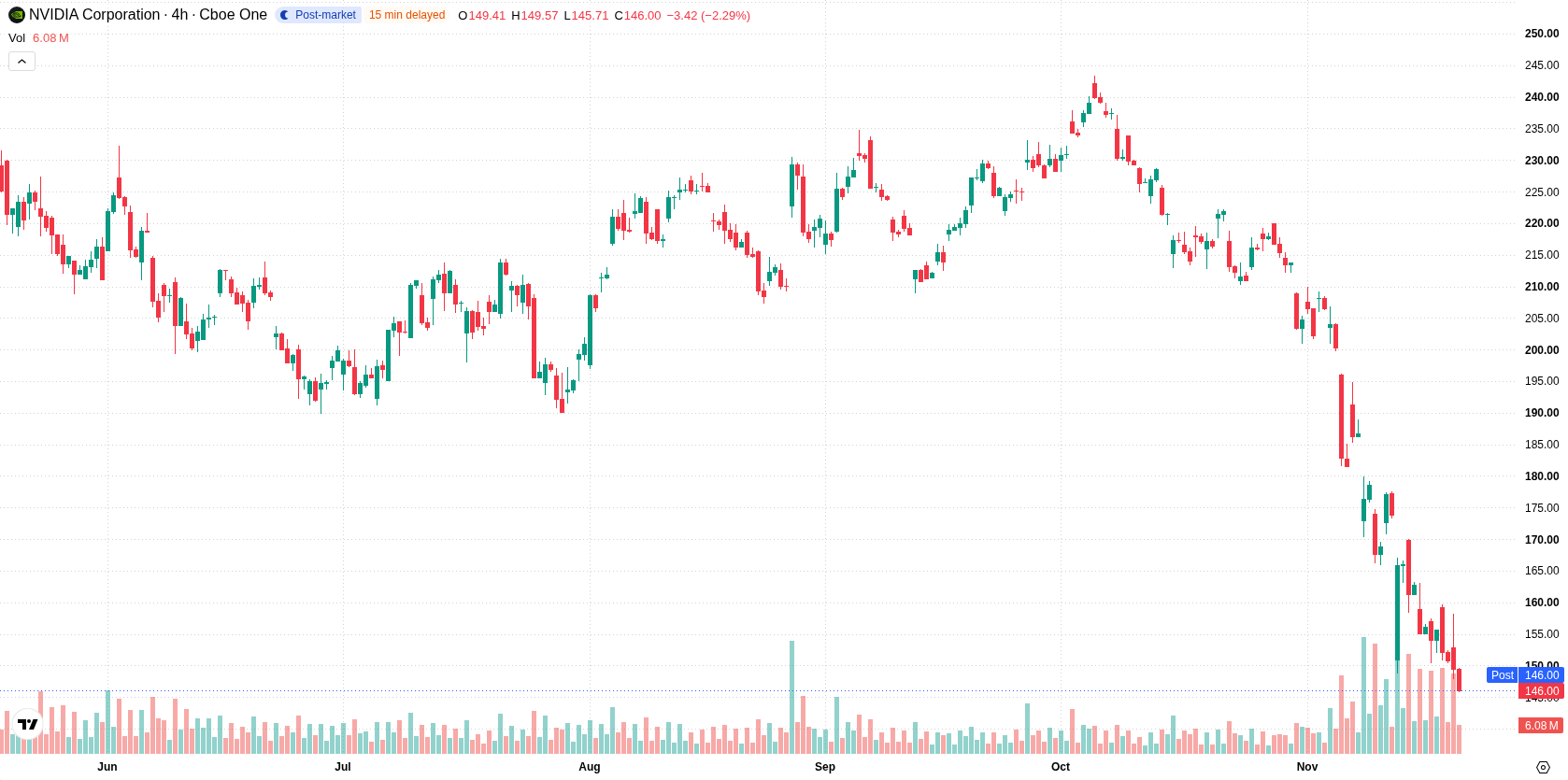
Bearish momentum with key moving averages overhead
On the technical front, the stock remains below the D1 SMA-50 at $210.33 and the D1 SMA-200 at $203.71, indicating ongoing bearish pressure aligned with the current macro risk. Its 4H SMA-20 at $166.71 is also above the last traded level, supporting a negative near-term momentum.
Momentum readings reinforce this view, with a strong sell signal from MACD and a sell forecast from ADX. The H4 Kijun at $178.97 stands as an immediate resistance level for any recovery attempts.
Further Chinese retaliatory measures remain the main external risk
Nvidia's outlook hinges on further developments in U.S.-China policy, with particular focus on any enacted Chinese countermeasures that could further strain its supply chain or market access. Continued pressure below the H4 Kijun around $179 would signal sustained downside risk. Stabilization may only emerge if new retaliatory actions are avoided and the stock reclaims resistance above that zone.
Previously it was reported that Nvidia faced a subpoena from the California Attorney General regarding its chip sales to China as part of heightened scrutiny over export compliance. The current escalation in U.S.-China semiconductor tensions adds a new layer of risk to the company's outlook, with the prospect of further Chinese countermeasures now the key macro factor to monitor for any shift in Nvidia’s Asia market access and supply chain stability.






Latest NVIDIA News




-
 Afghanistan
-
 Albania
-
 Algeria
-
 Angola
-
 Argentina
-
 Armenia
-
 Australia
-
 Austria
-
 Azerbaijan
-
 Bahamas
-
 Bahrain
-
 Bangladesh
-
 Belarus
-
 Belgium
-
 Bolivia
-
 Botswana
-
 Brazil
-
 Brunei
-
 Bulgaria
-
 Cambodia
-
 Cameroon
-
 Canada
-
 Chile
-
 China
-
 Colombia
-
 Congo
-
 Costa Rica
-
 Cote d'Ivoire
-
 Croatia
-
 Cuba
-
 Cyprus
-
 Czechia
-
 DR Congo
-
 Denmark
-
 Dominican Republic
-
 Ecuador
-
 Egypt
-
 El Salvador
-
 Estonia
-
 Eswatini
-
 Ethiopia
-
 Finland
-
 France
-
 Georgia
-
 Germany
-
 Ghana
-
 Greece
-
 Haiti
-
 Hong Kong
-
 Hungary
-
 India
-
 Indonesia
-
 Iran, Islamic republic
-
 Iraq
-
 Ireland
-
 Israel
-
 Italy
-
 Jamaica
-
 Japan
-
 Jordan
-
 Kazakhstan
-
 Kenya
-
 Korea
-
 Kuwait
-
 Kyrgyzstan
-
 Laos
-
 Latvia
-
 Lebanon
-
 Lesotho
-
 Libya
-
 Lithuania
-
 Luxembourg
-
 Madagascar
-
 Malaysia
-
 Malta
-
 Mauritius
-
 Mexico
-
 Moldova
-
 Mongolia
-
 Montenegro
-
 Morocco
-
 Mozambique
-
 Myanmar
-
 Namibia
-
 Nepal
-
 Netherlands
-
 New Zealand
-
 Nigeria
-
 North Macedonia
-
 Norway
-
 Oman
-
 Pakistan
-
 Palestine
-
 Panama
-
 Papua New Guinea
-
 Paraguay
-
 Peru
-
 Philippines
-
 Poland
-
 Portugal
-
 Puerto Rico
-
 Qatar
-
 Reunion
-
 Romania
-
 Rwanda
-
 Saudi Arabia
-
 Serbia
-
 Singapore
-
 Slovakia
-
 Slovenia
-
 Somalia
-
 South Africa
-
 Spain
-
 Sri Lanka
-
 Sweden
-
 Switzerland
-
 Syria
-
 Taiwan
-
 Tajikistan
-
 Tanzania
-
 Thailand
-
 Trinidad and Tobago
-
 Tunisia
-
 Turkey
-
 UAE
-
 Uganda
-
 Ukraine
-
 United Kingdom
-
United States
-
 Uruguay
-
 Uzbekistan
-
 Venezuela
-
 Vietnam
-
 Yemen
-
 Zambia
-
 Zimbabwe
- Forex
- Crypto












