

Upcoming bond issuance may deepen funding and leverage worries for SPCX investors

SPCX (SPCX) stock is trading at $138.43 and moved lower on November 19, 2026, with a daily loss of 3.51%. Investor attention is focused on the impacts of a recently announced bond sale, as the company seeks financing for a large-scale AI computing expansion.
 132.10
147.29
Highlights
- SpaceX plans a $4 billion bond sale as part of a $40 billion financing round to expand its artificial intelligence computing business.
- The bond issuance is expected to increase SpaceX's funding costs and leverage, potentially affecting risk assessments for the stock.
- Price action remains below key moving averages on weak momentum, with $134 as critical support and $148 as resistance.
SPCX bond sale announcement and funding channel risk
According to Yahoo Finance, SpaceX (SPCX) was reported on November 17, 2026, to be planning a $4 billion bond sale as part of a broader $40 billion financing package aimed at expanding its artificial intelligence computing business.
This capital raise is expected to increase SPCX's overall funding costs and leverage, which could alter the company's balance sheet profile. As a result, investor expectations and risk assessments for SPCX stock may shift in response to the scale and execution of the planned bond sale.
The effectiveness and investor demand for the bond issuance will be key factors in determining how funding conditions and credit risk expectations evolve for SPCX. Broader market sentiment toward technology sector debt may further influence the stock's short-term direction.
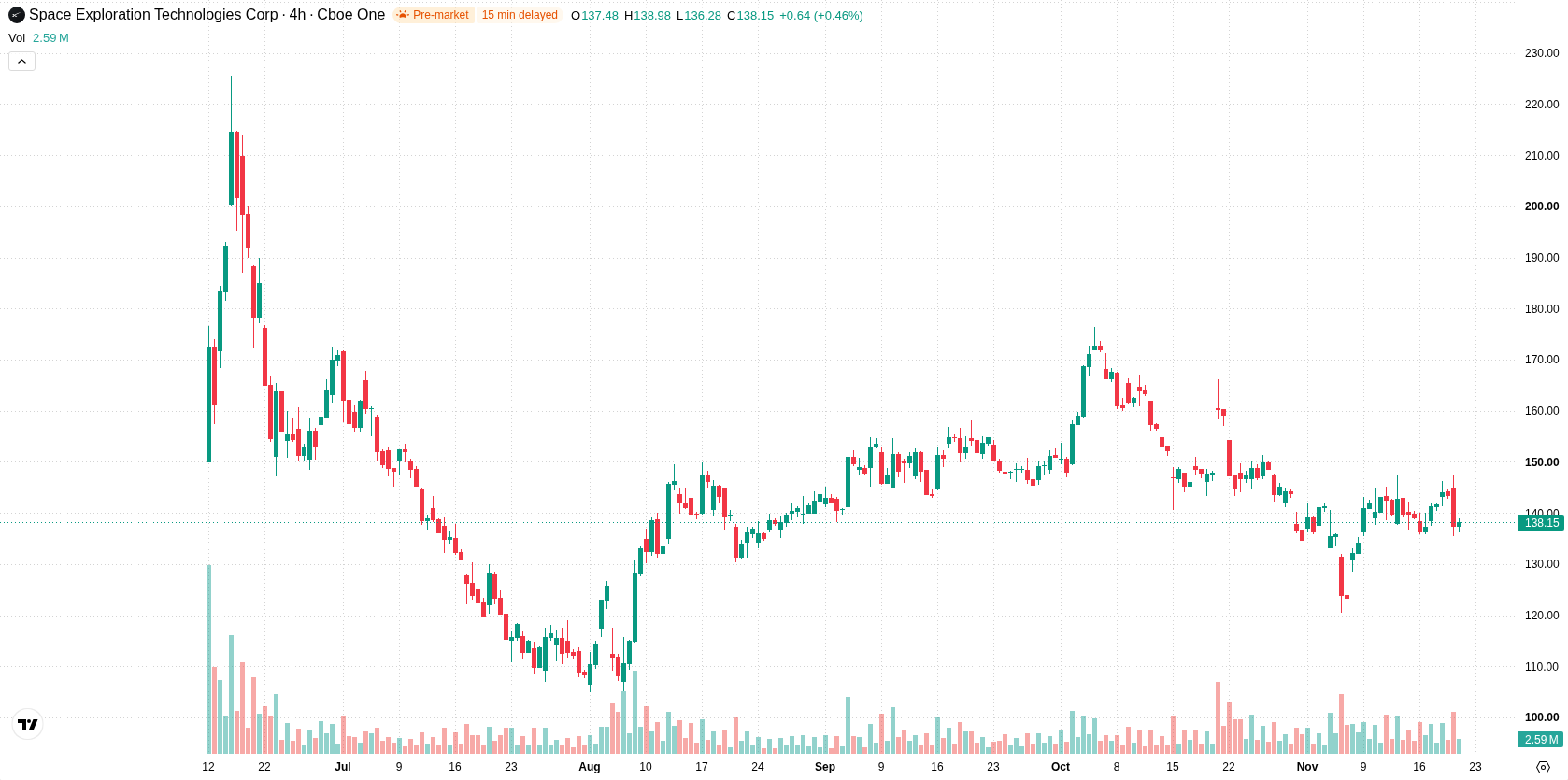
Ongoing technical weakness below major moving averages
On the 4H chart, price action has remained below both the D1 SMA-50 at $148.15 and the H4 SMA-20 at $139.9, signaling ongoing technical weakness after the macro announcement. With the H4 Kijun level at $134 acting as a local support, traders are watching for signs of stabilization or renewed selling around this zone.
The MACD currently reads -0.18 with a strong sell forecast, while the ADX at 10.63 suggests neutral trend strength with low conviction. These mixed signals, alongside price holding above the H4 Kijun, indicate that momentum is negative but not decisively trending.
Bond sale execution to drive support or risk scenario
The key external risk remains the execution and reception of the proposed $4 billion bond sale. A break below support at $134 could signal further downside as funding risk worsens, while holding this level may attract buyers seeking a technical base. Resistance can be expected near $148, with confirmation required before any more constructive outlook emerges.
Previously it was reported that SpaceX secured significant financing through a large bond sale to fund its expansion into artificial intelligence computing infrastructure. The current article adds that the execution and market reception of the newly announced $4 billion bond issuance will be a decisive factor for SPCX's funding conditions, with attention centered on how this impacts credit risk and the company's ability to maintain key technical support levels.











-
 Afghanistan
-
 Albania
-
 Algeria
-
 Angola
-
 Argentina
-
 Armenia
-
 Australia
-
 Austria
-
 Azerbaijan
-
 Bahamas
-
 Bahrain
-
 Bangladesh
-
 Belarus
-
 Belgium
-
 Bolivia
-
 Botswana
-
 Brazil
-
 Brunei
-
 Bulgaria
-
 Cambodia
-
 Cameroon
-
 Canada
-
 Chile
-
 China
-
 Colombia
-
 Congo
-
 Costa Rica
-
 Cote d'Ivoire
-
 Croatia
-
 Cuba
-
 Cyprus
-
 Czechia
-
 DR Congo
-
 Denmark
-
 Dominican Republic
-
 Ecuador
-
 Egypt
-
 El Salvador
-
 Estonia
-
 Eswatini
-
 Ethiopia
-
 Finland
-
 France
-
 Georgia
-
 Germany
-
 Ghana
-
 Greece
-
 Haiti
-
 Hong Kong
-
 Hungary
-
 India
-
 Indonesia
-
 Iran, Islamic republic
-
 Iraq
-
 Ireland
-
 Israel
-
 Italy
-
 Jamaica
-
 Japan
-
 Jordan
-
 Kazakhstan
-
 Kenya
-
 Korea
-
 Kuwait
-
 Kyrgyzstan
-
 Laos
-
 Latvia
-
 Lebanon
-
 Lesotho
-
 Libya
-
 Lithuania
-
 Luxembourg
-
 Madagascar
-
 Malaysia
-
 Malta
-
 Mauritius
-
 Mexico
-
 Moldova
-
 Mongolia
-
 Montenegro
-
 Morocco
-
 Mozambique
-
 Myanmar
-
 Namibia
-
 Nepal
-
 Netherlands
-
 New Zealand
-
 Nigeria
-
 North Macedonia
-
 Norway
-
 Oman
-
 Pakistan
-
 Palestine
-
 Panama
-
 Papua New Guinea
-
 Paraguay
-
 Peru
-
 Philippines
-
 Poland
-
 Portugal
-
 Puerto Rico
-
 Qatar
-
 Reunion
-
 Romania
-
 Rwanda
-
 Saudi Arabia
-
 Serbia
-
 Singapore
-
 Slovakia
-
 Slovenia
-
 Somalia
-
 South Africa
-
 Spain
-
 Sri Lanka
-
 Sweden
-
 Switzerland
-
 Syria
-
 Taiwan
-
 Tajikistan
-
 Tanzania
-
 Thailand
-
 Trinidad and Tobago
-
 Tunisia
-
 Turkey
-
 UAE
-
 Uganda
-
 Ukraine
-
 United Kingdom
-
United States
-
 Uruguay
-
 Uzbekistan
-
 Venezuela
-
 Vietnam
-
 Yemen
-
 Zambia
-
 Zimbabwe
- Forex
- Crypto












