

Nvidia drops after warning on regulatory risks amid tighter U.S. export controls affecting China business

Nvidia (NVDA) stock is trading lower, last quoted at $128.01 as of November 20, 2026, down 12.31% on the day. The stock is reacting to renewed regulatory risks tied to U.S. export controls. Markets are watching for further U.S. measures that could restrict Nvidia's business with China.
 143.72
163.00
Highlights
- Nvidia warned customers of legal risks in supplying AI chip access to China due to tighter U.S. export controls.
- Stricter U.S. rules could restrict Nvidia sales of advanced chips in China, raising compliance burdens and revenue risk.
- Nvidia stock trades below key moving averages with pronounced bearish momentum and downside risk prevailing under ongoing regulatory uncertainty.
U.S. export controls drive renewed regulatory risk for Nvidia
According to CNBC, on November 17, 2026, Nvidia warned its customers about potential legal risks linked to providing artificial intelligence chip access to China as the U.S. Commerce Department moved to tighten export controls.
Stricter U.S. export controls could limit Nvidia's ability to sell advanced chips to China, exposing both the company and its customers to increased compliance challenges and potentially reducing revenue from the Chinese market.
Any escalation in regulatory enforcement could further strain Nvidia's business exposure in the region and heighten operational risks for its partners.
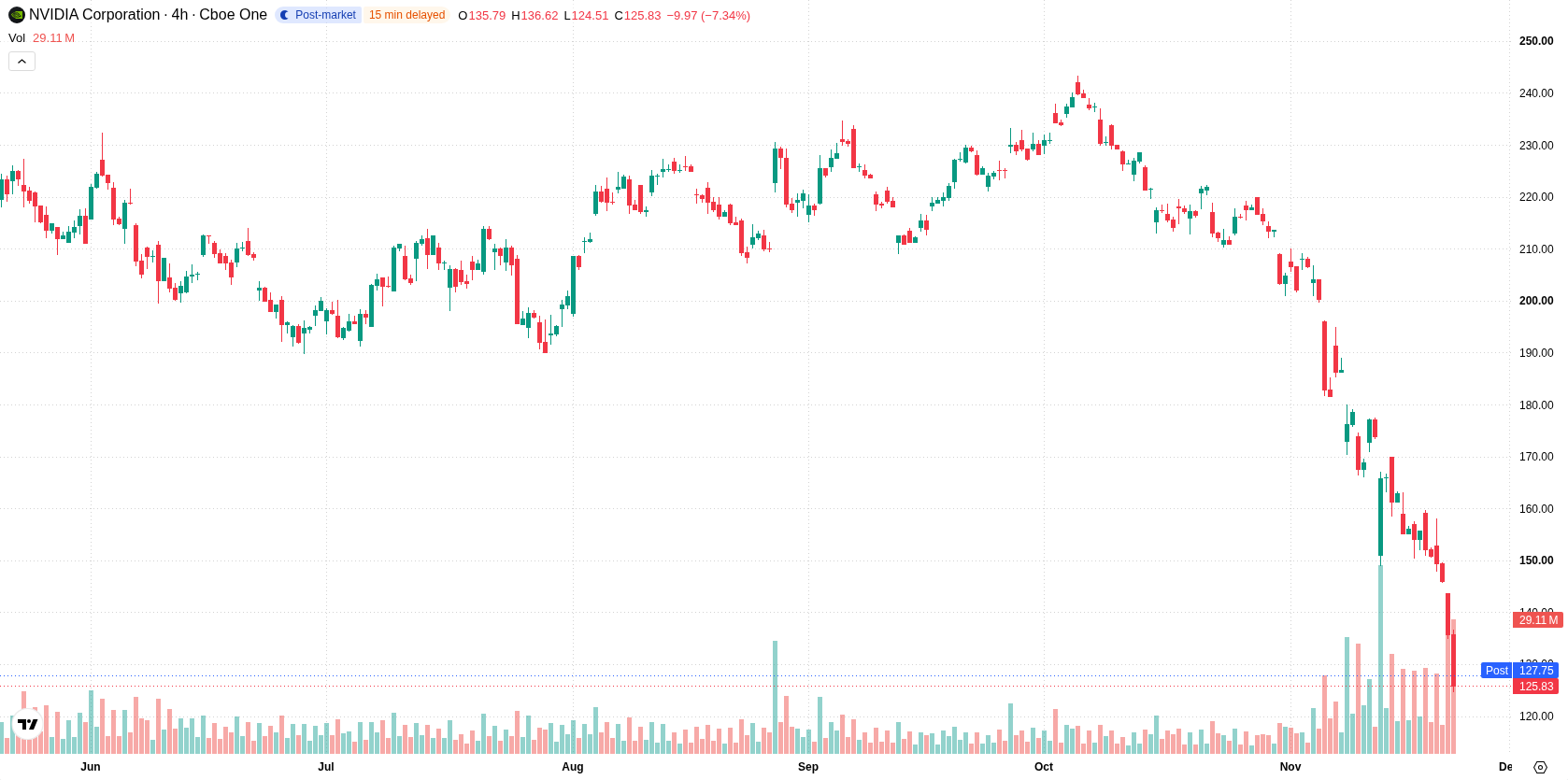
Price holds below major D1 averages after export news
The 4H chart shows price remains well below the D1 SMA-50 at $208.95 and D1 SMA-200 at $203.59, signaling continued bearish momentum following the policy-driven risk event.
With the RSI in a deeply oversold zone, short-term downward pressure is pronounced, and both MACD and ADX reinforce the prevailing selling signal. The H4 Kijun acts as a resistance around $169.
Export risk persists; $169 resistance is key for stabilization
External risk remains elevated in the face of U.S. export control uncertainty. A move above resistance around $169 would be needed to suggest stabilization. Until then, downside risk prevails if regulatory restrictions continue.
Previously it was reported that Nvidia faced heightened legal and regulatory scrutiny, including a U.S. SEC investigation into its accounting practices and broader probes related to export-control violations. The current environment reinforces these risks, as escalating U.S. export controls on AI chips to China serve as the central factor investors should monitor for any potential shift in Nvidia’s outlook.










-
 Afghanistan
-
 Albania
-
 Algeria
-
 Angola
-
 Argentina
-
 Armenia
-
 Australia
-
 Austria
-
 Azerbaijan
-
 Bahamas
-
 Bahrain
-
 Bangladesh
-
 Belarus
-
 Belgium
-
 Bolivia
-
 Botswana
-
 Brazil
-
 Brunei
-
 Bulgaria
-
 Cambodia
-
 Cameroon
-
 Canada
-
 Chile
-
 China
-
 Colombia
-
 Congo
-
 Costa Rica
-
 Cote d'Ivoire
-
 Croatia
-
 Cuba
-
 Cyprus
-
 Czechia
-
 DR Congo
-
 Denmark
-
 Dominican Republic
-
 Ecuador
-
 Egypt
-
 El Salvador
-
 Estonia
-
 Eswatini
-
 Ethiopia
-
 Finland
-
 France
-
 Georgia
-
 Germany
-
 Ghana
-
 Greece
-
 Haiti
-
 Hong Kong
-
 Hungary
-
 India
-
 Indonesia
-
 Iran, Islamic republic
-
 Iraq
-
 Ireland
-
 Israel
-
 Italy
-
 Jamaica
-
 Japan
-
 Jordan
-
 Kazakhstan
-
 Kenya
-
 Korea
-
 Kuwait
-
 Kyrgyzstan
-
 Laos
-
 Latvia
-
 Lebanon
-
 Lesotho
-
 Libya
-
 Lithuania
-
 Luxembourg
-
 Madagascar
-
 Malaysia
-
 Malta
-
 Mauritius
-
 Mexico
-
 Moldova
-
 Mongolia
-
 Montenegro
-
 Morocco
-
 Mozambique
-
 Myanmar
-
 Namibia
-
 Nepal
-
 Netherlands
-
 New Zealand
-
 Nigeria
-
 North Macedonia
-
 Norway
-
 Oman
-
 Pakistan
-
 Palestine
-
 Panama
-
 Papua New Guinea
-
 Paraguay
-
 Peru
-
 Philippines
-
 Poland
-
 Portugal
-
 Puerto Rico
-
 Qatar
-
 Reunion
-
 Romania
-
 Rwanda
-
 Saudi Arabia
-
 Serbia
-
 Singapore
-
 Slovakia
-
 Slovenia
-
 Somalia
-
 South Africa
-
 Spain
-
 Sri Lanka
-
 Sweden
-
 Switzerland
-
 Syria
-
 Taiwan
-
 Tajikistan
-
 Tanzania
-
 Thailand
-
 Trinidad and Tobago
-
 Tunisia
-
 Turkey
-
 UAE
-
 Uganda
-
 Ukraine
-
 United Kingdom
-
United States
-
 Uruguay
-
 Uzbekistan
-
 Venezuela
-
 Vietnam
-
 Yemen
-
 Zambia
-
 Zimbabwe
- Forex
- Crypto












