

S&P 500 technical analysis: Seller pressure intensifies as index remains under key resistance

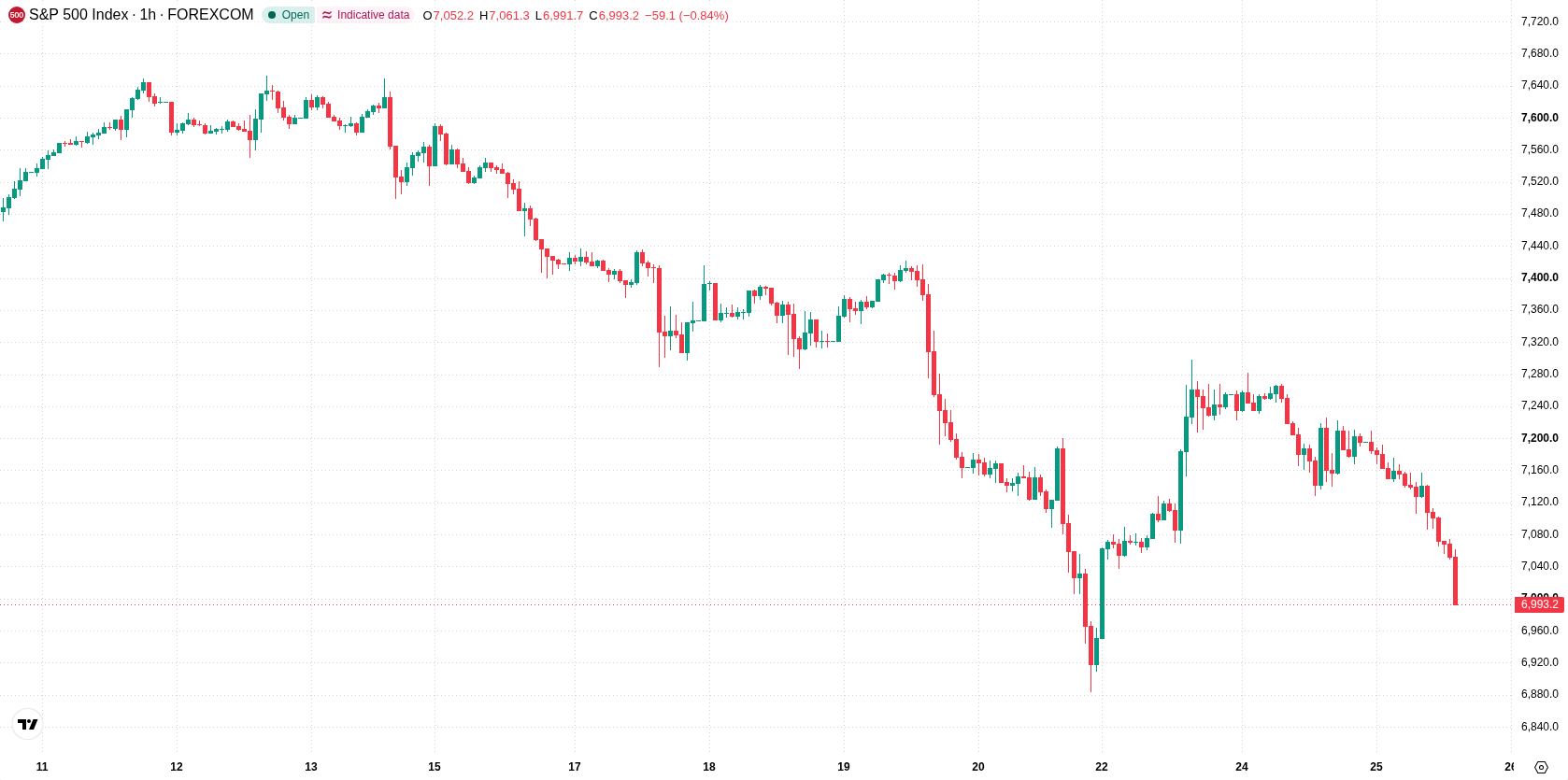
S&P 500 (SPX) is trading at 7,010, marking a daily decline of 2.65%. The index remains below its key short-, medium-, and long-term moving averages, indicating ongoing seller pressure.
 7222.92
7415.64
Highlights
- J.P. Morgan identifies that a merger between SpaceX and Tesla could make SpaceX eligible for S&P 500 inclusion, triggering an estimated 10% free float passive inflow.
- The S&P Dow Jones index committee may waive eligibility rules in this case, potentially allowing faster inclusion and increased liquidity for SpaceX.
- SPX/USD closed at 7,010, down 2.65%, with technical indicators showing dominant sell momentum and a projected range of 6,891 to 7,203.
Potential index inflow as merger could prompt forced buying
J.P. Morgan outlined that a possible merger between SpaceX and Tesla could make SpaceX eligible for inclusion in the S&P 500, a move that would trigger passive buying of about 10% of its free float according to Rallies. Such an event would introduce a significant mechanical inflow into the index from passive funds, with index-fund buying potentially equal to 10% of SpaceX’s publicly tradable shares. J.P. Morgan further noted the S&P Dow Jones index committee could potentially waive some eligibility rules in this scenario, leading to earlier inclusion and greater liquidity effects, though price action has remained under broader selling pressure.
Mixed oscillator signals as sell momentum confronts overbought reading
Technically, SPX is trading below the H1 SMA-20 at 7,147, the H1 SMA-50 at 7,264, and the D1 SMA-200 at 7,351, confirming seller strength across multiple timeframes. The immediate resistance is defined by the Ichimoku Kijun at 7,108. MACD and ADX both indicate strong sell momentum, while the RSI and CCI remain neutral and the Stochastic RSI is currently overbought, pointing toward potential short-term overheating. Bull/Bear Power is positive at 15.5, signaling marginal buyer presence, but overall the technical signals are mixed due to conflicting readings from the oscillators and trend indicators.
Rangebound trading likely as upside breakout faces resistance
In the coming sessions, SPX is expected to trade within a volatility band of 6,891 to 7,203. There is a 32% probability of an upside reversal, while downside continuation remains more likely at 68%. The most probable outcome is that the index trades rangebound unless it breaks above immediate resistance at 7,108, which could spark a rally. Conversely, a move below the 6,891 support would increase the risk of further declines.
Earlier, analysts noted that persistent inflation pressures and new trade tariffs were weighing on U.S. equity markets, with concerns mounting over the financial viability of large-scale AI investments. The current technical setup for the S&P 500 reinforces this negative backdrop, but an early upside reversal could be triggered if the index decisively reclaims the 7,108 resistance, making this level a critical pivot to monitor in upcoming sessions.










-
 Afghanistan
-
 Albania
-
 Algeria
-
 Angola
-
 Argentina
-
 Armenia
-
 Australia
-
 Austria
-
 Azerbaijan
-
 Bahamas
-
 Bahrain
-
 Bangladesh
-
 Belarus
-
 Belgium
-
 Bolivia
-
 Botswana
-
 Brazil
-
 Brunei
-
 Bulgaria
-
 Cambodia
-
 Cameroon
-
 Canada
-
 Chile
-
 China
-
 Colombia
-
 Congo
-
 Costa Rica
-
 Cote d'Ivoire
-
 Croatia
-
 Cuba
-
 Cyprus
-
 Czechia
-
 DR Congo
-
 Denmark
-
 Dominican Republic
-
 Ecuador
-
 Egypt
-
 El Salvador
-
 Estonia
-
 Eswatini
-
 Ethiopia
-
 Finland
-
 France
-
 Georgia
-
 Germany
-
 Ghana
-
 Greece
-
 Haiti
-
 Hong Kong
-
 Hungary
-
 India
-
 Indonesia
-
 Iran, Islamic republic
-
 Iraq
-
 Ireland
-
 Israel
-
 Italy
-
 Jamaica
-
 Japan
-
 Jordan
-
 Kazakhstan
-
 Kenya
-
 Korea
-
 Kuwait
-
 Kyrgyzstan
-
 Laos
-
 Latvia
-
 Lebanon
-
 Lesotho
-
 Libya
-
 Lithuania
-
 Luxembourg
-
 Madagascar
-
 Malaysia
-
 Malta
-
 Mauritius
-
 Mexico
-
 Moldova
-
 Mongolia
-
 Montenegro
-
 Morocco
-
 Mozambique
-
 Myanmar
-
 Namibia
-
 Nepal
-
 Netherlands
-
 New Zealand
-
 Nigeria
-
 North Macedonia
-
 Norway
-
 Oman
-
 Pakistan
-
 Palestine
-
 Panama
-
 Papua New Guinea
-
 Paraguay
-
 Peru
-
 Philippines
-
 Poland
-
 Portugal
-
 Puerto Rico
-
 Qatar
-
 Reunion
-
 Romania
-
 Rwanda
-
 Saudi Arabia
-
 Serbia
-
 Singapore
-
 Slovakia
-
 Slovenia
-
 Somalia
-
 South Africa
-
 Spain
-
 Sri Lanka
-
 Sweden
-
 Switzerland
-
 Syria
-
 Taiwan
-
 Tajikistan
-
 Tanzania
-
 Thailand
-
 Trinidad and Tobago
-
 Tunisia
-
 Turkey
-
 UAE
-
 Uganda
-
 Ukraine
-
 United Kingdom
-
United States
-
 Uruguay
-
 Uzbekistan
-
 Venezuela
-
 Vietnam
-
 Yemen
-
 Zambia
-
 Zimbabwe
- Forex
- Crypto












