

Denison Mines shares drop almost 6% after ongoing cost challenges and persistent downside pressure

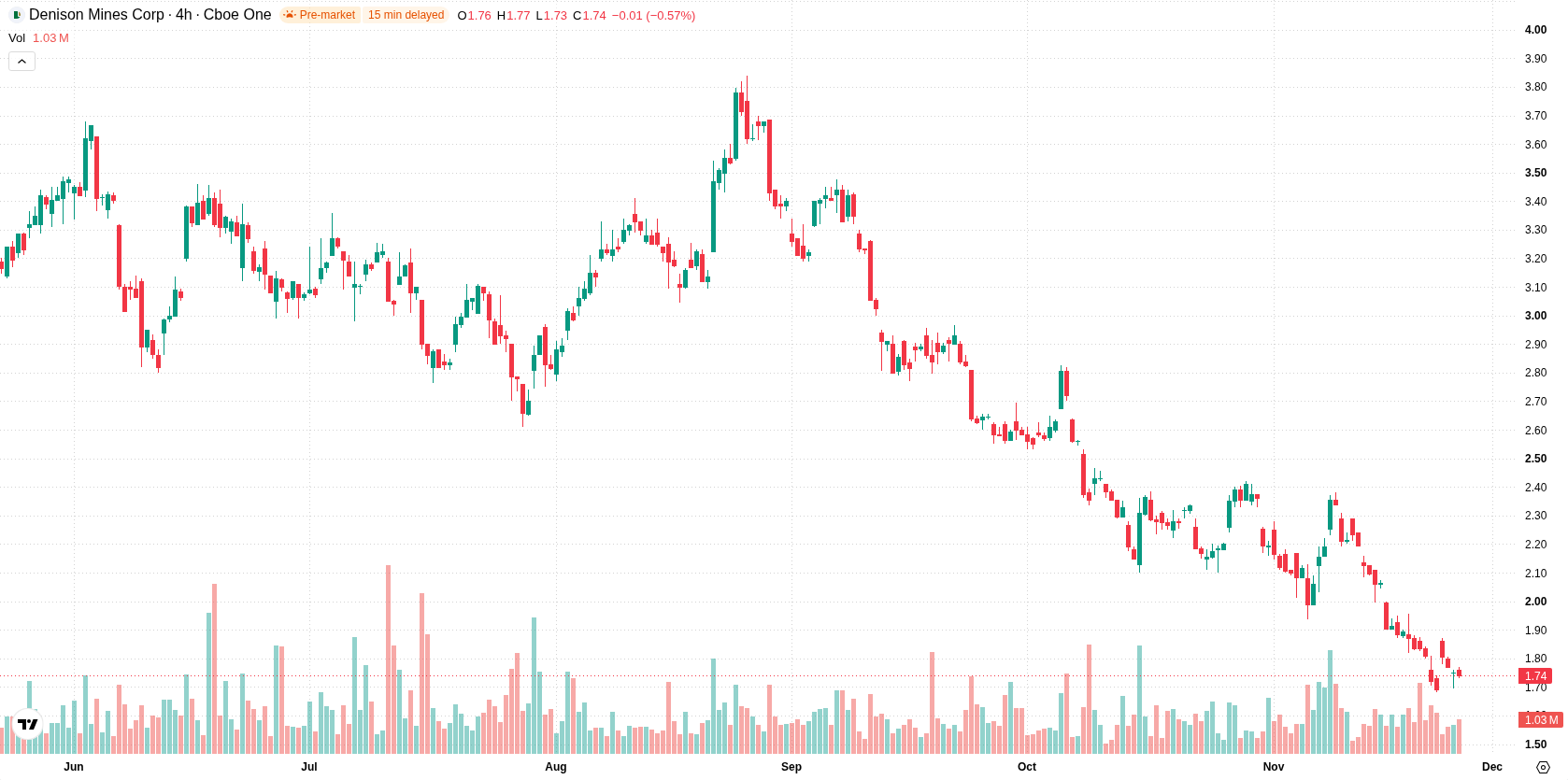
Denison Mines Corp (DNN) dropped 5.63% as ongoing project cost challenges and persistent technical weakness fueled renewed selling pressure. The decline is reinforced by the stock's position below key moving averages, indicating that downside momentum is supported across all timeframes.
 1.77
1.88
Highlights
- Denison Mines stock is under strong selling pressure due to persistent project cost issues and ongoing technical weakness.
- No recent regulatory or corporate actions have been announced related to Denison Mines.
- The stock trades below major moving averages, dropped 5.63% to $1.64, and is forecast to fluctuate between $1.54 and $1.8 with a high probability of further downside.
Sustained downside risk mounts amid strong multi-horizon selling pressure
Denison Mines has been under strong short-term and long-term selling pressure, facing persistent challenges related to project costs and broader technical weakness. There have been no reported regulatory or corporate actions. Recent developments continue to reflect heightened downside risk for the company.
Bearish momentum confirmed as moving averages and indicators reinforce lows
Denison Mines is trading below its 20-, 50-, and 200-day moving averages, with key levels at $2.06, $2.33, and $3.17, indicating sustained seller pressure across all timeframes. The MA-50 versus MA-200 alignment remains bearish, with a near-term resistance at $1.68 and downside support at $1.54. Momentum indicators highlight a weak technical structure: both MACD and Average Directional Index (ADX) demonstrate ongoing selling pressure, and the Commodity Channel Index (CCI) is in the oversold zone. The Relative Strength Index (RSI) and Stochastic RSI remain neutral, while sellers dominate intraday momentum based on negative Bull/Bear Power (BBP). Price action remains near the session low, and volatility stands at 4.73%.
Previously it was reported that Denison Mines faced heightened downside risk due to ongoing project cost challenges and technical weakness. The current analysis reinforces this view, highlighting the importance of monitoring $1.54 as a critical support level should selling pressure intensify further in coming sessions.






Latest Denison Mines News




-
 Afghanistan
-
 Albania
-
 Algeria
-
 Angola
-
 Argentina
-
 Armenia
-
 Australia
-
 Austria
-
 Azerbaijan
-
 Bahamas
-
 Bahrain
-
 Bangladesh
-
 Belarus
-
 Belgium
-
 Bolivia
-
 Botswana
-
 Brazil
-
 Brunei
-
 Bulgaria
-
 Cambodia
-
 Cameroon
-
 Canada
-
 Chile
-
 China
-
 Colombia
-
 Congo
-
 Costa Rica
-
 Cote d'Ivoire
-
 Croatia
-
 Cuba
-
 Cyprus
-
 Czechia
-
 DR Congo
-
 Denmark
-
 Dominican Republic
-
 Ecuador
-
 Egypt
-
 El Salvador
-
 Estonia
-
 Eswatini
-
 Ethiopia
-
 Finland
-
 France
-
 Georgia
-
 Germany
-
 Ghana
-
 Greece
-
 Haiti
-
 Hong Kong
-
 Hungary
-
 India
-
 Indonesia
-
 Iran, Islamic republic
-
 Iraq
-
 Ireland
-
 Israel
-
 Italy
-
 Jamaica
-
 Japan
-
 Jordan
-
 Kazakhstan
-
 Kenya
-
 Korea
-
 Kuwait
-
 Kyrgyzstan
-
 Laos
-
 Latvia
-
 Lebanon
-
 Lesotho
-
 Libya
-
 Lithuania
-
 Luxembourg
-
 Madagascar
-
 Malaysia
-
 Malta
-
 Mauritius
-
 Mexico
-
 Moldova
-
 Mongolia
-
 Montenegro
-
 Morocco
-
 Mozambique
-
 Myanmar
-
 Namibia
-
 Nepal
-
 Netherlands
-
 New Zealand
-
 Nigeria
-
 North Macedonia
-
 Norway
-
 Oman
-
 Pakistan
-
 Palestine
-
 Panama
-
 Papua New Guinea
-
 Paraguay
-
 Peru
-
 Philippines
-
 Poland
-
 Portugal
-
 Puerto Rico
-
 Qatar
-
 Reunion
-
 Romania
-
 Rwanda
-
 Saudi Arabia
-
 Serbia
-
 Singapore
-
 Slovakia
-
 Slovenia
-
 Somalia
-
 South Africa
-
 Spain
-
 Sri Lanka
-
 Sweden
-
 Switzerland
-
 Syria
-
 Taiwan
-
 Tajikistan
-
 Tanzania
-
 Thailand
-
 Trinidad and Tobago
-
 Tunisia
-
 Turkey
-
 UAE
-
 Uganda
-
 Ukraine
-
 United Kingdom
-
United States
-
 Uruguay
-
 Uzbekistan
-
 Venezuela
-
 Vietnam
-
 Yemen
-
 Zambia
-
 Zimbabwe
- Forex
- Crypto












