

Buyback timing supports Rolls-Royce but renewed airline volatility may limit gains

Rolls-Royce (RR) stock is trading lower, with the daily direction down as of November 25, 2026. Investors are gauging the impact of the company's recently accelerated share buyback and steady profit guidance, watching for implications for future capital returns. The next significant review of company targets is scheduled for February.
 1304.60
1362.80
Highlights
- Rolls-Royce accelerates a £1.5 billion share buyback and maintains its 2026 profit guidance with a target review set for February.
- Management advances the buyback to improve capital returns, but ongoing risks from global aviation demand may affect outcomes.
- Rolls-Royce stock trades below key moving averages with mixed technical signals and near-term resistance at GBX1,321, indicating possible continued consolidation.
Accelerated share buyback and profit guidance reaffirmed
According to Intelligencereport, on November 12, 2026, Rolls-Royce accelerated a £1.5 billion share buyback and reaffirmed its 2026 profit guidance, noting that an additional target review is expected in February.
The decision to bring forward the buyback signals management's confidence in profitability, and such actions can directly reduce share float, improving capital returns and influencing expectations of shareholder value. This type of corporate move often serves as an indicator of positive internal outlook, though it does not guarantee immediate market gains.
While the announcement supports a positive view of the company's capital allocation, broader market volatility and risks linked to global aviation demand can limit or offset the impact of buyback-driven sentiment. These factors remain relevant ahead of the company’s forthcoming review period.
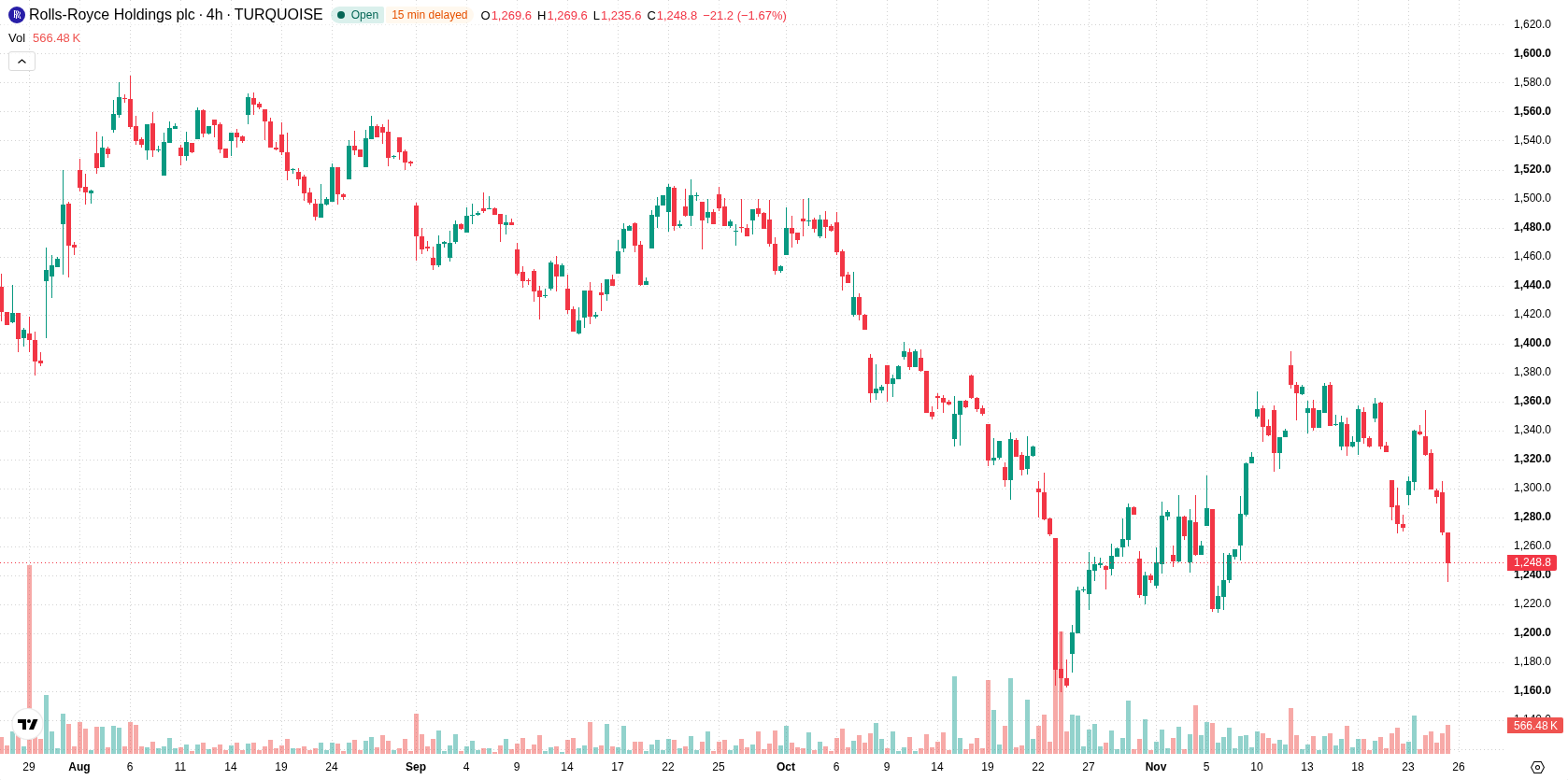
RR stock capped below key moving averages and resistance
On the technical side, the overall D1 chart remains bullish, but RR stock is trading below its D1 SMA-50 at GBX1,360 and D1 SMA-200 at GBX1,341, pointing to possible ongoing consolidation and limited upward momentum. The H4 SMA-20 at GBX1,321 currently acts as a cap on short-term rallies.
MACD on the 4H chart issues a sell reading, while ADX stays neutral, resulting in mixed signals for short-term direction. The Kijun on H4, located at GBX1,321, confirms this resistance in the near-term outlook.
External aviation demand risk and GBX1,321 resistance key for direction
Looking ahead, market attention remains on the February company review and how global aviation trends may affect further capital returns. Should RR stock move decisively above resistance around GBX1,321, this would signal possible renewed momentum. Conversely, failure to reclaim this level would keep downside risks in focus. Broader sentiment will depend on both corporate actions and industry conditions.
Earlier, analysts noted that Rolls-Royce's shares continued to show weakness despite government support and increased buyback plans, as broader technical and macroeconomic risks weighed on the outlook. The current analysis adds a new dimension by highlighting the importance of February's company review and global aviation demand as key drivers for the next move in capital returns and share performance.










-
 Afghanistan
-
 Albania
-
 Algeria
-
 Angola
-
 Argentina
-
 Armenia
-
 Australia
-
 Austria
-
 Azerbaijan
-
 Bahamas
-
 Bahrain
-
 Bangladesh
-
 Belarus
-
 Belgium
-
 Bolivia
-
 Botswana
-
 Brazil
-
 Brunei
-
 Bulgaria
-
 Cambodia
-
 Cameroon
-
 Canada
-
 Chile
-
 China
-
 Colombia
-
 Congo
-
 Costa Rica
-
 Cote d'Ivoire
-
 Croatia
-
 Cuba
-
 Cyprus
-
 Czechia
-
 DR Congo
-
 Denmark
-
 Dominican Republic
-
 Ecuador
-
 Egypt
-
 El Salvador
-
 Estonia
-
 Eswatini
-
 Ethiopia
-
 Finland
-
 France
-
 Georgia
-
 Germany
-
 Ghana
-
 Greece
-
 Haiti
-
 Hong Kong
-
 Hungary
-
 India
-
 Indonesia
-
 Iran, Islamic republic
-
 Iraq
-
 Ireland
-
 Israel
-
 Italy
-
 Jamaica
-
 Japan
-
 Jordan
-
 Kazakhstan
-
 Kenya
-
 Korea
-
 Kuwait
-
 Kyrgyzstan
-
 Laos
-
 Latvia
-
 Lebanon
-
 Lesotho
-
 Libya
-
 Lithuania
-
 Luxembourg
-
 Madagascar
-
 Malaysia
-
 Malta
-
 Mauritius
-
 Mexico
-
 Moldova
-
 Mongolia
-
 Montenegro
-
 Morocco
-
 Mozambique
-
 Myanmar
-
 Namibia
-
 Nepal
-
 Netherlands
-
 New Zealand
-
 Nigeria
-
 North Macedonia
-
 Norway
-
 Oman
-
 Pakistan
-
 Palestine
-
 Panama
-
 Papua New Guinea
-
 Paraguay
-
 Peru
-
 Philippines
-
 Poland
-
 Portugal
-
 Puerto Rico
-
 Qatar
-
 Reunion
-
 Romania
-
 Rwanda
-
 Saudi Arabia
-
 Serbia
-
 Singapore
-
 Slovakia
-
 Slovenia
-
 Somalia
-
 South Africa
-
 Spain
-
 Sri Lanka
-
 Sweden
-
 Switzerland
-
 Syria
-
 Taiwan
-
 Tajikistan
-
 Tanzania
-
 Thailand
-
 Trinidad and Tobago
-
 Tunisia
-
 Turkey
-
 UAE
-
 Uganda
-
 Ukraine
-
 United Kingdom
-
United States
-
 Uruguay
-
 Uzbekistan
-
 Venezuela
-
 Vietnam
-
 Yemen
-
 Zambia
-
 Zimbabwe
- Forex
- Crypto












