


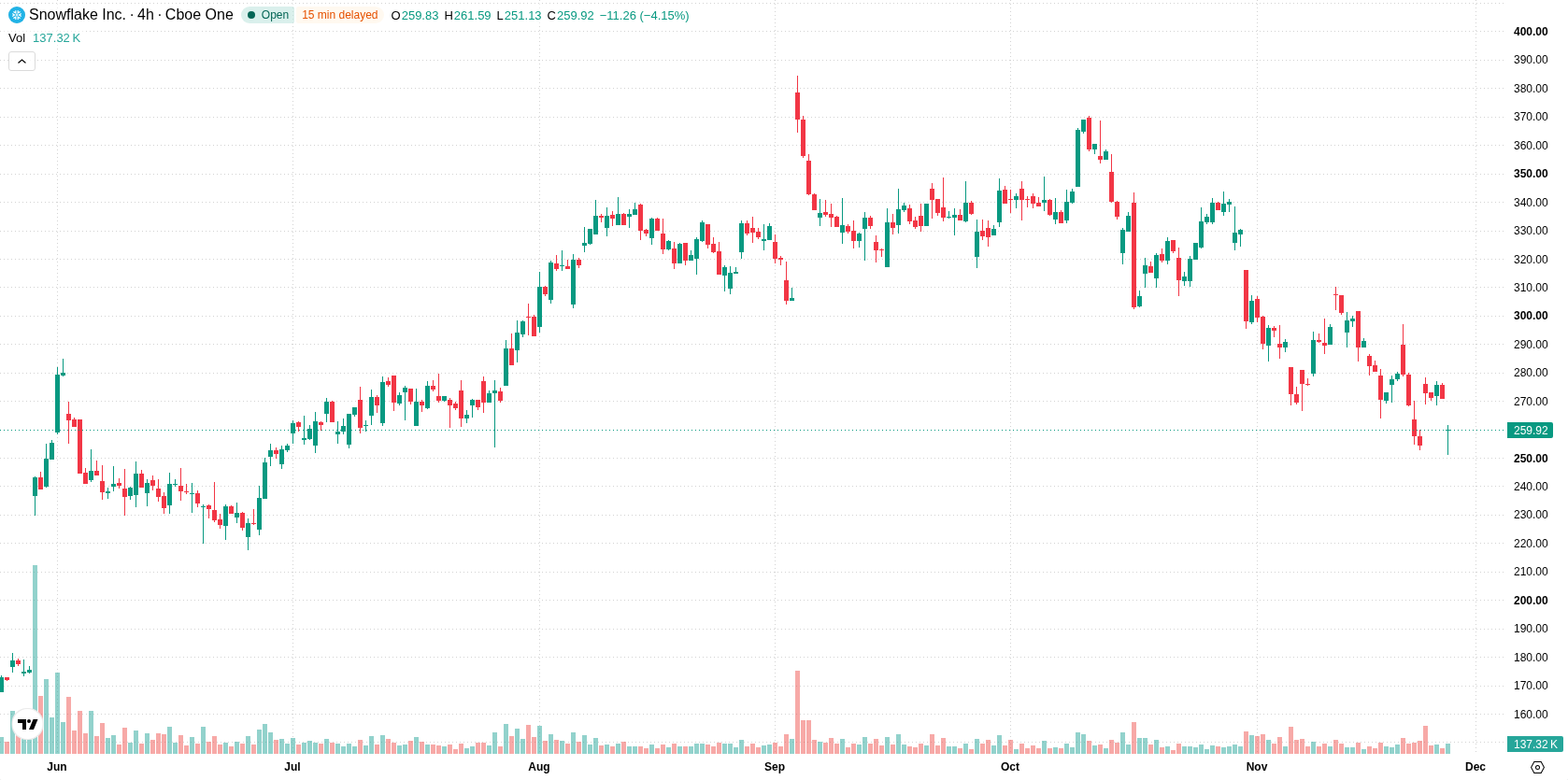
Snowflake Inc. (SNOW) fell 4.5% as sellers dominated the session, with continued negative momentum after the open. The move is supported by the stock trading below its 20-day and 50-day moving averages, signaling persistent selling pressure in the short and medium term.
 265.86
297.00
Highlights
- Snowflake reported 37% year-over-year product revenue growth for fiscal Q2 2027 and will publish Q3 results on December 2.
- The company expanded artificial intelligence offerings through marketplace integrations with Attentive and Jedify, enabling AI-powered business queries.
- Shares of Snowflake last traded at $258.98, under persistent selling pressure with indicators showing a strong likelihood of near-term downside and a projected $236.88 to $281.08 trading range.
AI integration, insider activity and fund inflows amid persistent price pressure
Snowflake has announced new artificial intelligence product integrations, partnering with Attentive and Jedify to launch Model Context Protocol connectors on its marketplace, enabling AI-powered business queries on company data. Management reported product revenue growth of 37% year-over-year for fiscal Q2 2027. The company will release its Q3 2027 earnings after market close on December 2. Recent insider activity included director Benoit Dageville selling 50,000 shares from The Snow Trust, while Bleakley Financial Group increased its holdings in Snowflake, though price action has remained under broader selling pressure.
Short-term weakness as technicals show bearish momentum and mixed signals
Snowflake remains below both the 20-day ($288.92) and 50-day ($316.52) moving averages, indicating ongoing short- and medium-term weakness. However, the stock is still trading above its 200-day moving average ($246.56), suggesting a bullish structure in the longer term, with the nearest resistance at $268.85 and support at $252.8. MACD and the Average Directional Index both point to a sell bias, while the RSI, Stochastic RSI, and CCI are currently neutral. Bull/Bear Power reveals that sellers are controlling intraday momentum, and volatility for the session stands at 2.90%. There are no confirmed divergences among the tracked indicators.
Earlier, analysts noted that Snowflake faced sustained selling pressure despite its ongoing product initiatives, with technical signals highlighting a broadly bearish short- and medium-term setup. The current analysis adds further weight to this assessment, with prevailing downside risk remaining elevated and a break below $236.88 now serving as confirmation of continued weakness.










-
 Afghanistan
-
 Albania
-
 Algeria
-
 Angola
-
 Argentina
-
 Armenia
-
 Australia
-
 Austria
-
 Azerbaijan
-
 Bahamas
-
 Bahrain
-
 Bangladesh
-
 Belarus
-
 Belgium
-
 Bolivia
-
 Botswana
-
 Brazil
-
 Brunei
-
 Bulgaria
-
 Cambodia
-
 Cameroon
-
 Canada
-
 Chile
-
 China
-
 Colombia
-
 Congo
-
 Costa Rica
-
 Cote d'Ivoire
-
 Croatia
-
 Cuba
-
 Cyprus
-
 Czechia
-
 DR Congo
-
 Denmark
-
 Dominican Republic
-
 Ecuador
-
 Egypt
-
 El Salvador
-
 Estonia
-
 Eswatini
-
 Ethiopia
-
 Finland
-
 France
-
 Georgia
-
 Germany
-
 Ghana
-
 Greece
-
 Haiti
-
 Hong Kong
-
 Hungary
-
 India
-
 Indonesia
-
 Iran, Islamic republic
-
 Iraq
-
 Ireland
-
 Israel
-
 Italy
-
 Jamaica
-
 Japan
-
 Jordan
-
 Kazakhstan
-
 Kenya
-
 Korea
-
 Kuwait
-
 Kyrgyzstan
-
 Laos
-
 Latvia
-
 Lebanon
-
 Lesotho
-
 Libya
-
 Lithuania
-
 Luxembourg
-
 Madagascar
-
 Malaysia
-
 Malta
-
 Mauritius
-
 Mexico
-
 Moldova
-
 Mongolia
-
 Montenegro
-
 Morocco
-
 Mozambique
-
 Myanmar
-
 Namibia
-
 Nepal
-
 Netherlands
-
 New Zealand
-
 Nigeria
-
 North Macedonia
-
 Norway
-
 Oman
-
 Pakistan
-
 Palestine
-
 Panama
-
 Papua New Guinea
-
 Paraguay
-
 Peru
-
 Philippines
-
 Poland
-
 Portugal
-
 Puerto Rico
-
 Qatar
-
 Reunion
-
 Romania
-
 Rwanda
-
 Saudi Arabia
-
 Serbia
-
 Singapore
-
 Slovakia
-
 Slovenia
-
 Somalia
-
 South Africa
-
 Spain
-
 Sri Lanka
-
 Sweden
-
 Switzerland
-
 Syria
-
 Taiwan
-
 Tajikistan
-
 Tanzania
-
 Thailand
-
 Trinidad and Tobago
-
 Tunisia
-
 Turkey
-
 UAE
-
 Uganda
-
 Ukraine
-
 United Kingdom
-
United States
-
 Uruguay
-
 Uzbekistan
-
 Venezuela
-
 Vietnam
-
 Yemen
-
 Zambia
-
 Zimbabwe
- Forex
- Crypto












