

Microsoft trades lower after heightened inflation fears, proposed tariffs and major cloud service disruption unsettle investors

Microsoft (MSFT) stock is trading lower as of November 25, 2026. A combination of higher U.S. inflation, newly proposed tariffs by President Trump, and a major outage in Microsoft’s cloud services has amplified market concerns about operational costs and reliability for technology firms. Investors are watching for new policy signals and actions from Microsoft on service resilience.
 490.18
526.49
Highlights
- Microsoft stock declined as investors reacted to higher U.S. inflation, new tariff proposals, and a major cloud service outage.
- Concerns grew over potential increases in operating costs, the effect of tariffs on profit margins, and heightened scrutiny of Microsoft’s AI and cloud investment pace.
- Technically, Microsoft stock trades below key moving averages and bearish indicators suggest further downside risk, with resistance near $515 and support at $444.
Inflation concerns and policy risks hit Microsoft shares
According to Benzinga, on November 25, 2026, Microsoft stock experienced a notable decline after investors reacted to rising U.S. inflation data, the announcement of proposed tariffs by President Trump, and an outage affecting Microsoft’s cloud infrastructure.
These developments increased unease over potential higher operating costs and the impact of tariffs on profit margins, while the cloud outage drew immediate attention to the reliability of Microsoft’s core cloud services.
Increased scrutiny of Microsoft’s AI investment pace and operational risks further contributed to negative sentiment, as the company’s vulnerability to geopolitical and regulatory pressures came under focus alongside the technical disruption.
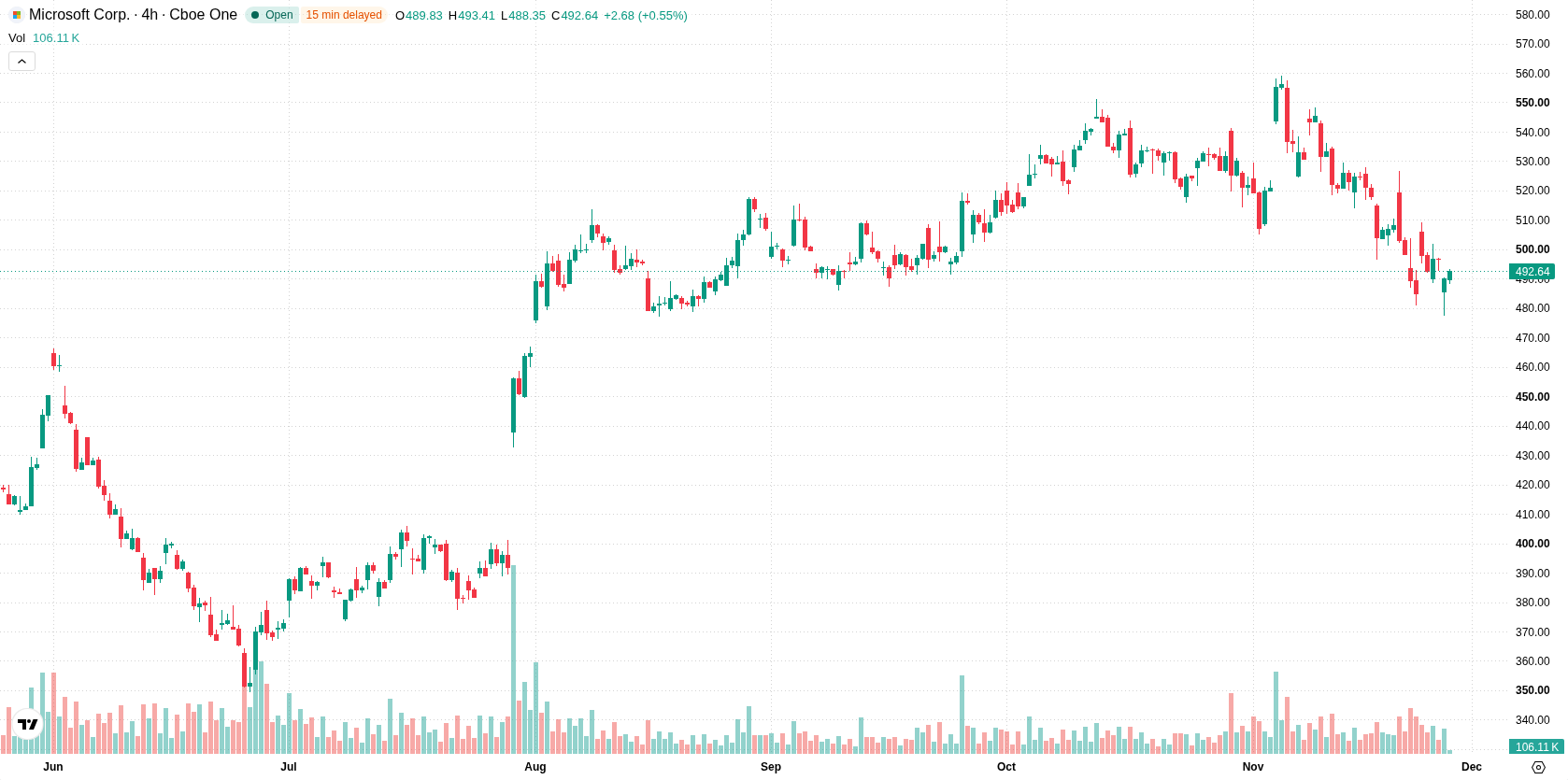
MSFT pressured below key averages amid bearish momentum
The macro-driven environment has put short-term pressure on the 4H chart, leaving MSFT trading below the D1 SMA-50 at $519.62 and below the H4 SMA-20 at $508.28. However, the price remains above the longer-term D1 SMA-200 at $444.47, suggesting that broader bullish momentum has not yet been fully reversed.
Technical readings show the MACD in bearish territory and the ADX projecting a sell signal, both consistent with recent downside momentum. The H4 Kijun at $514.66 is acting as near-term resistance, which could be significant if MSFT attempts a recovery.
Macro risks and service issues set trading range
MSFT remains exposed to further downside if U.S. inflation and tariff risks persist, or if the company does not address recent concerns regarding cloud service reliability. Immediate resistance is seen around $515, while support lies near $444. A decisive move above resistance may improve sentiment, but sustained pressure on operational costs and technical leadership could keep the stock within this volatility band.
Earlier, analysts noted growing investor concern over the reliability of Microsoft's cloud and enterprise services following major service outages and emerging security vulnerabilities. The latest developments reinforce these worries, as persistent inflation, tariff threats, and renewed questions around cloud resilience now position macroeconomic and operational factors as the critical drivers to watch for Microsoft’s next move.






Latest Microsoft News




-
 Afghanistan
-
 Albania
-
 Algeria
-
 Angola
-
 Argentina
-
 Armenia
-
 Australia
-
 Austria
-
 Azerbaijan
-
 Bahamas
-
 Bahrain
-
 Bangladesh
-
 Belarus
-
 Belgium
-
 Bolivia
-
 Botswana
-
 Brazil
-
 Brunei
-
 Bulgaria
-
 Cambodia
-
 Cameroon
-
 Canada
-
 Chile
-
 China
-
 Colombia
-
 Congo
-
 Costa Rica
-
 Cote d'Ivoire
-
 Croatia
-
 Cuba
-
 Cyprus
-
 Czechia
-
 DR Congo
-
 Denmark
-
 Dominican Republic
-
 Ecuador
-
 Egypt
-
 El Salvador
-
 Estonia
-
 Eswatini
-
 Ethiopia
-
 Finland
-
 France
-
 Georgia
-
 Germany
-
 Ghana
-
 Greece
-
 Haiti
-
 Hong Kong
-
 Hungary
-
 India
-
 Indonesia
-
 Iran, Islamic republic
-
 Iraq
-
 Ireland
-
 Israel
-
 Italy
-
 Jamaica
-
 Japan
-
 Jordan
-
 Kazakhstan
-
 Kenya
-
 Korea
-
 Kuwait
-
 Kyrgyzstan
-
 Laos
-
 Latvia
-
 Lebanon
-
 Lesotho
-
 Libya
-
 Lithuania
-
 Luxembourg
-
 Madagascar
-
 Malaysia
-
 Malta
-
 Mauritius
-
 Mexico
-
 Moldova
-
 Mongolia
-
 Montenegro
-
 Morocco
-
 Mozambique
-
 Myanmar
-
 Namibia
-
 Nepal
-
 Netherlands
-
 New Zealand
-
 Nigeria
-
 North Macedonia
-
 Norway
-
 Oman
-
 Pakistan
-
 Palestine
-
 Panama
-
 Papua New Guinea
-
 Paraguay
-
 Peru
-
 Philippines
-
 Poland
-
 Portugal
-
 Puerto Rico
-
 Qatar
-
 Reunion
-
 Romania
-
 Rwanda
-
 Saudi Arabia
-
 Serbia
-
 Singapore
-
 Slovakia
-
 Slovenia
-
 Somalia
-
 South Africa
-
 Spain
-
 Sri Lanka
-
 Sweden
-
 Switzerland
-
 Syria
-
 Taiwan
-
 Tajikistan
-
 Tanzania
-
 Thailand
-
 Trinidad and Tobago
-
 Tunisia
-
 Turkey
-
 UAE
-
 Uganda
-
 Ukraine
-
 United Kingdom
-
United States
-
 Uruguay
-
 Uzbekistan
-
 Venezuela
-
 Vietnam
-
 Yemen
-
 Zambia
-
 Zimbabwe
- Forex
- Crypto












