

Alphabet falls while renewed AI stock selling and tariff proposals rattle market sentiment

Alphabet (GOOGL) stock is trading lower, with selling pressure tied to macroeconomic and policy headwinds. Market participants are watching U.S. inflation, Federal Reserve moves, and the progress of proposed tariffs for further direction.
 271.48
295.43
Highlights
- Alphabet shares fell as AI-related stocks dropped with hotter inflation and increased expectations of a Federal Reserve rate hike.
- Proposed U.S. tariffs against 14 trading partners create new risks for global trade and Alphabet's future revenue outlook.
- GOOGL stock trades below key moving averages under persistent bearish pressure, with $284 acting as a significant short-term resistance.
Inflation, Fed policy, and proposed U.S. tariffs weigh on AI stocks
According to Benzinga, on November 25, 2026, shares of Alphabet fell as renewed selling hit AI-related stocks alongside higher inflation readings, increased expectations of a Federal Reserve interest rate hike, and the announcement of proposed new U.S. tariffs targeting 14 trading partners.
This combination of hotter inflation and shifting Fed policy increases borrowing costs and weighs on growth-oriented stocks such as GOOGL, while the prospect of new tariffs introduces risk of disruption to global trade and supply chains, adding uncertainty to the company's future revenue and profit outlook.
While the proposed tariffs have not yet been enacted, their potential scope and the current inflation environment have added to negative sentiment, compounding the impact of rising yields on technology equities.
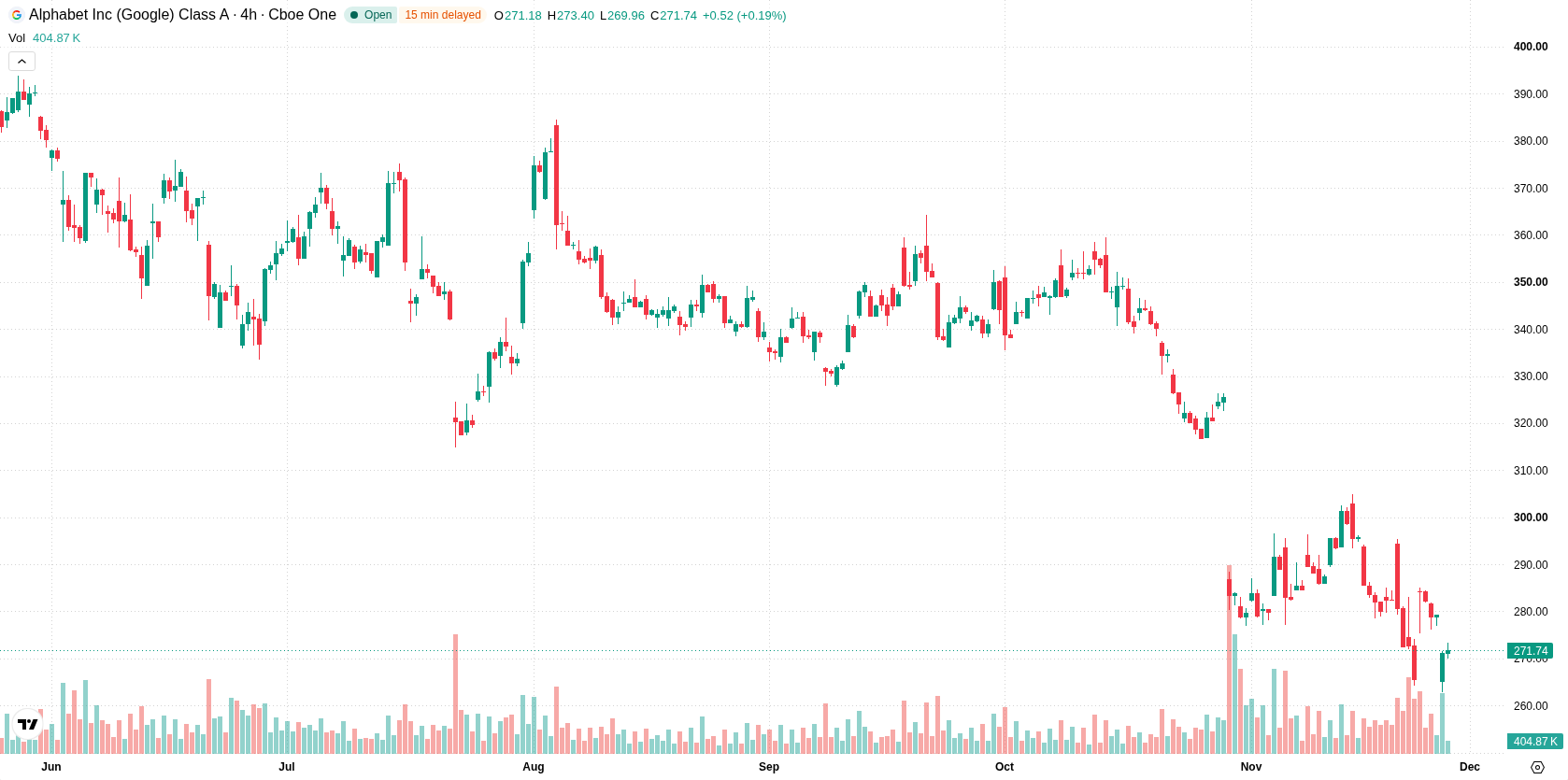
Bearish bias under key D1 averages and 4H resistance cluster
Technically, GOOGL remains under clear pressure, with price positioned below the D1 SMA-50 at $319.74 and the D1 SMA-200 at $336.54, reflecting a persistent bearish alignment amid broader macroeconomic headwinds. The H4 SMA-20 at $284.64 and the H4 Kijun at $284.6 are both positioned above the current price, reinforcing local resistance and limiting rebound attempts.
MACD readings indicate a strong sell condition, while ADX remains neutral, suggesting bearish momentum is dominant but trend strength has not sharply increased. The proximity of multiple moving averages and the Kijun around the $284 level highlights an upper barrier for any potential recovery.
External policy risks and $285 resistance dictate GOOGL's next move
Ongoing external risks from inflation, central bank policy, and trade measures remain decisive for GOOGL's next move. Should prices rebound toward resistance around $285, any failure to decisively break above this region would reinforce downside momentum. Conversely, stabilization above this band could change the short-term technical tone, but clarity on tariffs and monetary policy is needed before a sustained shift. Watch these macro catalysts closely for future direction.
Earlier, analysts noted that Alphabet remained under sustained downward pressure due to persistent regulatory and financial risks, particularly amid rising costs and global compliance challenges. The current article reinforces this view, highlighting that macroeconomic headwinds from inflation, Federal Reserve policy, and potential new tariffs remain the critical factors to monitor for Alphabet's next move.











-
 Afghanistan
-
 Albania
-
 Algeria
-
 Angola
-
 Argentina
-
 Armenia
-
 Australia
-
 Austria
-
 Azerbaijan
-
 Bahamas
-
 Bahrain
-
 Bangladesh
-
 Belarus
-
 Belgium
-
 Bolivia
-
 Botswana
-
 Brazil
-
 Brunei
-
 Bulgaria
-
 Cambodia
-
 Cameroon
-
 Canada
-
 Chile
-
 China
-
 Colombia
-
 Congo
-
 Costa Rica
-
 Cote d'Ivoire
-
 Croatia
-
 Cuba
-
 Cyprus
-
 Czechia
-
 DR Congo
-
 Denmark
-
 Dominican Republic
-
 Ecuador
-
 Egypt
-
 El Salvador
-
 Estonia
-
 Eswatini
-
 Ethiopia
-
 Finland
-
 France
-
 Georgia
-
 Germany
-
 Ghana
-
 Greece
-
 Haiti
-
 Hong Kong
-
 Hungary
-
 India
-
 Indonesia
-
 Iran, Islamic republic
-
 Iraq
-
 Ireland
-
 Israel
-
 Italy
-
 Jamaica
-
 Japan
-
 Jordan
-
 Kazakhstan
-
 Kenya
-
 Korea
-
 Kuwait
-
 Kyrgyzstan
-
 Laos
-
 Latvia
-
 Lebanon
-
 Lesotho
-
 Libya
-
 Lithuania
-
 Luxembourg
-
 Madagascar
-
 Malaysia
-
 Malta
-
 Mauritius
-
 Mexico
-
 Moldova
-
 Mongolia
-
 Montenegro
-
 Morocco
-
 Mozambique
-
 Myanmar
-
 Namibia
-
 Nepal
-
 Netherlands
-
 New Zealand
-
 Nigeria
-
 North Macedonia
-
 Norway
-
 Oman
-
 Pakistan
-
 Palestine
-
 Panama
-
 Papua New Guinea
-
 Paraguay
-
 Peru
-
 Philippines
-
 Poland
-
 Portugal
-
 Puerto Rico
-
 Qatar
-
 Reunion
-
 Romania
-
 Rwanda
-
 Saudi Arabia
-
 Serbia
-
 Singapore
-
 Slovakia
-
 Slovenia
-
 Somalia
-
 South Africa
-
 Spain
-
 Sri Lanka
-
 Sweden
-
 Switzerland
-
 Syria
-
 Taiwan
-
 Tajikistan
-
 Tanzania
-
 Thailand
-
 Trinidad and Tobago
-
 Tunisia
-
 Turkey
-
 UAE
-
 Uganda
-
 Ukraine
-
 United Kingdom
-
United States
-
 Uruguay
-
 Uzbekistan
-
 Venezuela
-
 Vietnam
-
 Yemen
-
 Zambia
-
 Zimbabwe
- Forex
- Crypto












