

Tesla eases while U.S. considers new tariffs; higher input costs under watch

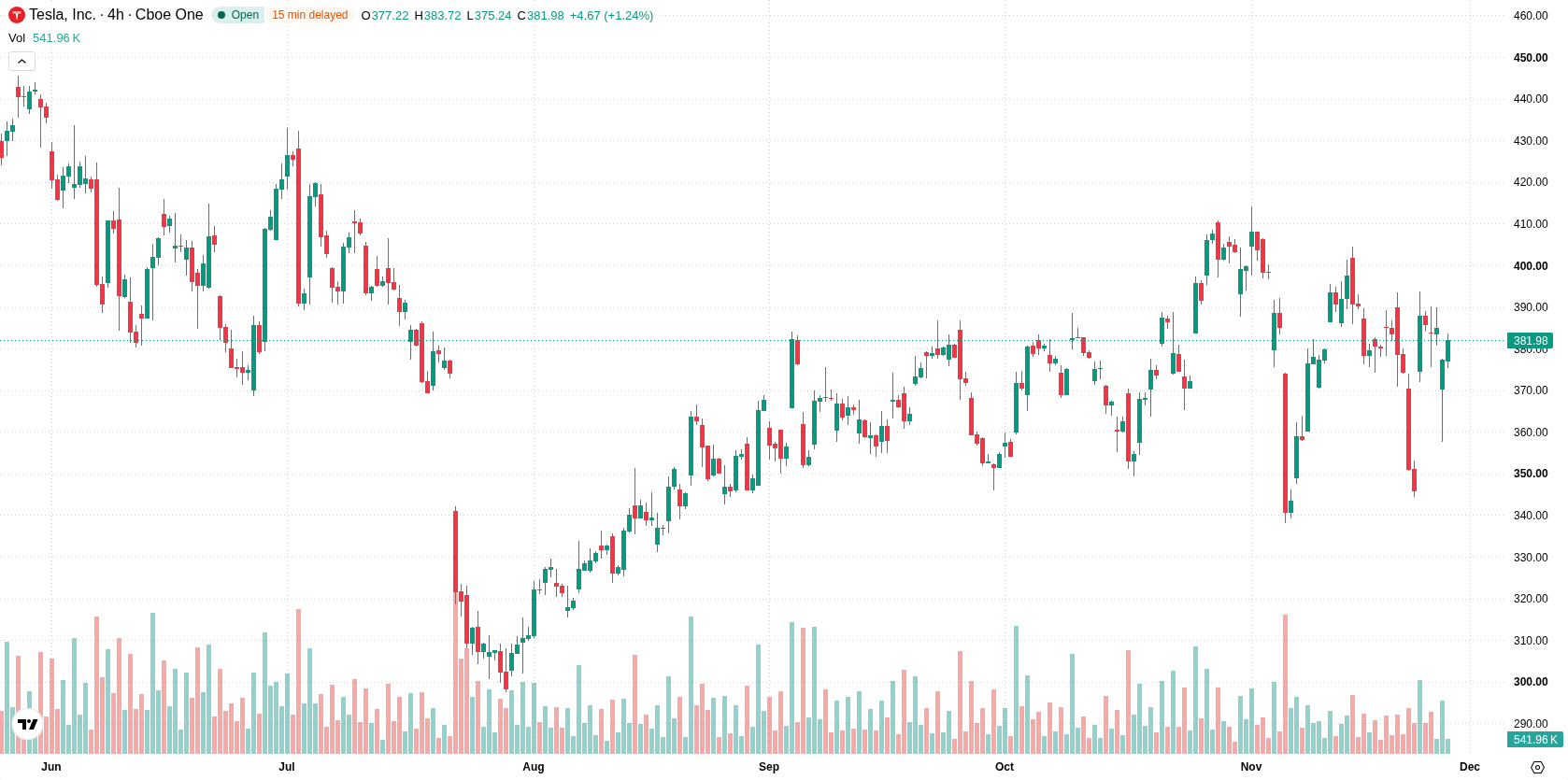
Tesla (TSLA) stock is trading in a modestly lower range at $381.4, with price remaining just above key longer-term moving averages. The main external driver is the U.S. government's plan to introduce new tariffs on select imports from China, the European Union, and other major trading partners. Traders are watching for concrete policy announcements and subsequent effects on Tesla's supply chain costs and forward earnings guidance.
 377.16
393.83
Highlights
- The U.S. government plans new tariffs on Chinese and EU imports, increasing policy risk for American automakers with global supply chains.
- Higher costs for imported electronics and battery materials could pressure margins for Tesla stock if the tariffs take effect.
- Tesla stock exhibits limited immediate downside above key support, but weak momentum and neutral trend signal vulnerability to further policy developments.
New U.S. tariff plans raise risk for TSLA's supply cost structure
According to Tipranks, as of November 25, 2026, the U.S. government is preparing to impose new tariffs on goods imported from China, the European Union, and other major partners, an action expected to affect American automakers that rely on global supply chains for critical components.
These proposed tariffs could increase the cost of imported electronics and battery materials, which are central to Tesla's manufacturing operations. If implemented, they would raise supply chain expenses and potentially pressure margins for TSLA due to higher input costs.
The announcement serves as a policy risk channel rather than a confirmed impact, and the market is awaiting further details about the actual scope, timing, and exemptions of the tariffs before fully imaging the consequences for TSLA's bottom line.
Price holding above major moving averages but momentum mixed
Following the tariff risk backdrop, the 4H chart setup reflects ongoing caution, with TSLA trading above the D1 SMA-50 at $376.66 and just above the D1 SMA-200 at $381.3. Momentum is tempered, as MACD remains in negative territory with a 'Sell' reading, while ADX signals a neutral trend.
Short-term support is highlighted by the H4 Kijun at $374.37, offering a near-term floor. Price remains slightly above a 4H SMA-20 at $380.13, suggesting limited immediate downside but no bullish momentum.
Tariff details and $381 region to guide next directional move
External tariff policy remains the chief risk to TSLA's margin stability over the coming weeks. Sustained trading above the support region around $381 may limit short-term downside, while a break below the H4 Kijun at $374.37 could open the way to further weakness. Watch for any detailed escalation or softening of tariff measures for cues on the next directional move.
Earlier, analysts noted that Tesla faced ongoing technical weakness amid merger speculation and delayed regulatory decisions, with downside risks prevailing. The current article adds a new dimension, as attention shifts to potential U.S. tariff policy changes, making the scope and timing of these macroeconomic measures the key drivers to watch for Tesla’s next move.











-
 Afghanistan
-
 Albania
-
 Algeria
-
 Angola
-
 Argentina
-
 Armenia
-
 Australia
-
 Austria
-
 Azerbaijan
-
 Bahamas
-
 Bahrain
-
 Bangladesh
-
 Belarus
-
 Belgium
-
 Bolivia
-
 Botswana
-
 Brazil
-
 Brunei
-
 Bulgaria
-
 Cambodia
-
 Cameroon
-
 Canada
-
 Chile
-
 China
-
 Colombia
-
 Congo
-
 Costa Rica
-
 Cote d'Ivoire
-
 Croatia
-
 Cuba
-
 Cyprus
-
 Czechia
-
 DR Congo
-
 Denmark
-
 Dominican Republic
-
 Ecuador
-
 Egypt
-
 El Salvador
-
 Estonia
-
 Eswatini
-
 Ethiopia
-
 Finland
-
 France
-
 Georgia
-
 Germany
-
 Ghana
-
 Greece
-
 Haiti
-
 Hong Kong
-
 Hungary
-
 India
-
 Indonesia
-
 Iran, Islamic republic
-
 Iraq
-
 Ireland
-
 Israel
-
 Italy
-
 Jamaica
-
 Japan
-
 Jordan
-
 Kazakhstan
-
 Kenya
-
 Korea
-
 Kuwait
-
 Kyrgyzstan
-
 Laos
-
 Latvia
-
 Lebanon
-
 Lesotho
-
 Libya
-
 Lithuania
-
 Luxembourg
-
 Madagascar
-
 Malaysia
-
 Malta
-
 Mauritius
-
 Mexico
-
 Moldova
-
 Mongolia
-
 Montenegro
-
 Morocco
-
 Mozambique
-
 Myanmar
-
 Namibia
-
 Nepal
-
 Netherlands
-
 New Zealand
-
 Nigeria
-
 North Macedonia
-
 Norway
-
 Oman
-
 Pakistan
-
 Palestine
-
 Panama
-
 Papua New Guinea
-
 Paraguay
-
 Peru
-
 Philippines
-
 Poland
-
 Portugal
-
 Puerto Rico
-
 Qatar
-
 Reunion
-
 Romania
-
 Rwanda
-
 Saudi Arabia
-
 Serbia
-
 Singapore
-
 Slovakia
-
 Slovenia
-
 Somalia
-
 South Africa
-
 Spain
-
 Sri Lanka
-
 Sweden
-
 Switzerland
-
 Syria
-
 Taiwan
-
 Tajikistan
-
 Tanzania
-
 Thailand
-
 Trinidad and Tobago
-
 Tunisia
-
 Turkey
-
 UAE
-
 Uganda
-
 Ukraine
-
 United Kingdom
-
United States
-
 Uruguay
-
 Uzbekistan
-
 Venezuela
-
 Vietnam
-
 Yemen
-
 Zambia
-
 Zimbabwe
- Forex
- Crypto












