

Can JPM sustain gains amid artificial intelligence-driven outlook and shifting policy conditions?

JPMorgan Chase (JPM) stock is trading lower in the latest session, with recent attention on the firm's updated 2027 macro outlook. The main external driver is the expectation of US earnings growth fueled by artificial intelligence, which is projected to affect demand for major financial equities into next year. Traders are watching the pace of AI adoption, the trajectory of US corporate earnings, and changes to monetary policy as possible influences on the stock's direction.
 317.72
328.27
Highlights
- JPMorgan Chase strategists project US equities to advance through 2027, led by productivity gains from artificial intelligence investment.
- Expected gains in corporate earnings from AI are conditional on stable monetary and fiscal policy, with risks if policy shifts.
- Shares of JPM remain under pressure below key moving averages, with multiple technical indicators confirming a prevailing sell signal and $325 acting as resistance.
AI-powered earnings forecasts drive 2027 US stock outlook
According to Bloomberg, on November 24, 2026, JPMorgan Chase & Co. strategists presented their view that US equities are likely to advance through 2027, with artificial intelligence identified as a key factor expected to power corporate earnings growth. This positive macro outlook for US stocks was attributed to expectations that rising investment in AI will enhance productivity and support stronger earnings. The announcement reflected a constructive stance on the environment for companies such as JPMorgan Chase, though price action has remained under broader selling pressure.
The anticipated impact of AI on US corporate profits acts primarily through increased capital investment and productivity gains, which can lift demand for equities like JPM. In this context, heightened interest in AI integration is seen as a supportive channel for the sector, as improved earnings power may result in more stable or expanding balance sheets.
However, this outlook is conditional and subject to risks arising from future shifts in monetary or fiscal policy, which could affect funding conditions or overall market sentiment. The direct link between AI investment and near-term financial stock performance remains uneven, with recent price movement reflecting broader caution in the equity market.
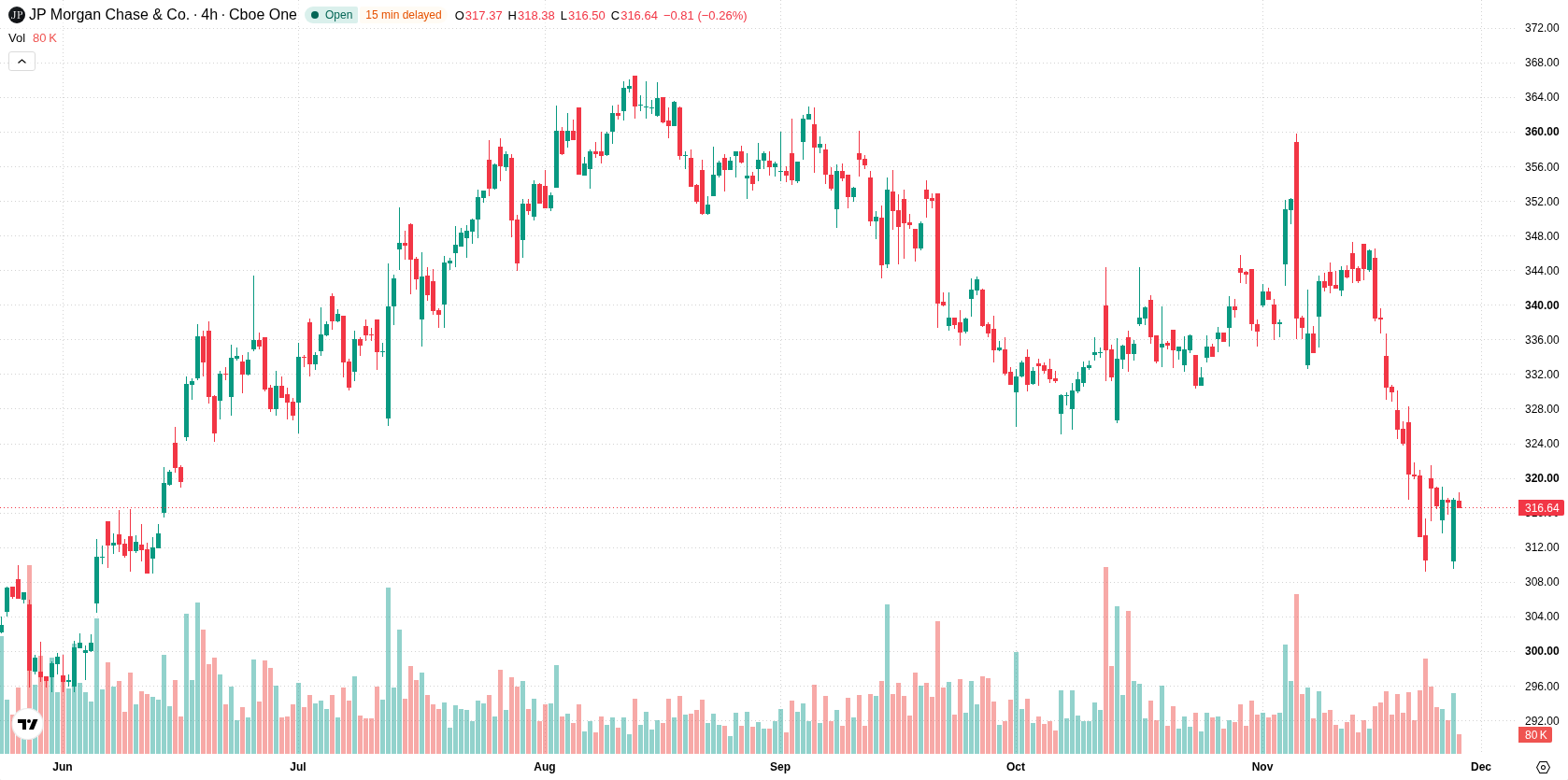
JPM remains below key moving averages and resistance
Technically, the 4H chart for JPM shows price action below the D1 SMA-50 at $335.99, and also below the D1 SMA-200 at $325.14, highlighting a market that remains under both intermediate- and longer-term moving averages despite the constructive macro narrative. The H4 SMA-20 at $329.37 and the Kijun level at $328.19 add to the technically heavy tone, acting as resistance overhead.
Indicators deliver mixed signals, with both MACD and ADX showing sell readings, confirming prevailing pressure on the stock despite the supportive backdrop for AI-driven earnings. Any potential move higher would require a sustained break above these technical barriers.
Monetary policy shifts may unsettle the current risk channel
A stabilization scenario for JPM hinges on steady progress in corporate earnings and clarity in US policy direction. Resistance remains around $325, where the D1 MA-200 is situated. A convincing move above this level could signal a change in momentum, while extended weakness below may leave JPM subject to broader market caution through the coming quarters.
Earlier, analysts noted that persistent demand for artificial intelligence could underpin continued gains in U.S. equities, despite headwinds from higher rates and slower earnings growth. In line with this broader perspective, JPMorgan Chase’s outlook remains constructive on the long-term benefits of AI integration, but the timing of any sustained recovery will depend on clear progress in corporate earnings and developments in U.S. policy direction.






Latest JPMorgan Chase News





-
 Afghanistan
-
 Albania
-
 Algeria
-
 Angola
-
 Argentina
-
 Armenia
-
 Australia
-
 Austria
-
 Azerbaijan
-
 Bahamas
-
 Bahrain
-
 Bangladesh
-
 Belarus
-
 Belgium
-
 Bolivia
-
 Botswana
-
 Brazil
-
 Brunei
-
 Bulgaria
-
 Cambodia
-
 Cameroon
-
 Canada
-
 Chile
-
 China
-
 Colombia
-
 Congo
-
 Costa Rica
-
 Cote d'Ivoire
-
 Croatia
-
 Cuba
-
 Cyprus
-
 Czechia
-
 DR Congo
-
 Denmark
-
 Dominican Republic
-
 Ecuador
-
 Egypt
-
 El Salvador
-
 Estonia
-
 Eswatini
-
 Ethiopia
-
 Finland
-
 France
-
 Georgia
-
 Germany
-
 Ghana
-
 Greece
-
 Haiti
-
 Hong Kong
-
 Hungary
-
 India
-
 Indonesia
-
 Iran, Islamic republic
-
 Iraq
-
 Ireland
-
 Israel
-
 Italy
-
 Jamaica
-
 Japan
-
 Jordan
-
 Kazakhstan
-
 Kenya
-
 Korea
-
 Kuwait
-
 Kyrgyzstan
-
 Laos
-
 Latvia
-
 Lebanon
-
 Lesotho
-
 Libya
-
 Lithuania
-
 Luxembourg
-
 Madagascar
-
 Malaysia
-
 Malta
-
 Mauritius
-
 Mexico
-
 Moldova
-
 Mongolia
-
 Montenegro
-
 Morocco
-
 Mozambique
-
 Myanmar
-
 Namibia
-
 Nepal
-
 Netherlands
-
 New Zealand
-
 Nigeria
-
 North Macedonia
-
 Norway
-
 Oman
-
 Pakistan
-
 Palestine
-
 Panama
-
 Papua New Guinea
-
 Paraguay
-
 Peru
-
 Philippines
-
 Poland
-
 Portugal
-
 Puerto Rico
-
 Qatar
-
 Reunion
-
 Romania
-
 Rwanda
-
 Saudi Arabia
-
 Serbia
-
 Singapore
-
 Slovakia
-
 Slovenia
-
 Somalia
-
 South Africa
-
 Spain
-
 Sri Lanka
-
 Sweden
-
 Switzerland
-
 Syria
-
 Taiwan
-
 Tajikistan
-
 Tanzania
-
 Thailand
-
 Trinidad and Tobago
-
 Tunisia
-
 Turkey
-
 UAE
-
 Uganda
-
 Ukraine
-
 United Kingdom
-
United States
-
 Uruguay
-
 Uzbekistan
-
 Venezuela
-
 Vietnam
-
 Yemen
-
 Zambia
-
 Zimbabwe
- Forex
- Crypto












