

Strait of Hormuz instability intensifies demand for defensive energy shares including Exxon Mobil

Exxon Mobil (XOM) stock is trading modestly lower, with the daily direction reflecting mild selling pressure. The main driver has been ongoing disruptions in the Strait of Hormuz, which have raised the geopolitical risk premium in global oil markets. Investors are watching for any further escalation or resolution in the region, as this is likely to affect both oil prices and XOM's market performance.
 159.59
162.07
Highlights
- Disruptions in the Strait of Hormuz on November 25, 2026, pushed Brent crude prices higher and caused Exxon Mobil stock to outperform the S&P 500 by 3.18%.
- Shares of Exxon Mobil are attracting flows as defensive holdings in response to elevated geopolitical risk premiums tied to shipping disruptions.
- Exxon Mobil stock trades within a longer-term bullish structure but faces near-term downward momentum, with key support at $157 and resistance near $164.
Geopolitical risk premium from Strait of Hormuz disruptions
According to Api Finexus, on November 25, 2026, disruptions in the Strait of Hormuz led to higher Brent crude prices and helped XOM outperform the S&P 500 by 3.18% due to an increased geopolitical risk premium in oil markets, though price action has remained under broader selling pressure.
The risk premium from shipping disruptions in a critical oil transit chokepoint supported energy stocks, with XOM perceived as a defensive holding during periods of geopolitical instability. This association has attracted investor flows to the sector as they seek shelter from volatility caused by supply chain risks and potential oil price spikes.
While this outperformance reflected the sector's defensive qualities in recent sessions, XOM's gains have been contained within the broader context of short-term market uncertainty. The absence of further reported escalations or resolutions in the Strait of Hormuz could keep the risk premium embedded in the oil sector for now.
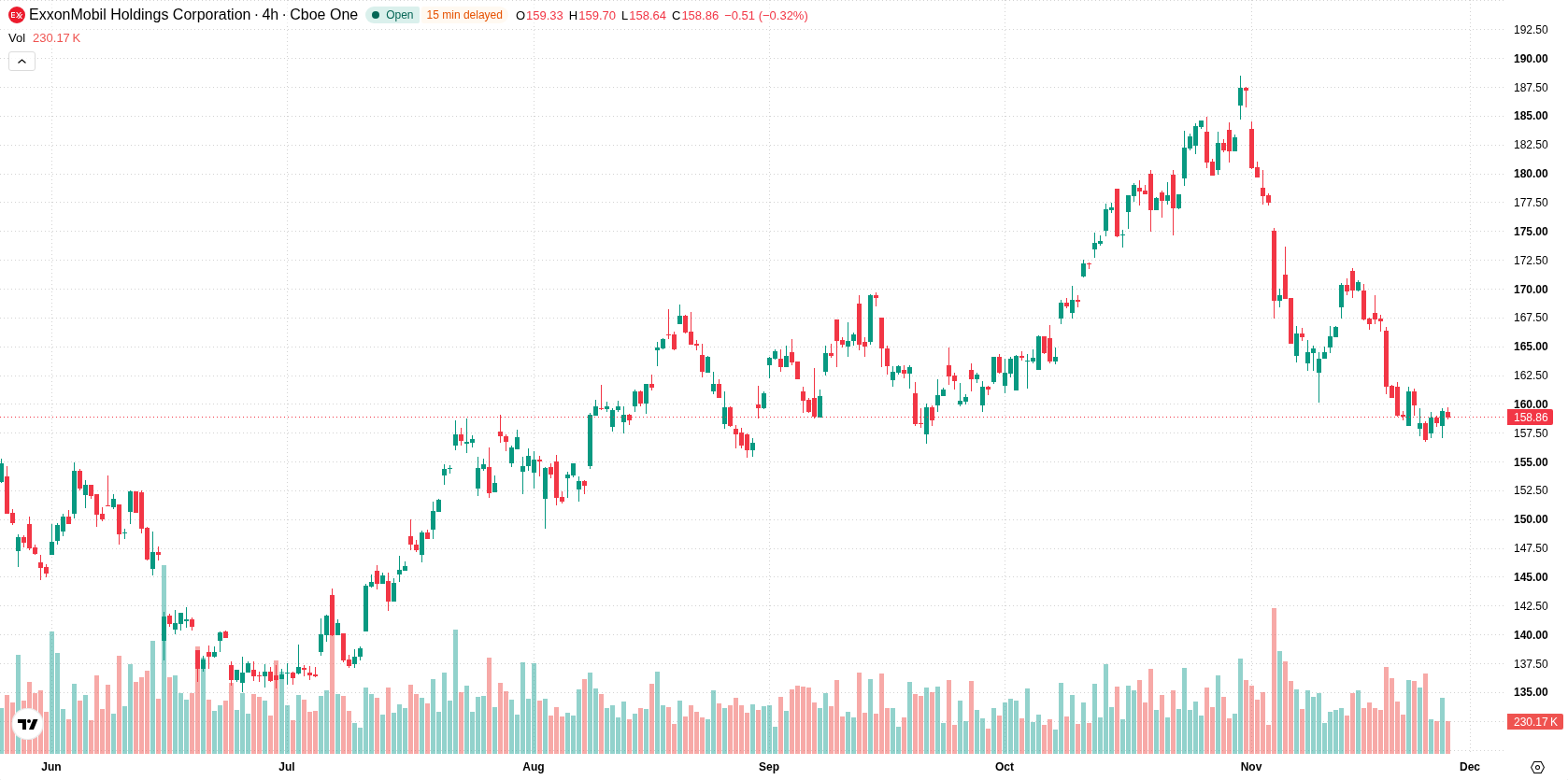
Technical signals mixed with resistance near H4 Kijun
On the technical front, XOM trades below the D1 SMA-50 at $168.98 but remains above the D1 SMA-200 at $156.92, highlighting the longer-term bullish alignment from the daily chart. The H4 SMA-20 at $163.41 is positioned above current levels, suggesting that short-term momentum has turned cautious within an overall supportive structure.
The H4 Kijun at $164.19 is acting as resistance and aligns with supply seen near recent technical highs. A negative MACD reading and sell signal, together with an ADX of 26.88 confirming a bearish direction, signal that momentum on the four-hour chart is currently pointing lower.
Geopolitics remains a key risk as XOM tests critical support
XOM's outlook may remain sensitive to geopolitical developments in the Strait of Hormuz, as any escalation could push prices back toward resistance around $164. A sustained drop below support near $157 would risk invalidating the longer-term bullish technical setup. For now, stabilization above the D1 SMA-200 supports the case for further resilience unless headline risks intensify.
Earlier, analysts noted that Exxon Mobil's longer-term outlook was challenged by sustained technical weakness and continued sell pressure despite company initiatives and sector flows. The current article adds a new dimension by highlighting how geopolitical developments in the Strait of Hormuz now play a pivotal role in shaping XOM's near-term direction, making further moves dependent on any escalation or easing of tensions in the region.









-
 Afghanistan
-
 Albania
-
 Algeria
-
 Angola
-
 Argentina
-
 Armenia
-
 Australia
-
 Austria
-
 Azerbaijan
-
 Bahamas
-
 Bahrain
-
 Bangladesh
-
 Belarus
-
 Belgium
-
 Bolivia
-
 Botswana
-
 Brazil
-
 Brunei
-
 Bulgaria
-
 Cambodia
-
 Cameroon
-
 Canada
-
 Chile
-
 China
-
 Colombia
-
 Congo
-
 Costa Rica
-
 Cote d'Ivoire
-
 Croatia
-
 Cuba
-
 Cyprus
-
 Czechia
-
 DR Congo
-
 Denmark
-
 Dominican Republic
-
 Ecuador
-
 Egypt
-
 El Salvador
-
 Estonia
-
 Eswatini
-
 Ethiopia
-
 Finland
-
 France
-
 Georgia
-
 Germany
-
 Ghana
-
 Greece
-
 Haiti
-
 Hong Kong
-
 Hungary
-
 India
-
 Indonesia
-
 Iran, Islamic republic
-
 Iraq
-
 Ireland
-
 Israel
-
 Italy
-
 Jamaica
-
 Japan
-
 Jordan
-
 Kazakhstan
-
 Kenya
-
 Korea
-
 Kuwait
-
 Kyrgyzstan
-
 Laos
-
 Latvia
-
 Lebanon
-
 Lesotho
-
 Libya
-
 Lithuania
-
 Luxembourg
-
 Madagascar
-
 Malaysia
-
 Malta
-
 Mauritius
-
 Mexico
-
 Moldova
-
 Mongolia
-
 Montenegro
-
 Morocco
-
 Mozambique
-
 Myanmar
-
 Namibia
-
 Nepal
-
 Netherlands
-
 New Zealand
-
 Nigeria
-
 North Macedonia
-
 Norway
-
 Oman
-
 Pakistan
-
 Palestine
-
 Panama
-
 Papua New Guinea
-
 Paraguay
-
 Peru
-
 Philippines
-
 Poland
-
 Portugal
-
 Puerto Rico
-
 Qatar
-
 Reunion
-
 Romania
-
 Rwanda
-
 Saudi Arabia
-
 Serbia
-
 Singapore
-
 Slovakia
-
 Slovenia
-
 Somalia
-
 South Africa
-
 Spain
-
 Sri Lanka
-
 Sweden
-
 Switzerland
-
 Syria
-
 Taiwan
-
 Tajikistan
-
 Tanzania
-
 Thailand
-
 Trinidad and Tobago
-
 Tunisia
-
 Turkey
-
 UAE
-
 Uganda
-
 Ukraine
-
 United Kingdom
-
United States
-
 Uruguay
-
 Uzbekistan
-
 Venezuela
-
 Vietnam
-
 Yemen
-
 Zambia
-
 Zimbabwe
- Forex
- Crypto












