

Nvidia falls as new US tariffs and inflation pressure hit semiconductor costs

Nvidia (NVDA) stock is trading lower, with a drop of 4.12% reported on November 25, 2026. The decline followed the announcement of new US tariffs and fresh PCE inflation data. Investors are watching future trade policy and inflation releases for further impact.
 147.88
171.50
Highlights
- Shares of Nvidia fell as new 20% tariffs announced by the Trump administration raised input costs for semiconductor producers.
- Rising October PCE inflation points to continued pressure on operating expenses and potential margin compression for Nvidia.
- Nvidia stock trades below key moving averages with technical signals indicating sustained downside momentum unless resistance near $160 is retaken.
US tariffs and inflation: direct hit to semiconductors
According to Yahoo Finance, on November 25, 2026, the Trump administration announced new 20% tariffs, and October PCE inflation data showed an uptick in prices. These factors contributed to a sell-off in semiconductor stocks, including Nvidia.
The newly imposed tariffs directly increase input costs for semiconductor producers while higher inflation signals ongoing pressure on operating expenses and the likelihood of tighter financing conditions. For Nvidia, these macroeconomic and policy shifts threaten to narrow margins and impact demand from downstream buyers sensitive to higher costs.
While the risk of additional tariff escalation and further inflation readings remains, the initial market reaction has emphasized Nvidia’s vulnerability to external policy shocks that alter the competitive and financial landscape.
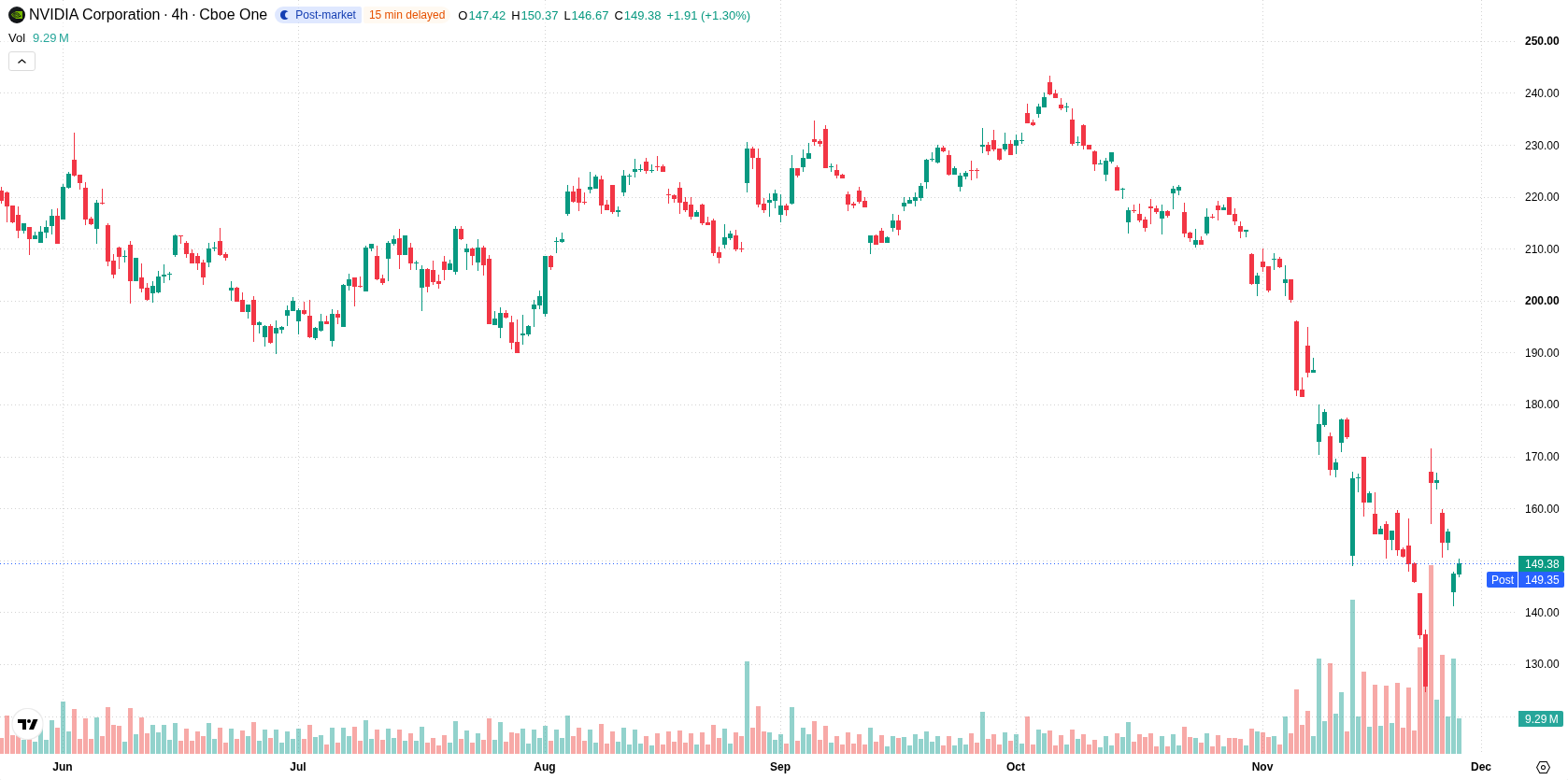
Policy pressure reinforced by bearish technicals on 4H chart
Technically, the down move aligns with a 4H chart that shows NVDA remaining below the D1 SMA-50 at $204.94 and the D1 SMA-200 at $203.06, indicating persistent bearish positioning. The 4H SMA-20 at $156.36 also sits above the current price, reinforcing downside momentum under current market stress.
The MACD is negative at -9.76, giving a strong sell signal, and the ADX at 38.38 further suggests a continuation of selling interest. The H4 Kijun at $159.7 acts as near-term resistance that would need to be overcome for any positive shift in direction.
Trade policy and inflation risks define next levels
The external backdrop of trade policy and inflation will continue to dictate NVDA’s near-term outlook. A move above the H4 Kijun resistance around $160 could offer initial signs of stabilization, but further escalation in tariffs or persistent inflation shocks would likely cap any recovery. For confirmation of a more constructive scenario, traders should watch for the price to reclaim zones above these resistance points. Until then, macro risk dominates trading conditions for the sector.
Previously it was reported that Jensen Huang was reinstated as Nvidia CEO following assurances from U.S. officials that he was not under investigation over export control concerns. The current market reaction adds a new dimension, as Nvidia’s outlook now hinges primarily on evolving U.S. trade policy and inflation trends, which remain the key variables to monitor for the next directional move.











-
 Afghanistan
-
 Albania
-
 Algeria
-
 Angola
-
 Argentina
-
 Armenia
-
 Australia
-
 Austria
-
 Azerbaijan
-
 Bahamas
-
 Bahrain
-
 Bangladesh
-
 Belarus
-
 Belgium
-
 Bolivia
-
 Botswana
-
 Brazil
-
 Brunei
-
 Bulgaria
-
 Cambodia
-
 Cameroon
-
 Canada
-
 Chile
-
 China
-
 Colombia
-
 Congo
-
 Costa Rica
-
 Cote d'Ivoire
-
 Croatia
-
 Cuba
-
 Cyprus
-
 Czechia
-
 DR Congo
-
 Denmark
-
 Dominican Republic
-
 Ecuador
-
 Egypt
-
 El Salvador
-
 Estonia
-
 Eswatini
-
 Ethiopia
-
 Finland
-
 France
-
 Georgia
-
 Germany
-
 Ghana
-
 Greece
-
 Haiti
-
 Hong Kong
-
 Hungary
-
 India
-
 Indonesia
-
 Iran, Islamic republic
-
 Iraq
-
 Ireland
-
 Israel
-
 Italy
-
 Jamaica
-
 Japan
-
 Jordan
-
 Kazakhstan
-
 Kenya
-
 Korea
-
 Kuwait
-
 Kyrgyzstan
-
 Laos
-
 Latvia
-
 Lebanon
-
 Lesotho
-
 Libya
-
 Lithuania
-
 Luxembourg
-
 Madagascar
-
 Malaysia
-
 Malta
-
 Mauritius
-
 Mexico
-
 Moldova
-
 Mongolia
-
 Montenegro
-
 Morocco
-
 Mozambique
-
 Myanmar
-
 Namibia
-
 Nepal
-
 Netherlands
-
 New Zealand
-
 Nigeria
-
 North Macedonia
-
 Norway
-
 Oman
-
 Pakistan
-
 Palestine
-
 Panama
-
 Papua New Guinea
-
 Paraguay
-
 Peru
-
 Philippines
-
 Poland
-
 Portugal
-
 Puerto Rico
-
 Qatar
-
 Reunion
-
 Romania
-
 Rwanda
-
 Saudi Arabia
-
 Serbia
-
 Singapore
-
 Slovakia
-
 Slovenia
-
 Somalia
-
 South Africa
-
 Spain
-
 Sri Lanka
-
 Sweden
-
 Switzerland
-
 Syria
-
 Taiwan
-
 Tajikistan
-
 Tanzania
-
 Thailand
-
 Trinidad and Tobago
-
 Tunisia
-
 Turkey
-
 UAE
-
 Uganda
-
 Ukraine
-
 United Kingdom
-
United States
-
 Uruguay
-
 Uzbekistan
-
 Venezuela
-
 Vietnam
-
 Yemen
-
 Zambia
-
 Zimbabwe
- Forex
- Crypto












