

Costco stock edges lower as inflation adds risk to interest rate outlook

Costco (COST) stock is trading below recent highs with a modest downward move as fresh inflation data heightens policy risk. Traders are assessing the implications of persistent price pressures for the retail sector. Attention remains on upcoming Federal Reserve decisions and further developments in the U.S. inflation outlook.
 1097.63
1122.81
Highlights
- The US PCE price index rose 3.8% year-on-year in October 2026, surpassing expectations and raising the likelihood of further Federal Reserve rate hikes.
- Higher borrowing costs and persistent inflation could constrain consumer spending and pressure revenue growth for major retailers like COST.
- COST stock holds a longer-term bullish position but short-term momentum remains uncertain, with support near $1,083 and mixed indicator views amid policy risk.
U.S. inflation release drives new policy risk for retailers
According to CNBC, the U.S. personal consumption expenditures (PCE) price index, which is the Federal Reserve's preferred measure of inflation, showed an annual rate of 3.8% for October 2026, as reported on November 25, 2026.
This higher-than-anticipated inflation print raises the probability that the Federal Reserve could pursue additional interest rate hikes. Such policy moves would increase borrowing costs for consumers and potentially dampen household spending, a factor that could weigh on revenue growth for large retailers like COST.
The influence of monetary policy on consumer demand is particularly relevant for COST, given its reliance on discretionary spending trends. Continued inflationary pressure thereby poses an ongoing risk to retail sector performance, even as short-term price movements remain relatively contained.
Macro caution meets mixed signals on 4H chart
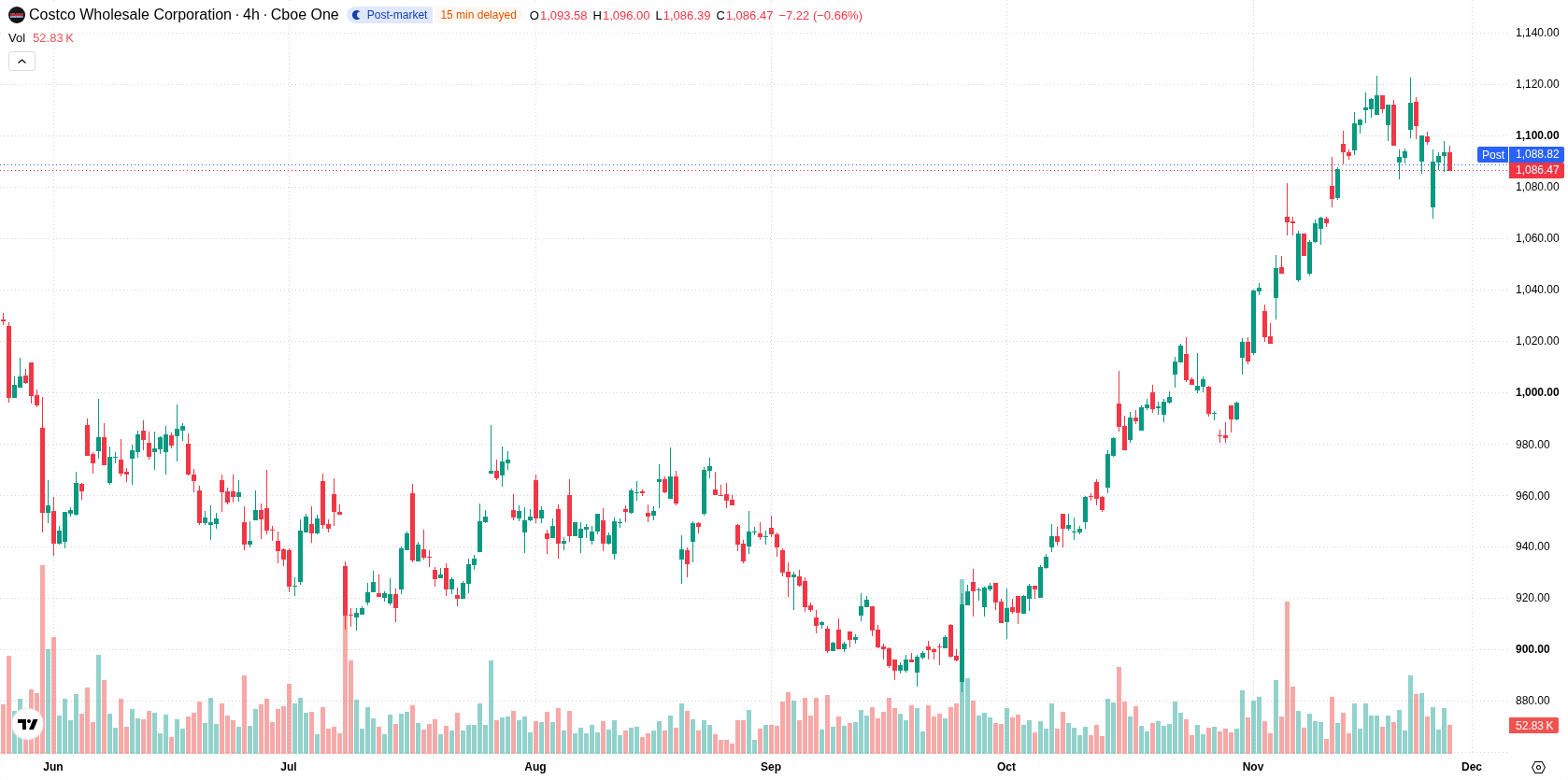
The macro-driven caution is reflected on the 4H chart, where COST remains positioned above both the D1 SMA-50 at $994 and the D1 SMA-200 at $979, indicating an underlying longer-term bullish alignment. However, short-term momentum is more tentative, with the price currently below the H4 SMA-20 at $1,100 and near the H4 Kijun support at $1,083.
Signals are mixed, as the ADX gives a sell forecast despite MACD indicating strong buy momentum. The proximity to notable moving averages and the H4 Kijun highlights a period of indecision amid elevated macro risk.
Sustained support at H4 Kijun around $1,083 limits further downside
If the H4 Kijun around $1,083 holds as support, COST could stabilize even as policy risk persists. A sustained break below that area would suggest that inflation-driven headwinds are starting to dominate. Further direction will depend on forthcoming Federal Reserve guidance and updated inflation releases.
Previously it was reported that upcoming capital return decisions, such as dividends or buybacks, were expected to play a central role in shaping Costco’s share demand and price direction. The current update adds macroeconomic uncertainty to this outlook, underscoring that inflation trends and Federal Reserve policy responses now represent the leading factors to watch for the stock’s next move.











-
 Afghanistan
-
 Albania
-
 Algeria
-
 Angola
-
 Argentina
-
 Armenia
-
 Australia
-
 Austria
-
 Azerbaijan
-
 Bahamas
-
 Bahrain
-
 Bangladesh
-
 Belarus
-
 Belgium
-
 Bolivia
-
 Botswana
-
 Brazil
-
 Brunei
-
 Bulgaria
-
 Cambodia
-
 Cameroon
-
 Canada
-
 Chile
-
 China
-
 Colombia
-
 Congo
-
 Costa Rica
-
 Cote d'Ivoire
-
 Croatia
-
 Cuba
-
 Cyprus
-
 Czechia
-
 DR Congo
-
 Denmark
-
 Dominican Republic
-
 Ecuador
-
 Egypt
-
 El Salvador
-
 Estonia
-
 Eswatini
-
 Ethiopia
-
 Finland
-
 France
-
 Georgia
-
 Germany
-
 Ghana
-
 Greece
-
 Haiti
-
 Hong Kong
-
 Hungary
-
 India
-
 Indonesia
-
 Iran, Islamic republic
-
 Iraq
-
 Ireland
-
 Israel
-
 Italy
-
 Jamaica
-
 Japan
-
 Jordan
-
 Kazakhstan
-
 Kenya
-
 Korea
-
 Kuwait
-
 Kyrgyzstan
-
 Laos
-
 Latvia
-
 Lebanon
-
 Lesotho
-
 Libya
-
 Lithuania
-
 Luxembourg
-
 Madagascar
-
 Malaysia
-
 Malta
-
 Mauritius
-
 Mexico
-
 Moldova
-
 Mongolia
-
 Montenegro
-
 Morocco
-
 Mozambique
-
 Myanmar
-
 Namibia
-
 Nepal
-
 Netherlands
-
 New Zealand
-
 Nigeria
-
 North Macedonia
-
 Norway
-
 Oman
-
 Pakistan
-
 Palestine
-
 Panama
-
 Papua New Guinea
-
 Paraguay
-
 Peru
-
 Philippines
-
 Poland
-
 Portugal
-
 Puerto Rico
-
 Qatar
-
 Reunion
-
 Romania
-
 Rwanda
-
 Saudi Arabia
-
 Serbia
-
 Singapore
-
 Slovakia
-
 Slovenia
-
 Somalia
-
 South Africa
-
 Spain
-
 Sri Lanka
-
 Sweden
-
 Switzerland
-
 Syria
-
 Taiwan
-
 Tajikistan
-
 Tanzania
-
 Thailand
-
 Trinidad and Tobago
-
 Tunisia
-
 Turkey
-
 UAE
-
 Uganda
-
 Ukraine
-
 United Kingdom
-
United States
-
 Uruguay
-
 Uzbekistan
-
 Venezuela
-
 Vietnam
-
 Yemen
-
 Zambia
-
 Zimbabwe
- Forex
- Crypto












