

New US tariffs keep Shell in focus on concerns over supply chains and market access

Shell (SHEL) stock is trading higher as of November 26, 2026. Market participants are watching for potential impacts from newly announced trade tariffs and the risk to future energy demand. Reactions from China, the EU, and India could affect the stock’s outlook if further escalation disrupts Shell’s global operations.
 3660.00
Highlights
- The Trump administration announced new tariffs on major trading partners including China, the EU, and India, creating risk for global trade flows.
- Shell faces potential disruption to its supply chain and market access if targeted countries retaliate or adjust trade policies.
- Shell stock holds above near-term technical support but positive momentum is limited by overhead resistance and mixed indicator signals.
US tariffs raise energy sector trade risk
According to CNBC, on November 25, 2026, the Trump administration announced new tariffs targeting more than a dozen major trading partners, including China, the European Union, and India.
This policy move raises the risk of significant disruption to global trade flows and energy demand—factors that are closely tied to Shell’s supply chain and market access. Any resulting retaliation or shifts in trade policy from targeted countries could directly affect Shell’s ability to operate efficiently in these regions.
No direct price reaction has been attributed to this development, but previous episodes of trade tension have meant volatility and uncertainty for multinational energy firms. The market is now focused on official responses from China, the EU, and India, which will determine the extent of any impact on energy demand and global trading routes.
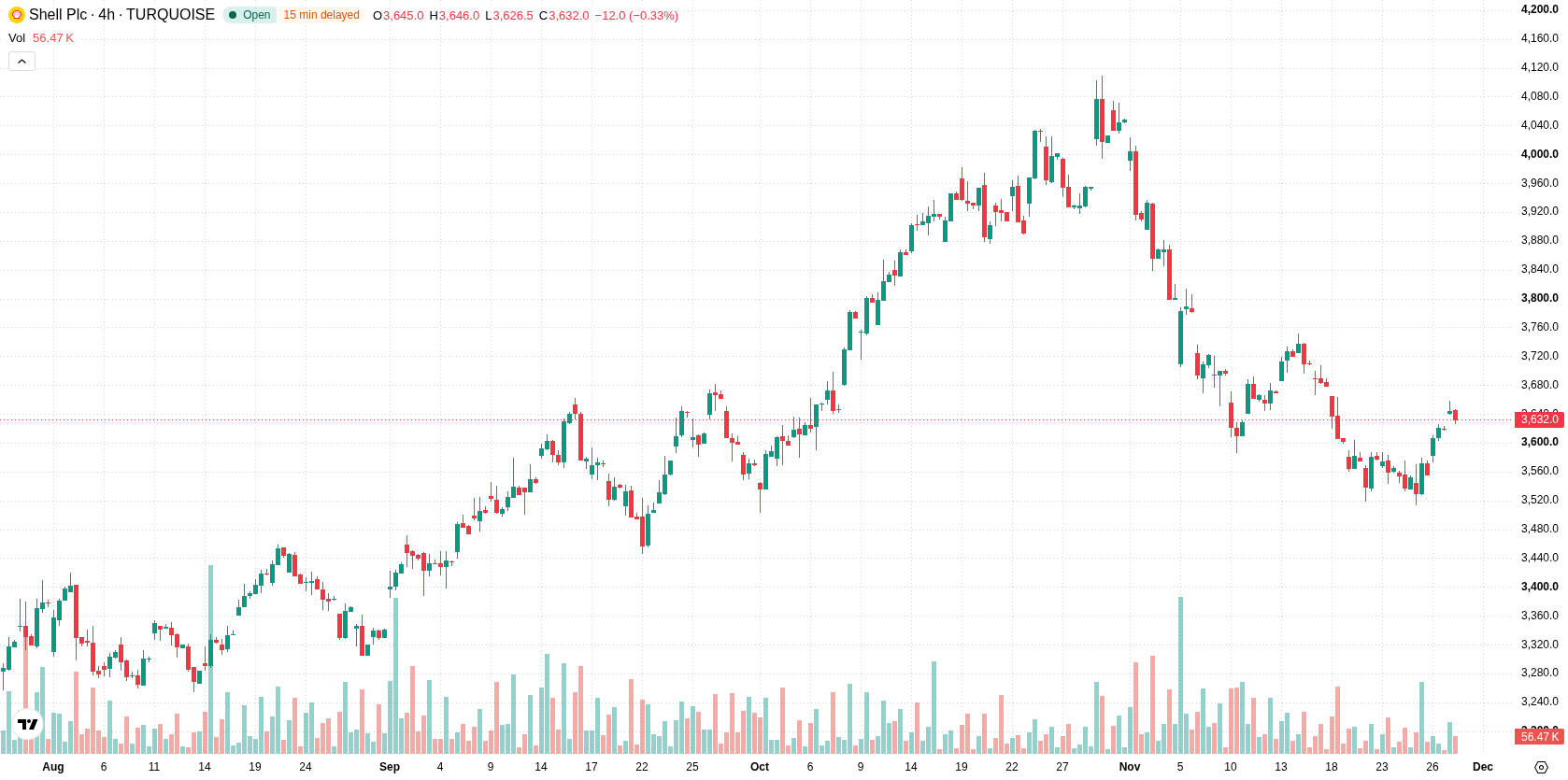
Mixed signals as Shell holds recent gains above support
On the technical side, the 4H chart shows Shell holding above the H4 Kijun at GBX3,586 and above the 4H SMA-20 at GBX3,573. The price remains below the D1 SMA-50 at GBX3,735, indicating near-term upward momentum but longer-term resistance not far above.
Momentum signals are mixed, with the ADX at 45.93 and MACD showing a strong sell reading and negative direction. This suggests some underlying caution despite the current bullish structure on the daily timeframe.
Global policy response to US tariffs sets next move
The outlook for Shell hinges on how major trading partners respond to the US tariffs. Support appears around GBX3,587, while resistance is near GBX3,736. Sustained trade friction or retaliation would likely challenge the stock’s upward movement, while a quick de-escalation could allow stabilization above current levels.
Earlier, analysts noted that Shell’s technical strength was tempered by macroeconomic risks, particularly from international developments. With the latest escalation in U.S. trade policy, the focus now shifts to potential retaliatory measures from China, the EU, and India, which remain the key factors likely to determine Shell’s next move.









-
 Afghanistan
-
 Albania
-
 Algeria
-
 Angola
-
 Argentina
-
 Armenia
-
 Australia
-
 Austria
-
 Azerbaijan
-
 Bahamas
-
 Bahrain
-
 Bangladesh
-
 Belarus
-
 Belgium
-
 Bolivia
-
 Botswana
-
 Brazil
-
 Brunei
-
 Bulgaria
-
 Cambodia
-
 Cameroon
-
 Canada
-
 Chile
-
 China
-
 Colombia
-
 Congo
-
 Costa Rica
-
 Cote d'Ivoire
-
 Croatia
-
 Cuba
-
 Cyprus
-
 Czechia
-
 DR Congo
-
 Denmark
-
 Dominican Republic
-
 Ecuador
-
 Egypt
-
 El Salvador
-
 Estonia
-
 Eswatini
-
 Ethiopia
-
 Finland
-
 France
-
 Georgia
-
 Germany
-
 Ghana
-
 Greece
-
 Haiti
-
 Hong Kong
-
 Hungary
-
 India
-
 Indonesia
-
 Iran, Islamic republic
-
 Iraq
-
 Ireland
-
 Israel
-
 Italy
-
 Jamaica
-
 Japan
-
 Jordan
-
 Kazakhstan
-
 Kenya
-
 Korea
-
 Kuwait
-
 Kyrgyzstan
-
 Laos
-
 Latvia
-
 Lebanon
-
 Lesotho
-
 Libya
-
 Lithuania
-
 Luxembourg
-
 Madagascar
-
 Malaysia
-
 Malta
-
 Mauritius
-
 Mexico
-
 Moldova
-
 Mongolia
-
 Montenegro
-
 Morocco
-
 Mozambique
-
 Myanmar
-
 Namibia
-
 Nepal
-
 Netherlands
-
 New Zealand
-
 Nigeria
-
 North Macedonia
-
 Norway
-
 Oman
-
 Pakistan
-
 Palestine
-
 Panama
-
 Papua New Guinea
-
 Paraguay
-
 Peru
-
 Philippines
-
 Poland
-
 Portugal
-
 Puerto Rico
-
 Qatar
-
 Reunion
-
 Romania
-
 Rwanda
-
 Saudi Arabia
-
 Serbia
-
 Singapore
-
 Slovakia
-
 Slovenia
-
 Somalia
-
 South Africa
-
 Spain
-
 Sri Lanka
-
 Sweden
-
 Switzerland
-
 Syria
-
 Taiwan
-
 Tajikistan
-
 Tanzania
-
 Thailand
-
 Trinidad and Tobago
-
 Tunisia
-
 Turkey
-
 UAE
-
 Uganda
-
 Ukraine
-
 United Kingdom
-
United States
-
 Uruguay
-
 Uzbekistan
-
 Venezuela
-
 Vietnam
-
 Yemen
-
 Zambia
-
 Zimbabwe
- Forex
- Crypto












