
Coursera Review For Finance Education


Editorial Note: While we adhere to strict Editorial Integrity, this post may contain references to products from our partners. Here's an explanation for How We Make Money. None of the data and information on this webpage constitutes investment advice according to our Disclaimer.
Coursera is an online education platform used for structured finance education through courses developed by universities and professional institutions. It covers key areas such as personal finance, corporate finance, financial markets, investment fundamentals, and fintech. Learning is delivered through guided modules, assignments, and certificates, making Coursera suitable for both beginners building financial literacy and professionals strengthening their finance knowledge.
As demand for accessible financial education continues to grow, many learners turn to online platforms to gain structured knowledge without enrolling in traditional academic programs. Coursera is often considered by those looking to study finance at their own pace while still following an organized curriculum created by recognized institutions.
In this review, we examine whether Coursera can be classified as an effective educational resource for finance learning, evaluate its practical usefulness, and highlight finance-related courses that may be most relevant for learners in 2026.
What is Coursera?

Coursera is an online education platform that partners with universities, business schools, and professional organizations to deliver structured learning programs. Its courses are designed to follow an academic format, combining video lectures, readings, quizzes, and graded assignments.

For finance learners, Coursera offers programs that range from introductory concepts to more advanced topics. Courses are created and taught by university professors and industry experts, which gives the platform a more formal and standardized approach compared to informal learning websites.
Most courses can be taken at an individual pace, while some programs follow fixed schedules. Learners can study for knowledge only or earn certificates that confirm course completion, depending on their goals.
Why Coursera works well for finance education
Finance is a subject where structure and accuracy matter. Coursera follows an academic approach, which makes it suitable for learning finance concepts correctly rather than informally or through fragmented materials.
The platform meets key criteria expected from finance education providers:
University-backed content. Courses are created by recognized universities and institutions.
Structured learning paths. Topics are taught in a logical sequence with clear learning goals.
Balanced methodology. Programs combine theory, case studies, and practical exercises.
Assessment and feedback. Quizzes and assignments help reinforce understanding.
Unlike casual learning platforms, Coursera maintains consistent academic standards. This is especially important in finance, where misunderstanding fundamentals can lead to poor real-world decisions.
As a result, Coursera is well suited for building financial literacy, strengthening theoretical knowledge, and preparing learners for more advanced finance studies or certifications.
Coursera finance courses overview
Coursera’s finance courses cover a wide range of topics, from basic financial literacy to more advanced academic and professional subjects. The platform does not focus on trading tactics. Instead, it emphasizes understanding how financial systems, businesses, and markets function.
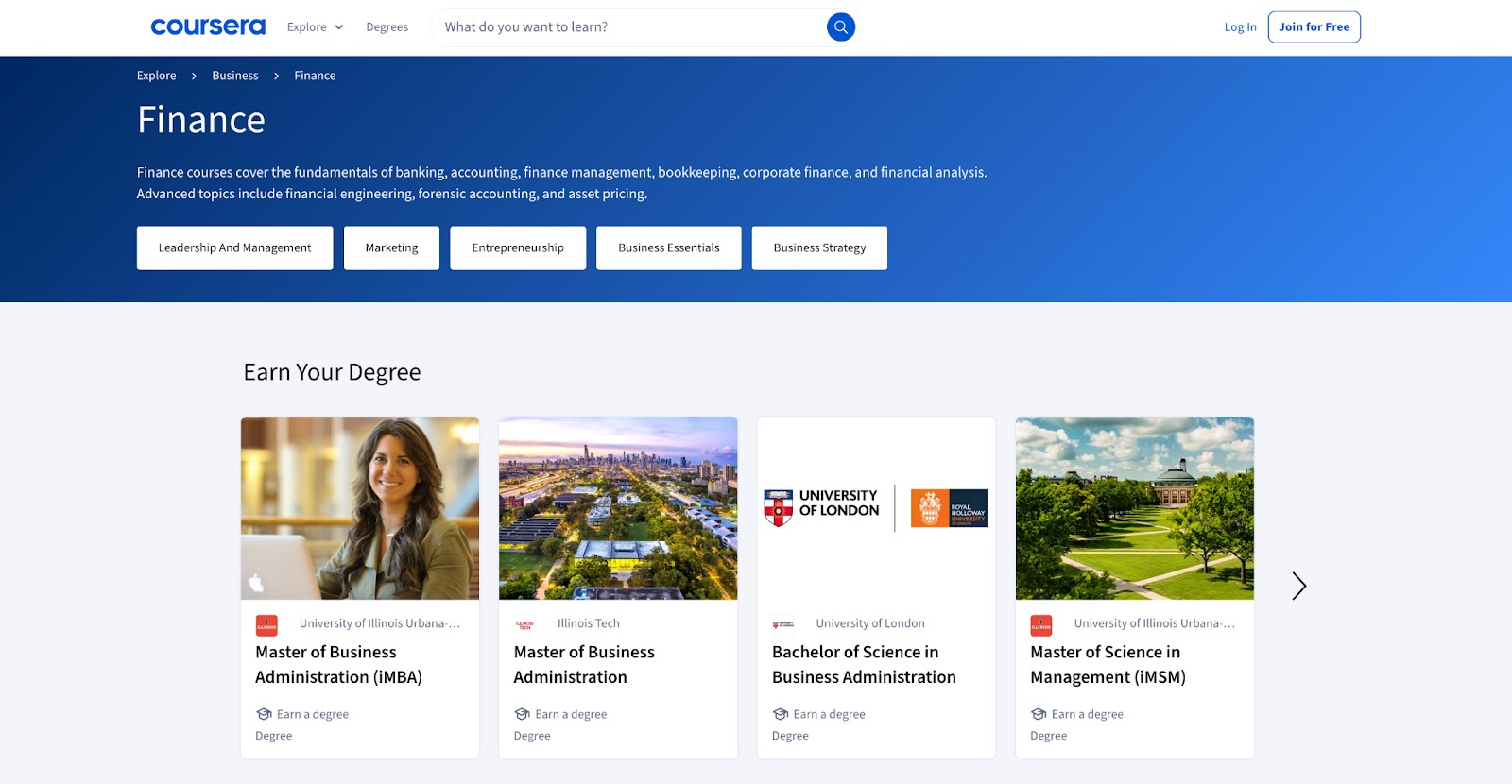
Most Coursera finance programs are organized as standalone courses or multi-course specializations. Learners progress through structured modules that build knowledge step by step, with assessments used to confirm understanding.
Key topics covered across Coursera’s finance-related offerings include:
Personal finance. Budgeting, saving, debt management, and long-term planning.
Corporate finance. Valuation, capital budgeting, and financial decision-making.
Financial markets. Stocks, bonds, risk, and market structure.
Investment fundamentals. Portfolio basics and asset allocation concepts.
Fintech. Digital payments, blockchain concepts, and financial innovation.
This broad coverage allows learners to choose courses based on their goals, whether they want practical financial skills or a stronger academic foundation in finance.
Top Coursera finance courses in 2026
Coursera’s finance courses include programs created by leading universities and professional institutions. Below are some of the most relevant options for learners in 2026, covering financial markets, corporate finance, personal finance, and fintech.
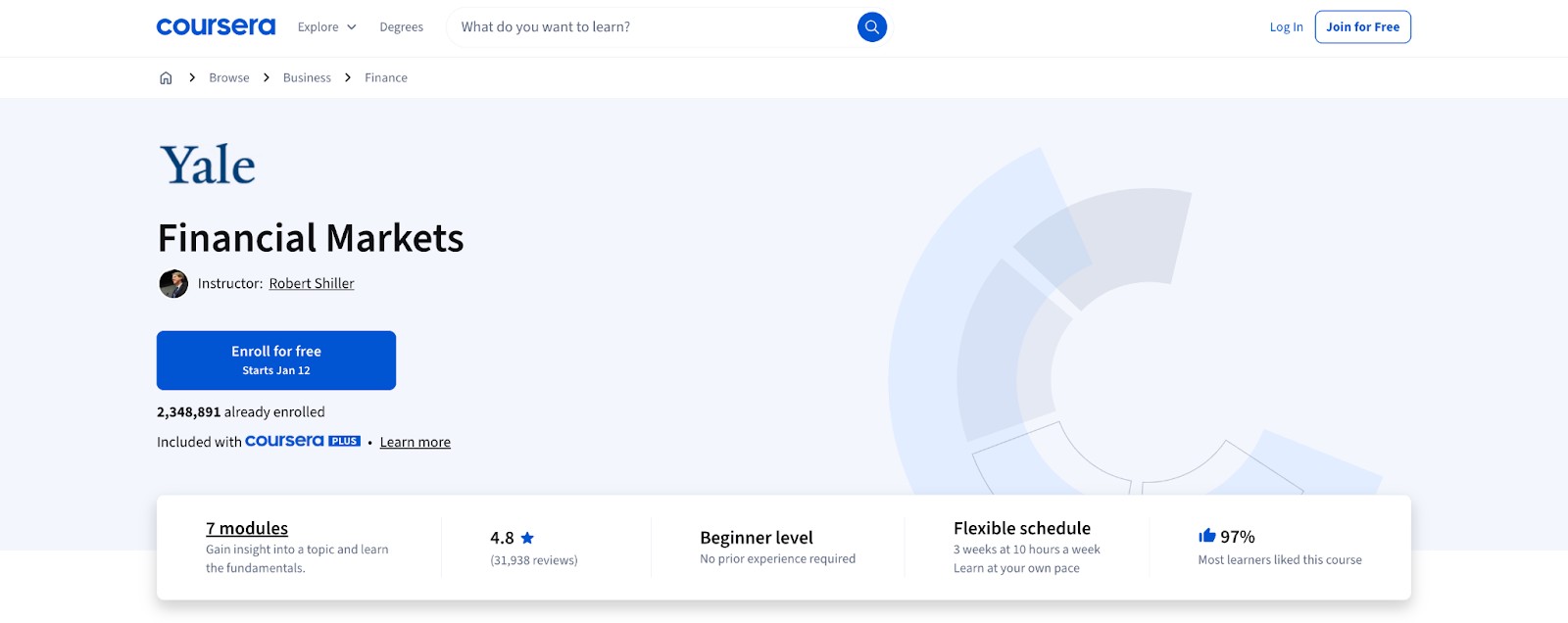
Financial Markets (Yale University)
This course explains how global financial markets function and how risk, return, and institutions interact. It focuses on market structure, investor behavior, and the role of financial systems in the economy.
- Pros
- Cons
Strong academic foundation. Developed by a top university.
Clear explanations. Complex concepts are explained step by step.
Broad market view. Covers stocks, bonds, and financial institutions.
Limited practical application. Few hands-on exercises.
Theory-heavy. May feel abstract for some learners.
Introduction to Corporate Finance (University of Pennsylvania)
This course covers core corporate finance principles, including valuation, capital budgeting, and financial decision-making. It focuses on how companies evaluate investments and manage capital.

- Pros
- Cons
Practical relevance. Real-world corporate finance examples.
Structured approach. Clear progression from basics to application.
Career value. Useful for business and finance roles.
Mathematically demanding. Requires comfort with numbers.
Dense content. Some topics need extra review.
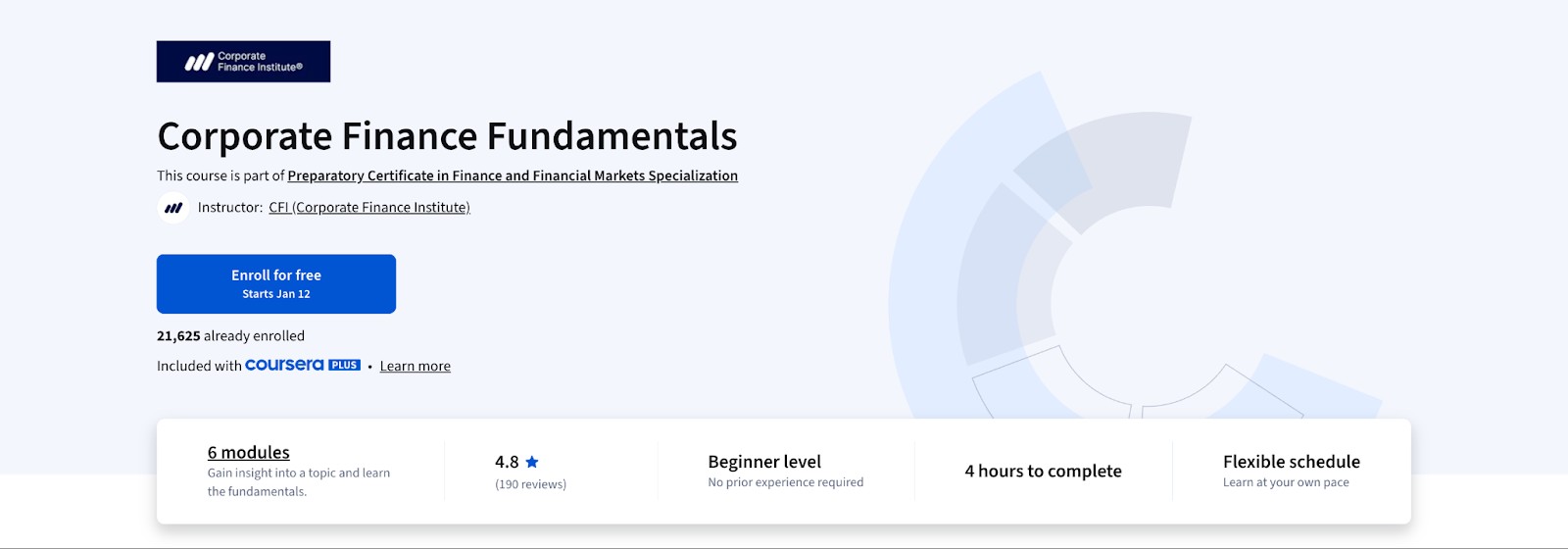
Corporate Finance Fundamentals (Corporate Finance Institute)
This program focuses on applied corporate finance skills, including financial statement analysis, valuation methods, and capital structure decisions. It is designed for professional use rather than academic theory.
- Pros
- Cons
Highly practical. Strong focus on real business scenarios.
Industry-oriented. Suitable for analysts and professionals.
Clear skill focus. Direct application to finance roles.
Less academic depth. Limited theoretical discussion.
Not beginner-friendly. Prior finance knowledge is helpful.
The Fundamentals of Personal Finance (SoFi)
This course focuses on everyday money management, covering budgeting, debt, saving, investing basics, and long-term financial planning.

- Pros
- Cons
Beginner-friendly. Easy to follow and practical.
Everyday relevance. Focuses on real-life decisions.
Clear structure. Suitable for non-finance learners.
Basic scope. Limited advanced investing content.
Not career-focused. Not designed for professional finance paths.
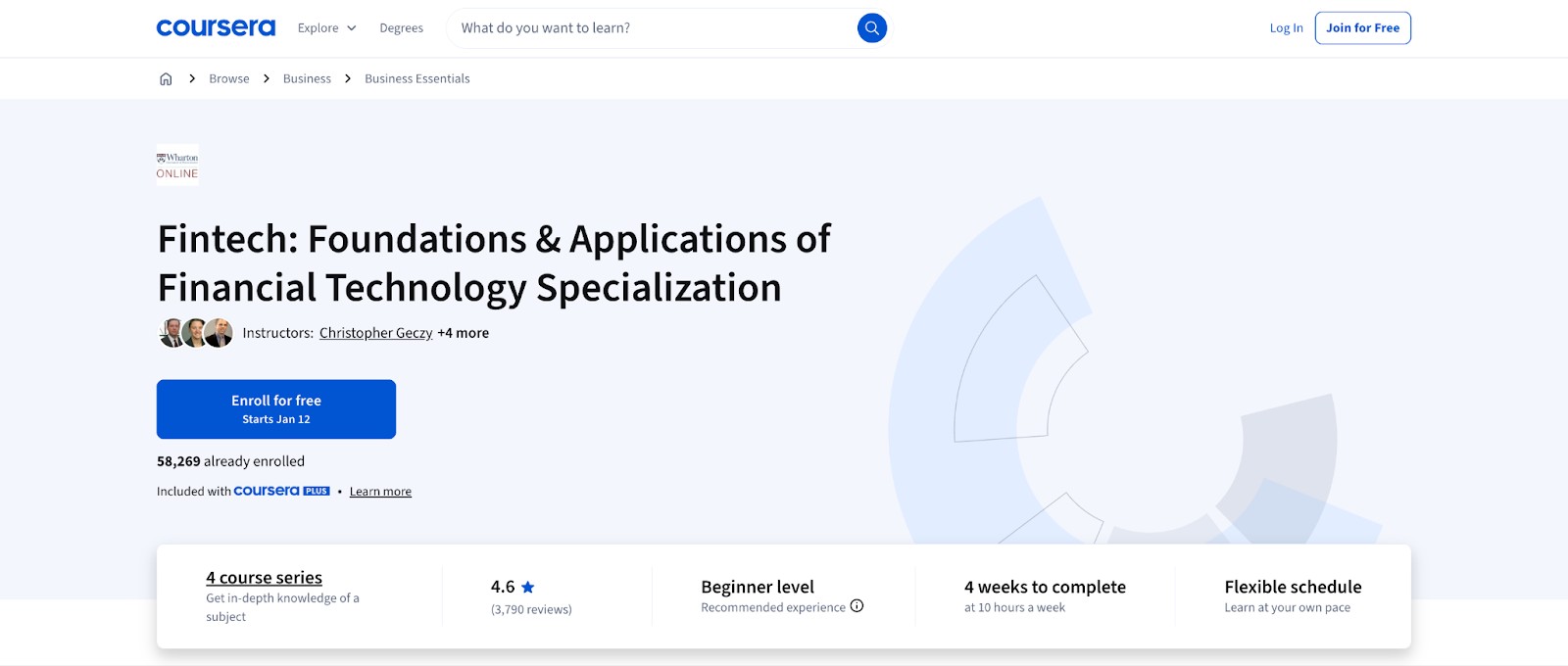
FinTech: Foundations and Applications of Financial Technology
This course introduces digital finance topics such as payments, blockchain concepts, and fintech innovation. It focuses on how technology is reshaping financial services.
- Pros
- Cons
Modern focus. Covers current fintech trends.
Broad overview. Useful for understanding digital finance.
Case-based learning. Real-world examples included.
Fast-changing field. Some content may age quickly.
Less traditional finance. Limited focus on core finance theory.
Coursera personal finance courses
Coursera’s personal finance courses focus on building practical financial skills for everyday life. These programs are designed for learners who want to improve how they manage money, rather than pursue professional finance careers.
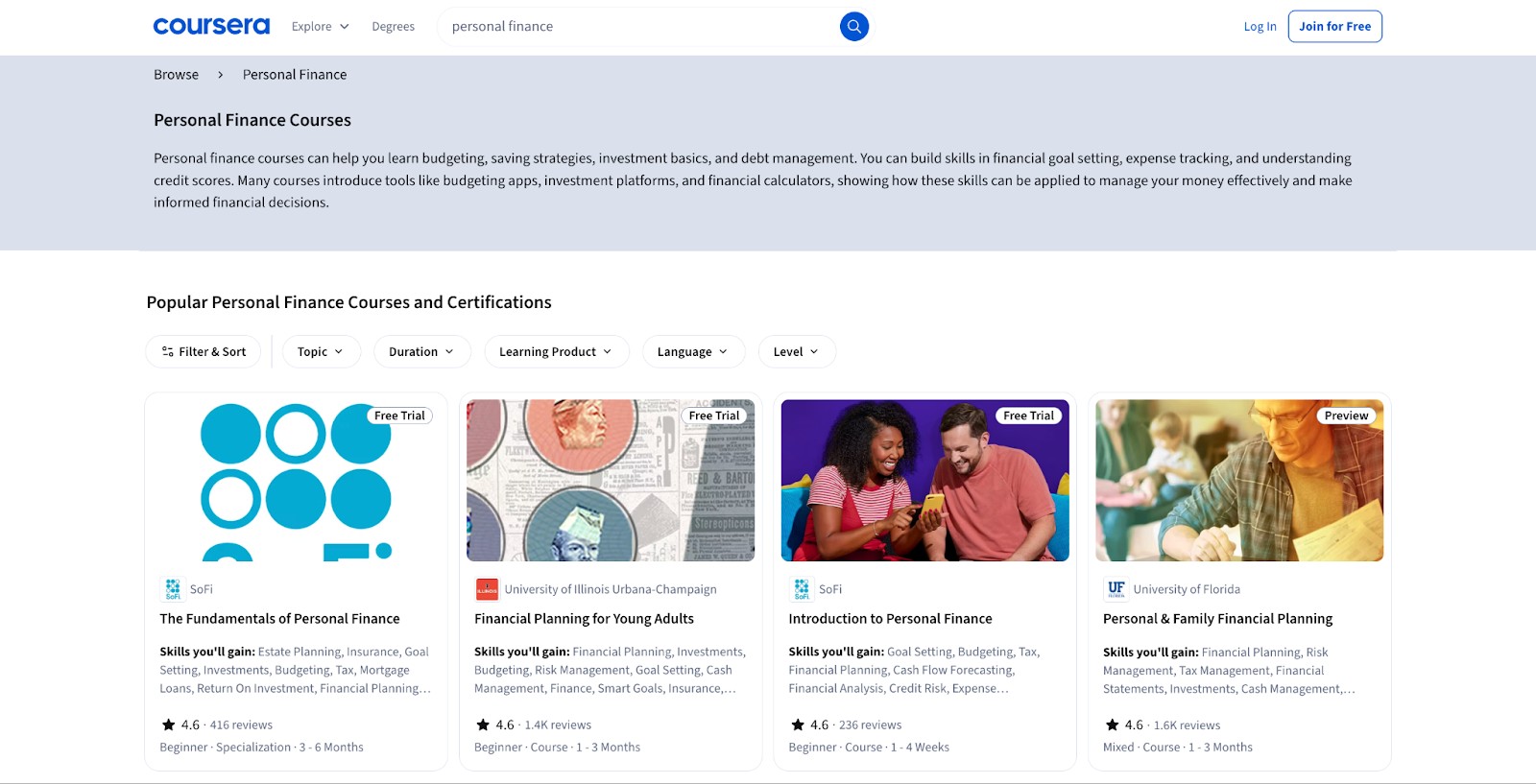
Most courses in this category emphasize clarity and real-world application. Concepts are explained in simple terms and supported by examples that reflect common financial situations.
What learners typically study
Personal finance courses on Coursera usually cover:
Budgeting basics. Managing income, expenses, and cash flow.
Debt management. Understanding credit, loans, and repayment strategies.
Saving and investing principles. Building savings habits and learning basic investment concepts.
Long-term planning. Retirement basics and financial goal setting.
These courses are well suited for beginners and non-finance professionals. They are less focused on market analysis or trading and more focused on financial literacy and responsible decision-making.
Overall, Coursera’s personal finance offerings work best as an entry point for building confidence with money and developing sound financial habits.
Coursera finance courses for professional skills
Beyond introductory learning, Coursera’s finance courses also support professional skill development. These programs are designed for learners who want to strengthen analytical abilities or prepare for finance-related roles in business, consulting, or management.
Courses in this category focus on applying financial concepts to real business situations rather than personal budgeting or general literacy.
Skills typically covered
Professional-level finance courses on Coursera often include:
Financial analysis. Interpreting financial statements and performance metrics.
Valuation techniques. Assessing companies and investment opportunities.
Corporate finance decisions. Capital budgeting, financing, and risk evaluation.
Accounting for managers. Using financial information for business decisions.
Portfolio basics. Understanding diversification and risk management concepts.
Many of these programs are offered as multi-course specializations. Learners complete a series of structured modules and, in some cases, a final project that demonstrates applied knowledge.
These courses are best suited for students, career switchers, and professionals who want a solid academic foundation before moving into advanced certifications or practical finance roles.
Certificates and credentials on Coursera
Coursera offers several types of certificates that confirm course completion and structured learning. These credentials are commonly used to demonstrate knowledge rather than replace formal professional licenses.
Types of certificates available
Coursera provides:
Course certificates. Issued after completing individual courses.
Professional certificates. Multi-course programs focused on job-related skills.
University-issued certificates. Available for select programs delivered by academic institutions.
Certificates can be useful for learners who want to show progress in finance education or support career development, especially at entry and mid-career levels.
How certificates are typically used
Coursera certificates are often used for:
CV and profile enhancement. Demonstrating structured learning in finance.
Career transitions. Supporting moves into finance-related roles.
Skill validation. Showing commitment to continuous education.
However, these credentials do not replace professional qualifications such as CFA, CPA, or similar licenses. Coursera certificates work best as a foundation or complement to formal education and hands-on experience.
Pros and cons of Coursera for finance learning
Like any education platform, Coursera has clear strengths as well as limitations when used for finance education. Understanding both helps set realistic expectations.
- Pros
- Cons
High-quality academic content. Courses are created by universities and recognized institutions.
Strong course structure. Learning paths follow a logical progression.
Wide topic coverage. From personal finance to corporate finance and fintech.
Flexible learning format. Suitable for self-paced study alongside work or school.
Paid certificates. Access to certificates usually requires payment.
Limited instructor interaction. Most courses rely on recorded content.
No market practice. Courses do not focus on live trading or real-time markets.
Overall, Coursera’s advantages favor learners seeking structured education, while its limitations matter more for those looking for hands-on market experience.
Who should use Coursera for finance education
Coursera is best suited for learners who want a structured and academically grounded approach to finance. The platform focuses on building understanding rather than teaching market timing or trading tactics.
Coursera works well for:
Beginners. Learners building a foundation in finance concepts and terminology.
Students. Those supporting formal education with university-level courses.
Career switchers. Users preparing to move into finance-related roles.
Professionals. Individuals strengthening theoretical knowledge or filling skill gaps.
At the same time, Coursera may not meet the expectations of every user.
It is less suitable for:
Active traders. Users looking for real-time market signals or strategies.
Mentorship seekers. Learners expecting one-on-one guidance.
Shortcut hunters. Anyone looking for quick or guaranteed outcomes.
Overall, Coursera is most effective for learners who value education, structure, and long-term skill development over immediate practical execution.
While Coursera helps build strong finance knowledge, many learners eventually want to apply what they study in real markets. Exploring some of the best brokers with a wide range of assets can help bridge the gap between theory and practice by offering access to stocks, Forex, and other instruments in one place. This combination allows learners to reinforce concepts through real investment decisions over time.
| Plus500 | Trading.com USA | OANDA | FOREX.com | IG Markets | |
|---|---|---|---|---|---|
|
Tradable assets |
2800 | 69 | 129 | 5500 | 20000 |
|
Min. deposit, $ |
100 | 50 | No | 100 | 1 |
|
Max. leverage |
1:300 | 1:50 | 1:200 | 1:50 | 1:200 |
|
Demo |
Yes | Yes | Yes | Yes | Yes |
|
Copy trading |
No | No | Yes | Yes | Yes |
|
Education |
4.20 | 8.90 | 4.60 | 5.00 | 8.40 |
|
TU overall score |
7.7 | 6.88 | 6.63 | 6.47 | 6.38 |
|
Open an account |
Go to broker 81% of retail CFD accounts lose money. |
Go to broker Your capital is at risk. |
Go to broker Your capital is at risk. |
Study review | Study review |
Strong foundation, not a standalone solution

When I evaluate finance learning platforms, I look at whether they improve how people think about money and financial decisions. Coursera performs well in this area. Its finance courses are structured, methodical, and built around explanation rather than shortcuts. Learners are guided through concepts step by step, which helps prevent the surface-level understanding that often comes from fragmented online content.
From my experience, Coursera works best as a foundation rather than a complete solution. It is particularly effective for beginners, students, and professionals who want to strengthen their theoretical base before applying knowledge in real-world settings. I often see the best results when Coursera is used alongside further study or practical experience, not as a replacement for it.
Conclusion
Coursera stands out as a reliable foundation for building strong finance knowledge through structured, academically rigorous courses. Its programs, such as Yale’s Financial Markets or Penn’s Introduction to Corporate Finance, provide learners with depth and clarity often missing from informal platforms. While Coursera certificates are respected for skill validation and CV enhancement, they complement rather than replace professional licenses or real-world practice. The key takeaway is that Coursera empowers learners to develop confidence and understanding in finance but works best as a springboard toward further study and practical experience.
FAQs
How do Coursera finance courses differ from informal online finance resources?
What topics are commonly found in Coursera’s personal finance courses?
Are Coursera certificates in finance recognized by employers or education providers?
Who might not find Coursera’s finance courses suitable for their needs?
Editors' Top Picks and Insights






Related Articles
Team that worked on the article
Dan Blystone began his trading career in 1998 as an arbitrage clerk on the floor of the Chicago Mercantile Exchange (CME). He later traded bond and Eurex futures at proprietary firms such as Altea Trading, gaining valuable experience in high-frequency trading and risk management.
Chinmay Soni is a financial analyst with more than 5 years of experience in working with stocks, Forex, derivatives, and other assets. As a founder of a boutique research firm and an active researcher, he covers various industries and fields, providing insights backed by statistical data.
Bitcoin is a decentralized digital cryptocurrency that was created in 2009 by an anonymous individual or group using the pseudonym Satoshi Nakamoto. It operates on a technology called blockchain, which is a distributed ledger that records all transactions across a network of computers.
CFD is a contract between an investor/trader and seller that demonstrates that the trader will need to pay the price difference between the current value of the asset and its value at the time of contract to the seller.
Risk management is a risk management model that involves controlling potential losses while maximizing profits. The main risk management tools are stop loss, take profit, calculation of position volume taking into account leverage and pip value.
An investor is an individual, who invests money in an asset with the expectation that its value would appreciate in the future. The asset can be anything, including a bond, debenture, mutual fund, equity, gold, silver, exchange-traded funds (ETFs), and real-estate property.
Diversification is an investment strategy that involves spreading investments across different asset classes, industries, and geographic regions to reduce overall risk.

-
 Afghanistan
-
 Albania
-
 Algeria
-
 Angola
-
 Argentina
-
 Armenia
-
 Australia
-
 Austria
-
 Azerbaijan
-
 Bahamas
-
 Bahrain
-
 Bangladesh
-
 Belarus
-
 Belgium
-
 Bolivia
-
 Botswana
-
 Brazil
-
 Brunei
-
 Bulgaria
-
 Cambodia
-
 Cameroon
-
 Canada
-
 Chile
Chile
-
 China
China
-
 Colombia
-
 Congo
Congo
-
 Costa Rica
-
 Cote d'Ivoire
-
 Croatia
-
 Cuba
Cuba
-
 Cyprus
-
 Czechia
-
 DR Congo
-
 Denmark
-
 Dominican Republic
-
 Ecuador
-
 Egypt
Egypt
-
 El Salvador
-
 Estonia
-
 Eswatini
-
 Ethiopia
-
 Finland
-
 France
-
 Georgia
-
 Germany
-
 Ghana
Ghana
-
 Greece
-
 Haiti
Haiti
-
 Hong Kong
-
 Hungary
-
 India
India
-
 Indonesia
-
 Iran, Islamic republic
-
 Iraq
Iraq
-
 Ireland
-
 Israel
-
 Italy
Italy
-
 Jamaica
-
 Japan
Japan
-
 Jordan
-
 Kazakhstan
-
 Kenya
Kenya
-
 Korea
Korea
-
 Kuwait
-
 Kyrgyzstan
-
 Laos
Laos
-
 Latvia
-
 Lebanon
-
 Lesotho
-
 Libya
Libya
-
 Lithuania
-
 Luxembourg
-
 Madagascar
-
 Malaysia
-
 Malta
Malta
-
 Mauritius
-
 Mexico
-
 Moldova
-
 Mongolia
-
 Montenegro
-
 Morocco
-
 Mozambique
-
 Myanmar
-
 Namibia
-
 Nepal
Nepal
-
 Netherlands
-
 New Zealand
-
 Nigeria
-
 North Macedonia
-
 Norway
-
 Oman
Oman
-
 Pakistan
-
 Palestine
-
 Panama
-
 Papua New Guinea
-
 Paraguay
-
 Peru
Peru
-
 Philippines
-
 Poland
-
 Portugal
-
 Puerto Rico
-
 Qatar
Qatar
-
 Reunion
-
 Romania
-
 Rwanda
-
 Saudi Arabia
-
 Serbia
-
 Singapore
-
 Slovakia
-
 Slovenia
-
 Somalia
-
 South Africa
-
 Spain
Spain
-
 Sri Lanka
-
 Sweden
-
 Switzerland
-
 Syria
Syria
-
 Taiwan
-
 Tajikistan
-
 Tanzania
-
 Thailand
-
 Trinidad and Tobago
-
 Tunisia
-
 Turkey
-
 UAE
UAE
-
 Uganda
-
 Ukraine
-
 United Kingdom
-
United States
-
 Uruguay
-
 Uzbekistan
-
 Venezuela
-
 Vietnam
-
 Yemen
Yemen
-
 Zambia
-
 Zimbabwe
- Forex
- Crypto










- What is Coursera?
- Why Coursera works well for finance education
- Coursera finance courses overview
- Top Coursera finance courses
- Coursera personal finance courses
- Coursera finance courses for professional skills
- Certificates and credentials on Coursera
- Pros and cons of Coursera for finance learning
- Who should use Coursera for finance education
- Expert opinion
- Conclusion
- FAQs


