
How To Use Alligator Indicator In Binary Options


Editorial Note: While we adhere to strict Editorial Integrity, this post may contain references to products from our partners. Here's an explanation for How We Make Money. None of the data and information on this webpage constitutes investment advice according to our Disclaimer.
The Alligator indicator is a powerful tool that helps traders in binary options spot when the market is shifting from a calm, range-bound phase to a more active, trending state. Instead of reacting late, traders can observe the slope and the separation between the three lines to get early clues about potential market momentum. This makes it easier to enter trades as trends begin, and to stay away when the market is stuck in sideways movement.
Many traders simply drop the Alligator indicator on their charts and start chasing trends blindly. But the Alligator is far more insightful when used correctly. It quietly shows when the market is asleep, drifting, or just about to wake up. Learning how to use the Alligator indicator in binary options trading isn’t just about spotting trends, it’s about identifying when not to trade. That early stir, the slight widening or crossing of lines, can be the difference between a guess and a smart entry.
In Alligator binary options trading, understanding the subtle signals of the indicator helps traders spot structural shifts early. This allows for more confident and timely decisions, rather than waiting for delayed confirmations.
Risk warning: Binary options trading is highly risky and may result in a total loss of funds. These speculative instruments often lack strong regulation, with over 80% of traders losing their capital. Invest only what you can afford to lose and seek professional advice.
Introduction to the Alligator indicator
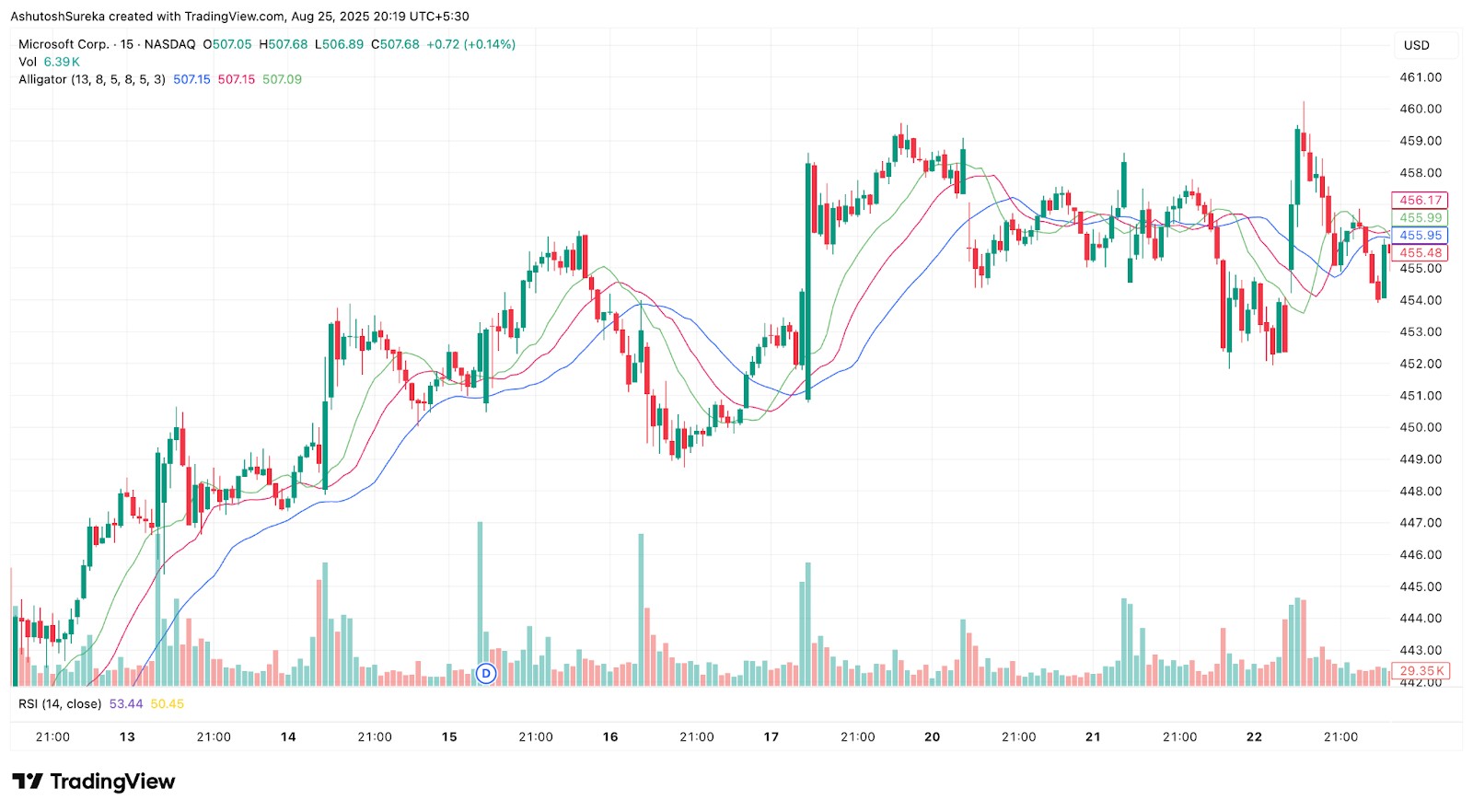
Most new traders plug the alligator binary options indicator onto their chart and simply look for its three smoothed moving averages to fan out. That approach overlooks the true value of the tool. Bill Williams designed the Alligator to reveal when the market is asleep, stirring, or about to break into a trend. In a binary options context, understanding these phases gives you a serious edge because execution windows are short.
The spacing and slope of the jaw, teeth and lips tell you if price is compressing or expanding. When combined with supply‑demand zones, the Alligator becomes a powerful timing device that shows you where big players are accumulating positions.
Unlike oscillators that flash constant overbought/oversold signals, the Alligator’s core purpose is to filter out noise and keep you out of choppy markets. During the “sleeping” phase the lines are intertwined and price tends to drift, which signals caution. When the lines separate during the “awakening” and “eating” phases, a directional move is beginning. For binary options traders who must make decisions on short expiries, recognising these shifts is more valuable than chasing every tick.
What is the Alligator indicator and how does it work?
The Alligator indicator is built from three smoothed moving averages, each set with a distinct length and shifted forward on the chart.
The jaw is a 13-period smoothed moving average projected eight candles forward, showing the market’s long-term state of balance. The teeth use an 8-period smoothed moving average shifted five candles ahead, highlighting medium-term market reactions. The lips are a 5-period smoothed moving average advanced three candles, reflecting short-term price adjustments.
Together, these settings form a clear picture: the jaw anchors broader trends, the teeth track intermediate movement, and the lips capture quick, short-range changes.
When the lines intertwine, the Alligator is “sleeping” and the market is consolidating. When they begin to spread in one direction, the Alligator “wakes up,” signalling that volatility and trend strength are increasing.
Origins and purpose in trend analysis
Bill Williams introduced the Alligator indicator in his 1995 book Trading Chaos. His goal was to provide a simple visual tool that shows when the market has digested its current range and is ready to trend. Williams emphasised three market states, Sleeping, Awakening and Eating, which correspond to consolidation, early breakout and strong trend. Traders often confuse the Alligator with moving‑average crossovers, but its forward shifts mean it anticipates rather than reacts to price. This makes it especially useful for binary options traders who need to anticipate moves instead of waiting for traditional trend confirmations.
Why it suits binary options trading setups
Binary options require precise timing and quick decision‑making. The Alligator’s ability to filter out sideways markets and highlight the start of a trend is particularly valuable when trading short expiries. When the lines widen and angle upward, they indicate that momentum is building; when they flatten, they warn of an impending consolidation. This clear visual structure makes the Alligator a practical tool for both beginners and experienced traders seeking clarity in fast‑moving markets. It also complements other price‑based tools like fractals or supply‑demand zones, giving you multiple layers of confirmation for entries.
Core components of the Alligator indicator
The Alligator indicator is made up of three moving averages that work together to show market balance and direction. In binary options trading, these elements are often described as the jaw, teeth, and lips, and their interaction signals whether the market is consolidating or trending.
Understanding the three lines (jaw, teeth, lips)
The Alligator indicator uses three forward‑shifted moving averages to map balance and momentum:
Jaw (blue). A 13-period smoothed moving average that is projected eight candles ahead, representing the broader price balance over the long term.
Teeth (red). An 8-period smoothed moving average shifted five candles forward, designed to highlight medium-range price responses.
Lips (green). A 5-period smoothed moving average moved three candles in advance, focusing on short-term price shifts and quick market reactions.
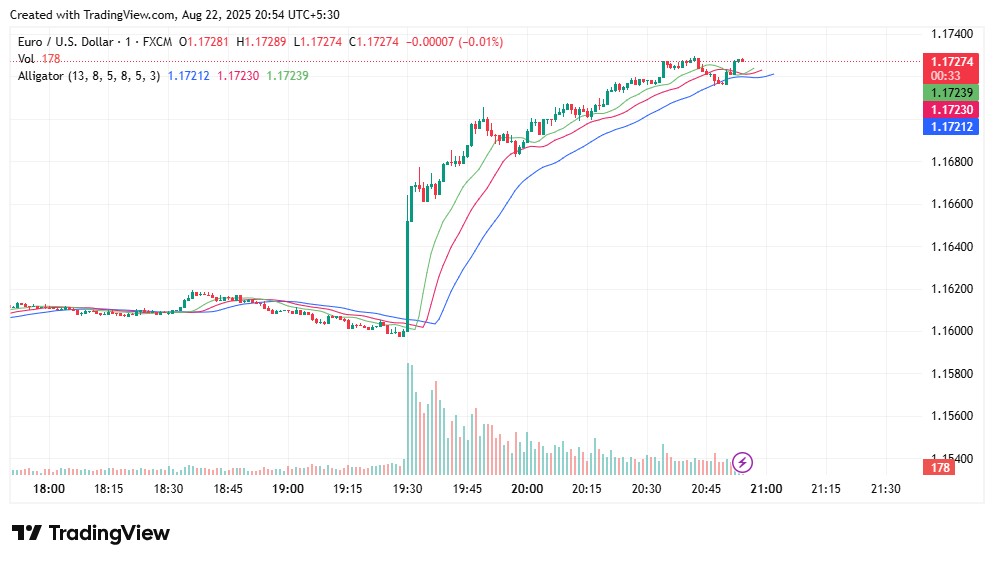
When these lines are layered on your chart, they produce a “mouth” that shows whether price is contained (mouth closed) or trending (mouth open). This design helps traders avoid entering during range‑bound periods and focus on times when momentum is likely to carry price for a few candles. Many beginners throw the indicator on a low timeframe without understanding that the forward shifts make it predictive, something you can exploit by aligning entries just as the lips and teeth begin to fan away from the jaw.
Meaning of the opening and closing of the mouth
The Alligator’s mouth helps read market rhythm:
Sleeping. When the three lines are intertwined, the Alligator is sleeping. Price action tends to be flat and choppy, so avoid taking new binary positions.
Awakening. As the lips (green line) begin to separate from the teeth and jaw, the Alligator is awakening. This early separation hints at the start of a trend, and entry opportunities often arise during this phase.
Eating. When the lines are fully spread apart and angle strongly in one direction, the Alligator is eating. This represents a well‑established trend, and traders can ride it for short expiries in the direction of the move.
Sated. As the lines converge again, the Alligator becomes sated. This signals that momentum is waning and a reversal or range may follow. For binary options, this is often the cue to exit before expiry or stand aside.
Understanding these phases keeps you disciplined: you only take trades when the mouth is opening in the direction you want to trade, and you avoid being trapped in the chop when the mouth is closed.
Visualizing momentum and consolidation
Momentum is not just about direction, it is about the distance between the Alligator’s lines. Wide separation indicates strong trending conditions, while narrow spacing suggests consolidation. On higher timeframes, such as the 15‑minute chart, you will see fewer but stronger signals; on shorter charts like the 1‑minute, signals appear more frequently but carry more noise. An easy way to visualise this is by plotting the Alligator on a trending pair like EUR/USD: during a sustained move the lines expand and maintain clear spacing; when price begins to coil, they flatten and overlap. This real‑time feedback helps you decide whether to hold a position until expiry or to avoid trading altogether.
How to set up the Alligator indicator on trading platforms
To use the Alligator indicator effectively in binary options trading, traders need to set it up correctly on their platform. Most modern charting tools and broker platforms include the Alligator as a standard feature, making it easy to add and customize for different strategies.
Best platforms for using Alligator in binary trading
The Alligator indicator is available on nearly all modern trading platforms, including MetaTrader 4/5, TradingView and broker‑provided terminals.
| Feature | MetaTrader | TradingView | Binary Options Needs |
|---|---|---|---|
| Backtesting | Supports testing of custom parameter sets | Limited backtesting, mainly visual | Historical testing helps refine entry rules |
| Interface | More technical, suited for advanced users | Clean, intuitive, easy to navigate | Fast and simple layout preferred |
| Indicators | Full customization, including shifts for Alligator | Easy overlays of additional indicators, but less customizable | Must allow forward projection of moving averages |
| Execution Speed | Depends on broker integration | Web-based, charting only | Critical — requires low latency order execution |
| Real-time Charting | Broker-dependent | Real-time across devices | Essential for short expiries and quick signals |
Recommended indicator settings for short-term trades
The default Alligator settings (jaw 13, teeth 8, lips 5 with shifts of 8, 5 and 3) work well on 5‑minute and 15‑minute charts. However, binary options often involve expiries as short as 60 seconds. For 1‑minute trades you can speed up the indicator by using settings such as jaw 8, teeth 5 and lips 3 with shifts of 5, 3 and 2. This shorter configuration reacts faster to price but may produce more false signals. Always backtest on a demo account before deploying real capital.
Customization tips to fit 1-minute and 15-minute charts
Different timeframes require different adjustments to keep the Alligator useful:
1‑minute charts. Shorten the periods and shifts (e.g., 8/5/3 periods and 5/3/2 shifts) and combine the Alligator with a volume or volatility filter (such as ATR) to avoid whipsaws.
15‑minute charts. Use default or slightly longer periods (13/8/5 with shifts of 8/5/3). This timeframe smooths out noise and aligns well with expiries of 30 to 60 minutes.
Multiple timeframes. Consider overlaying the indicator on a higher timeframe (e.g., 30‑minute) for context and using a lower timeframe (e.g., 5‑minute) for entries. When the Alligator mouth is opening on both charts in the same direction, the probability of a profitable binary trade increases.
Best Alligator indicator strategies for binary options
The Alligator indicator is flexible and can be applied in several ways for binary options trading. It helps traders spot trends, avoid sideways markets, and even time reversals. Below are three of the most effective strategies.
Alligator trend-following entry method
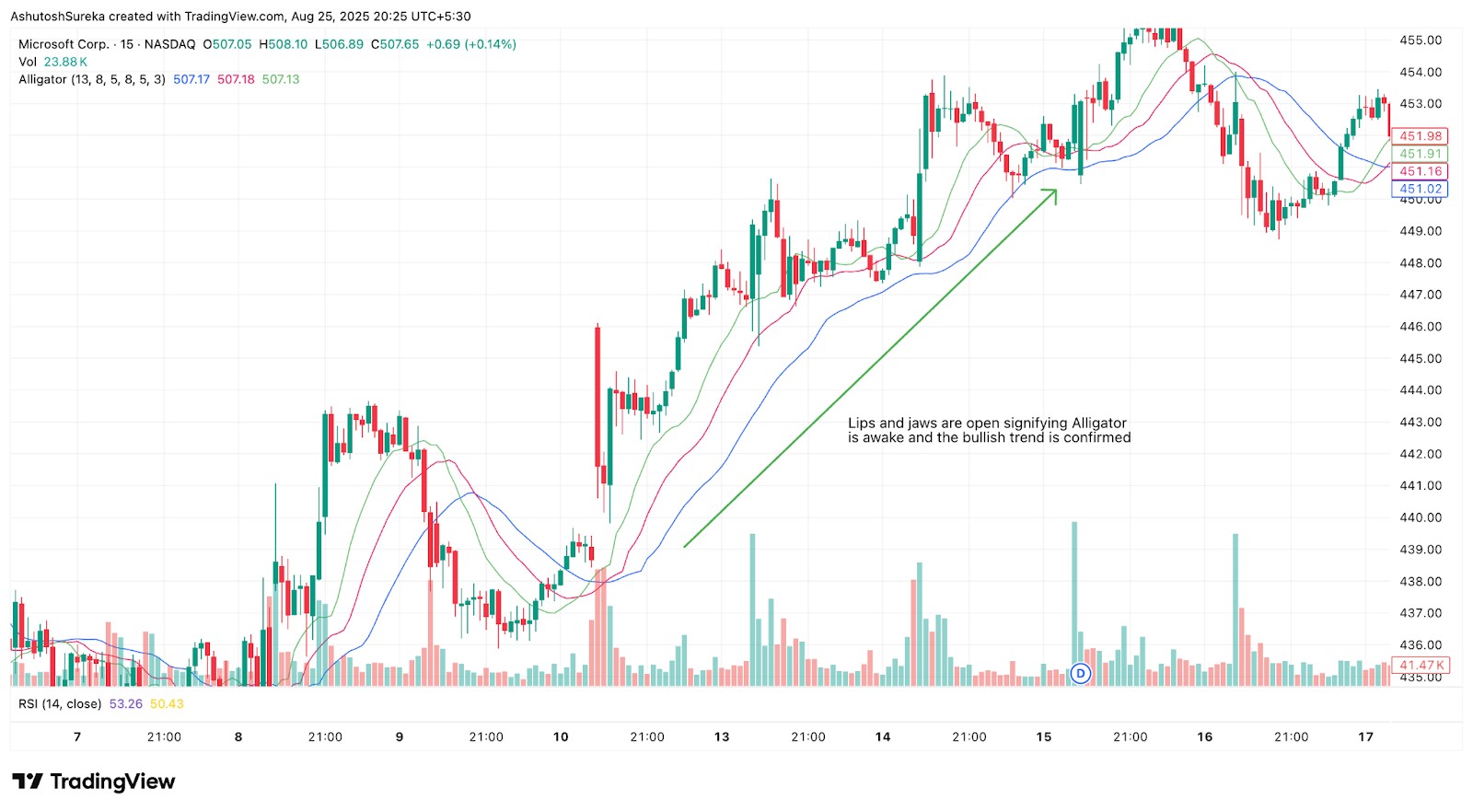
One of the strongest uses of the Alligator indicator is in trend-following setups. When the jaw, teeth, and lips spread apart and point in the same direction, the Alligator is said to be “awake.” This signals the start of a trend that can be traded in short-term binary expiries.
How to apply it:
for call trades, look for all three lines pointing upward with price action staying above them;
for put trades, check for all three lines sloping downward with price below;
enter after a confirmation candle closes in the trend’s direction.
Avoid jumping in right when the lines start separating; early signals might be misleading. Add confirmation from RSI or volume indicators to strengthen your entry.
Reversal spotting using Alligator mouth closing
Besides following trends, the Alligator can help anticipate when a trend is slowing down. As the three moving averages begin to converge, the Alligator is said to be "falling asleep", a visual signal that momentum is fading. Traders often prepare for reversals at this point or anticipate consolidation zones.

How to apply it:
watch for the three lines tightening after an extended move;
look for a candle that closes against the current trend as an early reversal clue;
confirm with candlestick formations like engulfing bars or pin bars.
Not every mouth closing means a reversal, some lead to sideways movement instead. Practice identifying false signals using demo charts before going live.
Sideways filter to avoid false entries
Most losses in binary trading happen when entering sideways or choppy markets. This is where the alligator indicator really shines in binary options trading, as it helps traders stay out when there’s no clear trend.
How to apply it:
when the jaw, teeth, and lips are entangled and not pointing clearly, it’s best to stay out;
re-enter only when the lines fan out and signal momentum;
use ranging phases to map out support and resistance for future breakouts.
Staying out when the Alligator is sleeping is often better than forcing trades. Wait for proper alignment before re-engaging with the trend.
Understanding how to use the Alligator indicator in binary options means more than just looking at the lines, it's about knowing when to act, when to wait, and how to filter out noise to make better trading decisions.
Combining Alligator indicator with other indicators
The Alligator indicator works well on its own, but combining it with other tools makes it stronger for binary options trading. Traders often use momentum indicators, trend filters, and volume tools alongside the Alligator to confirm setups and avoid false entries.
Using RSI to confirm Alligator trend signals
RSI is a momentum indicator that pairs naturally with the Alligator indicator. While the Alligator shows whether a trend is forming, RSI tells if the trend has enough strength.
How to apply it:
when the Alligator lines spread upward, a call setup is stronger if RSI is above 60;
when the Alligator lines spread downward, a put setup is more reliable if RSI is below 40;
avoid trades if RSI is between 40 and 60, even if the Alligator shows direction.
RSI helps avoid weak trends where price lacks strength. Works best on 5-minute to 15-minute charts for binary setups.
MACD and Alligator for double confirmation
MACD filters trend direction and momentum. When combined with the Alligator indicator, it provides a double layer of confirmation for binary trades.
How to apply it:
for call trades, check that Alligator lines point up and MACD histogram is positive;
for put trades, look for Alligator lines pointing down with MACD below zero;
enter only when both indicators align, reducing false signals.
Use MACD as a filter, not as the primary entry signal. Avoid trading when MACD is flat, even if the Alligator shows movement.
Volume indicators to avoid false breakouts
Volume confirms whether a price move has market participation. Adding volume to the Alligator indicator prevents traders from entering false breakouts.
How to apply it:
if Alligator lines spread wide but volume is low, skip the trade;
enter only when a breakout or continuation move is backed by strong volume;
tools like OBV (On Balance Volume) or simple volume bars are effective with this setup.
Volume acts as a reality check to ensure the trend is genuine. Practice combining Alligator and volume on demo charts before live trading.
Benefits and limitations of using Alligator indicator in binary options
The Alligator indicator can be very effective in binary options trading, but like any tool, it has both strengths and weaknesses. Knowing when it works well and when it lags helps traders use it more effectively.
When Alligator performs best
The Alligator indicator shines in trending markets. Its three lines open wide and move in the same direction, giving traders a clear view of momentum.
Best conditions:
strong trending phases on Forex pairs such as EUR/USD or GBP/USD;
breakouts following long consolidation periods;
medium timeframes like 5-minute or 15-minute charts where trends are cleaner.
In these situations, the Alligator helps traders catch the bulk of the move and avoid sideways noise.
Situations where it gives lagging signals
Since the Alligator indicator is based on smoothed moving averages, it reacts slowly to sudden changes. This makes it less effective in fast reversals or very short time frames:
signals often arrive late after the trend has already started;
in choppy markets, the lines tangle and give confusing signals;
on 1-minute charts, lagging behavior is more noticeable and can reduce win rate.
This lag is a common challenge in binary options trading, where quick entries are often required.
Tips to reduce false alerts
To maximise the Alligator’s effectiveness:
Wait for clear separation. Do not enter when the lines barely diverge; a wide mouth indicates stronger momentum.
Confirm with filters. Use RSI, MACD or volume to verify that the trend has strength.
Focus on high‑volume periods. Trade during major sessions (London/NY) where liquidity is higher.
Adapt your expiry. On faster charts use shorter expiries; on slower charts give the trade room to develop.
Avoid major news events. The Alligator reacts poorly to sudden spikes; stay out of the market when economic releases are imminent.
Once you understand how to filter signals and improve accuracy, the next step is choosing a reliable broker. The table below compares top binary options brokers that support strategies like the Alligator, helping you match the right platform to your trading style.
| Foundation year | Min. deposit | Min. trade size | Min. Payout (%) | Max. Payout (%) | Demo | Copy trading | Open an account | |
|---|---|---|---|---|---|---|---|---|
| 2013 | 5 | 1 | 17 | 95 | Yes | No | Go to broker Your capital is at risk. |
|
| 2019 | 10 | 1 | 60 | 90 | Yes | No | Go to broker Your capital is at risk.
|
|
| 2009 | 250 | 1 | No | 100 | Yes | No | Study review | |
| 2017 | 5 | 1 | 50 | 128 | Yes | Yes | Go to broker Your capital is at risk. |
|
| 2019 | 10 | 1 | 20 | 98 | Yes | No | Go to broker Your capital is at risk. |
Using Alligator squeezes and sleep phases to master binary entries

Most traders misuse the Alligator indicator by treating it like a trend-following tool alone. But in binary options, where expiry timing is everything, the real edge comes from mastering the "sleep-wake cycle" of the Alligator’s lines. When the three lines (lips, teeth, jaw) compress tightly and move sideways, this is the Alligator sleeping. What most traders ignore is that this “sleep” is not just consolidation, but the prelude to an aggressive breakout. Instead of placing trades during trending movements, expert binary traders prepare entries just as the lines begin to separate after a deep sleep. This moment, when the Alligator yawns, is your early signal to place a short expiry trade in the breakout direction, especially effective on 1m or 5m charts.
Another high-level trick is using the Alligator to filter out fakeouts during news releases or volatile sessions. Combine it with an ATR (Average True Range) and set a threshold: only take entries where the Alligator opens after a sleep phase and ATR spikes above a set level (say 1.5x the average). This reduces whipsaws and gives binary traders a tighter, high-probability entry. During ranging markets, this technique keeps you out. During breakouts, it confirms direction. This combo works exceptionally well during London or New York overlap sessions on high-volume assets like EUR/USD or NASDAQ binaries.
Conclusion
Traders who master the Alligator for binary options do not focus on the trend itself. They focus on when it is waking up. The real value lies in the moments of compression not the wide-open mouth. If you can train your eye to see the early slope changes and treat flat phases as preparation not noise you will catch the move before it becomes obvious. The Alligator rewards those who wait patiently during stillness and strike precisely when movement begins. That habit separates the reactive from the strategic in binary trading.
FAQs
Can this indicator be used on crypto binary options?
Yes, the Alligator indicator can be used on crypto binary options as it helps identify trend direction and entry zones. It performs best on liquid pairs like BTC or ETH with clear directional movement.
How can I tell if the Alligator signal is false?
A false Alligator signal often appears when the lines are tightly twisted or quickly reverse. To avoid traps, confirm the signal with price structure or wait for a strong candle break after the Alligator opens.
Is the Alligator better for trending or ranging markets?
The Alligator works best in trending markets, as it helps visualize when momentum is building or fading. In ranging conditions, it often gives choppy and misleading signals due to frequent line crossovers.
What expiry time works best with Alligator signals?
For binary options, 15 to 30-minute expiries generally align well with Alligator signals on the 5-minute chart. The key is to match expiry with the strength and duration of the trend you’re trading.
Editors' Top Picks and Insights






Related Articles
Team that worked on the article
Emilio is a futures trader and financial writer who specializes in technical analysis, market news, and trading psychology. He began his career by completing the Cornerstone Traders Qualification under the mentorship of a gold futures veteran from Bank of America on Wall Street.
Dan Blystone began his trading career in 1998 as an arbitrage clerk on the floor of the Chicago Mercantile Exchange (CME). He later traded bond and Eurex futures at proprietary firms such as Altea Trading, gaining valuable experience in high-frequency trading and risk management.
Chinmay Soni is a financial analyst with more than 5 years of experience in working with stocks, Forex, derivatives, and other assets. As a founder of a boutique research firm and an active researcher, he covers various industries and fields, providing insights backed by statistical data.
ATR (Average True Range) is a volatility indicator that helps traders assess the potential price range or volatility of a financial instrument. It calculates the average of true price ranges over a specified period, providing insight into the level of price fluctuations within that timeframe.
Binary options trading is a financial trading method where traders speculate on the price movement of various assets, such as stocks, currencies, or commodities, by predicting whether the price will rise or fall within a specified time frame, often as short as a few minutes. Unlike traditional trading, binary options have only two possible outcomes: a fixed payout if the trader's prediction is correct or a loss of the invested amount if the prediction is wrong.
Options trading is a financial derivative strategy that involves the buying and selling of options contracts, which give traders the right (but not the obligation) to buy or sell an underlying asset at a specified price, known as the strike price, before or on a predetermined expiration date. There are two main types of options: call options, which allow the holder to buy the underlying asset, and put options, which allow the holder to sell the underlying asset.
Backtesting is the process of testing a trading strategy on historical data. It allows you to evaluate the strategy's performance in the past and identify its potential risks and benefits.
Index in trading is the measure of the performance of a group of stocks, which can include the assets and securities in it.

-
 Afghanistan
-
 Albania
-
 Algeria
-
 Angola
-
 Argentina
-
 Armenia
-
 Australia
-
 Austria
-
 Azerbaijan
-
 Bahamas
-
 Bahrain
-
 Bangladesh
-
 Belarus
-
 Belgium
-
 Bolivia
-
 Botswana
-
 Brazil
-
 Brunei
-
 Bulgaria
-
 Cambodia
-
 Cameroon
-
 Canada
-
 Chile
Chile
-
 China
China
-
 Colombia
-
 Congo
Congo
-
 Costa Rica
-
 Cote d'Ivoire
-
 Croatia
-
 Cuba
Cuba
-
 Cyprus
-
 Czechia
-
 DR Congo
-
 Denmark
-
 Dominican Republic
-
 Ecuador
-
 Egypt
Egypt
-
 El Salvador
-
 Estonia
-
 Eswatini
-
 Ethiopia
-
 Finland
-
 France
-
 Georgia
-
 Germany
-
 Ghana
Ghana
-
 Greece
-
 Haiti
Haiti
-
 Hong Kong
-
 Hungary
-
 India
India
-
 Indonesia
-
 Iran, Islamic republic
-
 Iraq
Iraq
-
 Ireland
-
 Israel
-
 Italy
Italy
-
 Jamaica
-
 Japan
Japan
-
 Jordan
-
 Kazakhstan
-
 Kenya
Kenya
-
 Korea
Korea
-
 Kuwait
-
 Kyrgyzstan
-
 Laos
Laos
-
 Latvia
-
 Lebanon
-
 Lesotho
-
 Libya
Libya
-
 Lithuania
-
 Luxembourg
-
 Madagascar
-
 Malaysia
-
 Malta
Malta
-
 Mauritius
-
 Mexico
-
 Moldova
-
 Mongolia
-
 Montenegro
-
 Morocco
-
 Mozambique
-
 Myanmar
-
 Namibia
-
 Nepal
Nepal
-
 Netherlands
-
 New Zealand
-
 Nigeria
-
 North Macedonia
-
 Norway
-
 Oman
Oman
-
 Pakistan
-
 Palestine
-
 Panama
-
 Papua New Guinea
-
 Paraguay
-
 Peru
Peru
-
 Philippines
-
 Poland
-
 Portugal
-
 Puerto Rico
-
 Qatar
Qatar
-
 Reunion
-
 Romania
-
 Rwanda
-
 Saudi Arabia
-
 Serbia
-
 Singapore
-
 Slovakia
-
 Slovenia
-
 Somalia
-
 South Africa
-
 Spain
Spain
-
 Sri Lanka
-
 Sweden
-
 Switzerland
-
 Syria
Syria
-
 Taiwan
-
 Tajikistan
-
 Tanzania
-
 Thailand
-
 Trinidad and Tobago
-
 Tunisia
-
 Turkey
-
 UAE
UAE
-
 Uganda
-
 Ukraine
-
 United Kingdom
-
United States
-
 Uruguay
-
 Uzbekistan
-
 Venezuela
-
 Vietnam
-
 Yemen
Yemen
-
 Zambia
-
 Zimbabwe
- Forex
- Crypto










- Introduction to the Alligator indicator
- Core components of the Alligator indicator
- How to set up the Alligator indicator on trading platforms
- Best Alligator indicator strategies for binary options
- Combining Alligator indicator with other indicators
- Benefits and limitations of using Alligator indicator
- Expert opinion
- Conclusion
- FAQs


