
JPY Intervention: BOJ Actions And Forex Responses


Editorial Note: While we adhere to strict Editorial Integrity, this post may contain references to products from our partners. Here's an explanation for How We Make Money. None of the data and information on this webpage constitutes investment advice according to our Disclaimer.
Japan’s currency policy is shaped by the Ministry of Finance, which instructs the Bank of Japan to intervene when sharp yen movements threaten economic stability. Using its foreign exchange fund, the central bank buys or sells yen to influence the exchange rate, often around key levels such as ¥155 per dollar. These interventions aim to curb volatility, protect corporate competitiveness, and stabilize inflation, though their long-term impact depends on broader monetary policy and global market conditions.
In this article, we will discuss how Japanese currency intervention works, the tools used by the Bank of Japan, and the signals traders should monitor. We will also explore why the yen exchange rate changes, how interventions affect global markets, and what strategies investors can apply to manage risk and capture opportunities.
How the Bank of Japan intervenes in the yen exchange rate
Foreign exchange intervention in Japan is directed by the Ministry of Finance, with the Bank of Japan framework positioning the central bank as the operational arm for intervention under the Foreign Exchange and Foreign Trade Act. The Japanese central bank itself does not decide when to act; instead, it carries out intervention once instructed by the ministry. A dedicated division within the Bank of Japan monitors exchange rates daily, tracks market activity, and communicates with overseas central banks. This information forms the basis for potential Japanese intervention in foreign exchange market operations.

Coordination with the Ministry of Finance
Funding for every Japanese foreign exchange intervention comes from the Foreign Exchange Fund Special Account, controlled exclusively by the Ministry of Finance. The Bank of Japan uses this account to settle all transactions with market participants.
After each operation, the central bank provides detailed reports to the ministry on market responses, allowing officials to determine whether further Japanese government intervention is necessary in the currency market. Interventions can take three forms: direct operations by the Bank of Japan, entrustment interventions where Japanese funds are deployed overseas, and reverse-entrustment interventions where the bank acts for foreign authorities.
Operational mechanisms
The Bank of Japan typically enters the market by buying or selling currencies to influence the yen’s value. To counter depreciation, it sells dollars and buys yen; to restrain excessive appreciation, it buys dollars and sells yen. These yen intervention operations usually take place in the spot market, with settlements following the T+2 global standard and confirmation through SWIFT.
Beyond spot trades, the bank may use forward contracts, which commit to exchanges at a fixed rate on a future date. This approach allows the authorities to shape expectations around what caused the change in the yen's exchange rate without immediate settlement. Interventions may be sterilized, where monetary operations offset the liquidity impact, or non-sterilized, where the money supply shifts alongside the exchange rate. Sterilized actions maintain stability in domestic money markets, while non-sterilized ones affect both currency valuation and borrowing costs.
Decision process and strategy
The decision to act depends on whether exchange-rate movements are seen as excessively volatile or damaging to economic stability. A sharp yen depreciation risks import-driven inflation, while strong appreciation threatens export competitiveness. Once the ministry decides, the Bank of Japan’s Foreign Exchange Division executes the trades, while settlements are managed by its International Department.
Market timing is crucial. Authorities may conduct unannounced operations, often called “stealth interventions,” to catch markets off guard. In some cases, they confirm actions afterward or send signals of readiness to intervene.
Effectiveness, risks, and historical context
The effectiveness of Japanese currency intervention depends not only on the size of transactions but also on broader market conditions. Large, coordinated efforts with other central banks often prove most effective. Still, interest-rate differentials with the United States, inflation trends, and global capital flows often determine how long interventions last. Such actions consume foreign exchange reserves and may even encourage speculation if markets anticipate further operations, which makes careful liquidity and sentiment management vital.
One notable case occurred in 2022, when JPY intervention was used to counter steep yen depreciation triggered by Japan’s ultra-low interest rate policy and aggressive rate hikes abroad. Historically, Japanese intervention in foreign exchange market has also been coordinated with international partners to curb volatility and protect economic stability.
| Stage | Bank of Japan actions | Ministry of Finance role |
|---|---|---|
| Market monitoring | Collecting and analyzing exchange rate data and trading volumes | Receiving daily reports and analytics |
| Receiving instructions | Preparing operations upon ministry’s decision | Deciding on intervention scale and direction |
| Market execution | Currency operations via spot and forward contracts | Managing expenditures from the special account |
| Reporting | Providing results and market feedback | Assessing outcomes and adjusting strategy |
The Japan central bank acts as the technical executor of Japan’s currency policy intervention, while the Ministry of Finance defines the strategic direction and objectives. This system enables Japan to intervene swiftly, precisely, and within a strictly regulated framework.
The role of the Japanese government in currency interventions
In Japan, the Ministry of Finance holds full authority over foreign exchange interventions, while the Bank of Japan serves as the executing agent. The process is rooted in legal mandates, strategic objectives, and oversight mechanisms that ensure coordination between government and central bank.

Who decides on intervention:
Primary authority. The Minister of Finance makes the final decision.
Legal basis. Powers are granted under the Foreign Exchange and Foreign Trade Act.
Inputs. Market data and analysis are provided daily by the Bank of Japan.
Execution. Once instructed, the Bank of Japan carries out the trades in the market.
Key point. The government decides; the central bank only executes.
The Japanese government intervenes with specific economic aims:
Limit excessive volatility. Interventions occur when speculative flows or sharp movements disrupt stability.
Protect export competitiveness. Excessive yen appreciation makes Japanese goods more costly abroad. Interventions historically aimed at curbing this strength.
Control import-driven inflation. A weakening yen raises the cost of imported energy and raw materials. Operations help to reduce pressure on consumer prices.
Safeguard economic stability. Exchange rate swings affect borrowing costs, the trade balance, and investor confidence.
Legal mechanisms and oversight:
Funding source. Interventions are financed through the Foreign Exchange Fund Special Account managed by the Ministry of Finance.
Execution role. The Bank of Japan uses this account to settle trades once directed.
Transparency. Results are published in monthly and quarterly reports.
Government oversight. Ensures flexibility to adjust strategy as global conditions change.
When Japan intervenes in the yen exchange rate and why
Japan does not intervene frequently or lightly. Interventions tend to happen under certain conditions and for specific reasons. Below are the triggers and examples, drawn from historical and recent practices.
When Japan intervenes
Rapid yen movements. Authorities act when the yen intervention becomes necessary to counter sudden, sharp swings in either direction, as these are viewed as destabilizing.
Speculative pressure. If markets appear dominated by speculation rather than fundamentals, Forex intervention activities may be used to restore order.
Economic harm. A strong yen can weaken export competitiveness, while a weak yen raises import costs and fuels inflation, both of which may prompt intervention by the Japanese government in the currency market.
Key thresholds. Officials monitor important technical or psychological levels, and reaching them may trigger Japanese currency intervention even if not publicly announced.
Official warnings. Public statements often serve as early signals. In many cases, comments by policymakers precede actual Bank of Japan intervention, acting as a deterrent to excessive market speculation.
Why Japan intervenes
Japan’s government and the Bank of Japan occasionally step into the foreign exchange market to influence the value of the yen. These interventions are not random; they are guided by clear economic and financial goals. The table below outlines the main motivations behind such actions and explains why maintaining balance in the yen is so critical for the country’s economy.
| Motivation | Explanation |
|---|---|
| Stabilize financial markets | Sharp fluctuations in the yen create uncertainty for businesses, investors, and trade. Interventions are often used to stabilize extreme moves and prevent spill-over effects in equities, bonds, and global commerce. |
| Protect export competitiveness | Excessive yen appreciation makes Japanese goods less competitive abroad. Intervention by the Bank of Japan helps support exporters and sustain growth in overseas markets. |
| Curb inflation and import costs | A weakening yen raises the price of imported energy, food, and raw materials. Japanese currency intervention is used to reduce these inflationary pressures and safeguard household purchasing power. |
| Prevent speculative excesses | When speculation dominates, yen movements can become exaggerated. Interventions counter these flows and reinforce credibility. |
| Maintain broader economic stability | Exchange rate shifts affect the trade balance, borrowing costs, inflation expectations, and consumer confidence. Japanese government’s intervention in the currency market helps preserve overall stability. |
Historical and recent examples
Japan’s history of currency market actions shows how interventions are used as a policy tool in response to extreme yen movements. By looking at past episodes, it becomes clearer why authorities step in and what outcomes they seek to achieve. The table below highlights several key moments when the yen’s trajectory prompted direct government or central bank action.
| Period | What happened | Reason for intervention |
|---|---|---|
| 2010–2011 | Yen appreciated sharply against the dollar | Protect exports and prevent deflationary pressures |
| Late 2022 | Yen weakened rapidly amid global rate hikes | Support the yen, curb import costs, stabilize markets |
| 2024 | Yen fell to historic lows against the dollar | Prevent further depreciation and safeguard price stability |
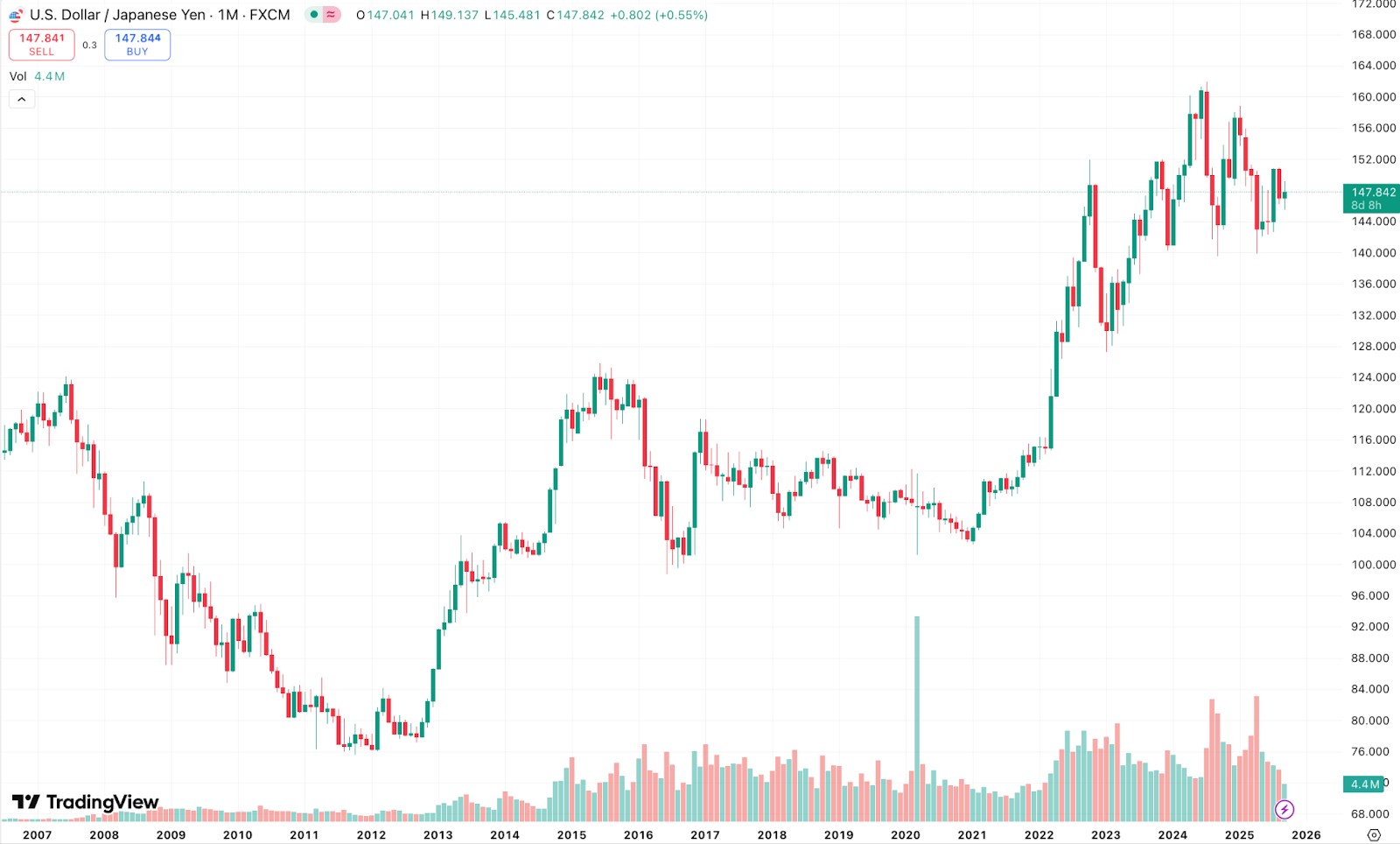
How the yen exchange rate affects the economy, exports, and inflation
Changes in the yen’s value directly affect Japan’s economy. When the currency strengthens, Japanese products become more expensive overseas, which reduces the competitiveness of exporters. This limits production, slows hiring, and cuts export revenues. A stronger yen also lowers the cost of imports, easing prices for energy, raw materials, and consumer goods.
A weaker yen delivers the opposite outcome. Moderate depreciation supports exporters by making goods cheaper in global markets, encouraging sales and boosting profits. However, sharp declines, particularly when the exchange rate weakens beyond ¥155 per dollar, strain importers. Rising costs for raw materials, energy, and components quickly feed into higher domestic inflation.
Persistent yen weakness also makes external debt more expensive and increases borrowing costs throughout the economy. This reduces household spending and narrows the government’s fiscal capacity. In such situations, JPY intervention serves as a tool to stabilize the market and protect economic stability. Authorities must balance the benefits of a competitive currency with the risks of higher inflation. This is why the Japanese central bank’s intervention remains a key policy instrument for safeguarding both financial stability and long-term growth.
How Japan’s interventions affect the global currency market
Japanese currency intervention is closely watched worldwide because Japan manages the world’s third most important currency. Any action by the Bank of Japan intervention mechanism instantly influences trading dynamics and reshapes expectations.
Traders and institutional funds track signals of potential moves, as both announced and anticipated currency interventions can shift short-term trends and redefine the yen’s trading range. Every Japanese intervention in foreign exchange market activity redirects demand toward the yen and away from higher-yielding currencies, forcing investors to rebalance portfolios and reassess exposure to risk.
Why global traders watch Japan’s actions
Japan holds one of the largest foreign currency reserves, giving it significant power over global liquidity. When markets expect a Japanese central bank intervention, volumes in the U.S. dollar, euro, and yen increase as participants reposition ahead of possible shocks.
Speculators often amplify volatility, while the threat of intervention alone can slow yen sell-offs. This creates additional demand for the yen near critical exchange-rate levels and adds weight to the signaling effect of official comments.
The impact of interventions on the dollar and euro
The U.S. dollar is often directly affected by Yen interventions. When the bank sells dollars to support the yen, the dollar weakens locally while the euro and other currencies gain strength. The euro is particularly sensitive to these moves, since it competes with the dollar as a global reserve asset. If a Yen intervention aligns with dovish Federal Reserve policies, the downward pressure on the dollar becomes stronger.
Coordinated efforts magnify these effects. A currency intervention Japan carries out with other major central banks can unsettle valuations across global markets, influencing both developed and emerging economies for extended periods.
Implications for global investment strategies
For global investors, the Japanese government’s intervention in the currency market signals the need to reassess currency risk. A stronger yen makes Japanese assets more expensive, lowering returns on hedged investments. Funds often respond by reducing exposure to Japan until stability returns.
Intervention also disrupts carry trade strategies, where investors borrow yen at low interest rates to invest in higher-yielding currencies. When Japanese currency intervention occurs, these trades are quickly unwound, driving yen appreciation and sparking a chain reaction across cross-currency pairs. This creates ripple effects that reshape global positioning and portfolio strategies.
| Area of impact | Effect of Japan’s intervention |
|---|---|
| U.S. dollar | Localized weakening due to dollar sales for yen |
| Euro | Gains against the dollar, especially when the Fed is dovish |
| Cross-currency pairs | Increased volatility in emerging market currencies |
| Carry trades | Forced position closures, strengthening the yen |
| Investment portfolios | Reduced exposure to Japanese assets, increased hedging |
| Global strategies | Rebalancing of currency risks and asset allocations |
Why the yen exchange rate changes and when to expect new interventions
The yen exchange rate reflects the response to global macroeconomic factors. For anyone tracking what caused the change in the yen's exchange rate, the primary triggers remain clear. The weakening of the Japanese currency intensifies when there is a shift in the interest rates of the U.S. Federal Reserve (Fed). If U.S. rates rise, the yield differential between the dollar and the yen widens, accelerating capital outflows from Japan. This pressure is reinforced by Japan’s trade balance deficit, when import costs exceed exports, demand for the yen falls. Inflation also impacts the rate: rising prices in Japan without a comparable tightening of monetary policy by the Bank of Japan pushes the yen further down.
How the yen’s behavior predicts the likelihood of intervention
There are several market signals that point to a greater probability of a Bank of Japan intervention. A common trigger is when the yen records new lows for several consecutive sessions and moves rapidly toward psychological thresholds, such as ¥155 per dollar.
Rising intraday volatility and unusual trading volumes during Asian hours also serve as warning signs. In many cases, these shifts are followed by verbal warnings or direct central bank interventions. Public statements from the Ministry of Finance, particularly those calling for stability, are often interpreted as early preparation for a government intervention in the currency market.
What signals traders should monitor
For traders, it is important to track not only the yen’s value but also the macroeconomic indicators that influence policy decisions. Interest-rate differentials between U.S. and Japanese bonds remain a leading driver. Trade data, especially the balance of exports and imports, is another key factor. A rise in energy imports adds pressure on the currency and can raise the likelihood of JPY intervention.
Carry trades are another important signal. When investors borrow yen to buy dollar-denominated assets, imbalances build that may lead to an intervention in foreign exchange market. Traders should also watch for liquidity spikes, unusual moves in money markets, and direct comments from Japanese officials.
| Macroeconomic factor | Impact on the yen exchange rate | Probability of intervention |
|---|---|---|
| Rise in Fed rates | Yen weakening | Increases |
| Rise in Japanese inflation | Yen weakening | Increases |
| Trade balance deficit | Yen weakening | Increases |
| Rise in US Treasury yields | Yen weakening | Increases |
| Surge in carry trades | Yen weakening, higher volatility | High if yen drops sharply |
| Public statements by officials | Yen stabilization or strengthening | Maximum in the short term |
Ready to put this into practice? Below is a quick, curated list of regulated Forex brokers that handle JPY pairs well, provide fast execution during the Tokyo session, and offer robust risk tools for event-driven moves (like BOJ headlines). Compare minimum deposits, max leverage, and fees to match your style. If you actively trade intervention risk, also look for real-time alerts and options access for hedging. Use the table to pick a broker that keeps costs low and fills reliable when yen volatility spikes.
| Plus500 | Interactive Brokers | XM | Pepperstone | Fusion Markets | |
|---|---|---|---|---|---|
|
JPY |
Yes | Yes | Yes | Yes | Yes |
|
Currency pairs |
60 | 100 | 57 | 90 | 90 |
|
Min. deposit, $ |
100 | No | 5 | No | 1 |
|
Max. leverage |
1:300 | 1:30 | 1:1000 | 1:500 | 1:500 |
|
Deposit fee, % |
No | No | No | No | No |
|
Withdrawal fee, % |
No | Yes | No | No | No |
|
TU overall score |
7.7 | 6.37 | 9.35 | 9.3 | 9.25 |
|
Open an account |
Go to broker 81% of retail CFD accounts lose money. |
Study review | Go to broker Your capital is at risk. |
Go to broker Your capital is at risk.
|
Go to broker Your capital is at risk. |
How Japan’s interventions reshape the market and how to trade it

When Japanese currency intervention is anticipated, Japanese banks often increase their spot market activity in USD/JPY. However, a large share of transactions actually passes through cross pairs such as EUR/JPY and GBP/JPY. These shifts may not immediately appear in headline USD/JPY movements, but seasoned traders detect pricing distortions in the crosses before direct changes in the dollar-yen rate. Focusing only on USD/JPY can be limiting, while monitoring cross pairs often reveals the earliest signs of a Bank of Japan intervention.
In practice, the Ministry of Finance adapts its tactics to global monetary policy. If the Federal Reserve adopts a dovish approach, pressure on the dollar eases and the likelihood of Japan currency intervention decreases. On the other hand, if U.S. monetary policy remains tight and the yen weakens beyond ¥155, a new round of Japanese government intervention in the currency market becomes more likely. Traders who follow the alignment between U.S. Treasury yields and USD/JPY often gain an advance signal of potential JPY intervention.
Conclusion
Japan's approach to yen intervention is a meticulously coordinated response to protect its economic stability amidst volatile global markets. By acting decisively through the Ministry of Finance and the Bank of Japan, the country curbs excessive currency swings—such as stepping in during 2022 when the yen weakened rapidly—to shield exporters and manage inflation. These interventions ripple through global markets, affecting major currencies and reshaping investment strategies. Ultimately, understanding Japan’s intervention signals and the forces driving yen volatility is essential for navigating forex markets and seizing opportunities as policy actions unfold.
FAQs
How do Japan Yen interventions affect domestic inflation and import prices?
What is the decision-making process behind initiating a Japan Yen intervention?
What role does the Foreign Exchange Fund Special Account play in Japan’s currency interventions?
How can traders anticipate interventions based on macroeconomic indicators?
Editors' Top Picks and Insights






Related Articles
Team that worked on the article
Andrey Mastykin is an experienced author, editor, and content strategist who has been with Traders Union since 2020. As an editor, he is meticulous about fact-checking and ensuring the accuracy of all information published on the Traders Union platform.
Dan Blystone began his trading career in 1998 as an arbitrage clerk on the floor of the Chicago Mercantile Exchange (CME). He later traded bond and Eurex futures at proprietary firms such as Altea Trading, gaining valuable experience in high-frequency trading and risk management.
Chinmay Soni is a financial analyst with more than 5 years of experience in working with stocks, Forex, derivatives, and other assets. As a founder of a boutique research firm and an active researcher, he covers various industries and fields, providing insights backed by statistical data.
Volatility refers to the degree of variation or fluctuation in the price or value of a financial asset, such as stocks, bonds, or cryptocurrencies, over a period of time. Higher volatility indicates that an asset's price is experiencing more significant and rapid price swings, while lower volatility suggests relatively stable and gradual price movements.
CFD is a contract between an investor/trader and seller that demonstrates that the trader will need to pay the price difference between the current value of the asset and its value at the time of contract to the seller.
Forex leverage is a tool enabling traders to control larger positions with a relatively small amount of capital, amplifying potential profits and losses based on the chosen leverage ratio.
Risk management is a risk management model that involves controlling potential losses while maximizing profits. The main risk management tools are stop loss, take profit, calculation of position volume taking into account leverage and pip value.
Yield refers to the earnings or income derived from an investment. It mirrors the returns generated by owning assets such as stocks, bonds, or other financial instruments.

-
 Afghanistan
-
 Albania
-
 Algeria
-
 Angola
-
 Argentina
-
 Armenia
-
 Australia
-
 Austria
-
 Azerbaijan
-
 Bahamas
-
 Bahrain
-
 Bangladesh
-
 Belarus
-
 Belgium
-
 Bolivia
-
 Botswana
-
 Brazil
-
 Brunei
-
 Bulgaria
-
 Cambodia
-
 Cameroon
-
 Canada
-
 Chile
Chile
-
 China
China
-
 Colombia
-
 Congo
Congo
-
 Costa Rica
-
 Cote d'Ivoire
-
 Croatia
-
 Cuba
Cuba
-
 Cyprus
-
 Czechia
-
 DR Congo
-
 Denmark
-
 Dominican Republic
-
 Ecuador
-
 Egypt
Egypt
-
 El Salvador
-
 Estonia
-
 Eswatini
-
 Ethiopia
-
 Finland
-
 France
-
 Georgia
-
 Germany
-
 Ghana
Ghana
-
 Greece
-
 Haiti
Haiti
-
 Hong Kong
-
 Hungary
-
 India
India
-
 Indonesia
-
 Iran, Islamic republic
-
 Iraq
Iraq
-
 Ireland
-
 Israel
-
 Italy
Italy
-
 Jamaica
-
 Japan
Japan
-
 Jordan
-
 Kazakhstan
-
 Kenya
Kenya
-
 Korea
Korea
-
 Kuwait
-
 Kyrgyzstan
-
 Laos
Laos
-
 Latvia
-
 Lebanon
-
 Lesotho
-
 Libya
Libya
-
 Lithuania
-
 Luxembourg
-
 Madagascar
-
 Malaysia
-
 Malta
Malta
-
 Mauritius
-
 Mexico
-
 Moldova
-
 Mongolia
-
 Montenegro
-
 Morocco
-
 Mozambique
-
 Myanmar
-
 Namibia
-
 Nepal
Nepal
-
 Netherlands
-
 New Zealand
-
 Nigeria
-
 North Macedonia
-
 Norway
-
 Oman
Oman
-
 Pakistan
-
 Palestine
-
 Panama
-
 Papua New Guinea
-
 Paraguay
-
 Peru
Peru
-
 Philippines
-
 Poland
-
 Portugal
-
 Puerto Rico
-
 Qatar
Qatar
-
 Reunion
-
 Romania
-
 Rwanda
-
 Saudi Arabia
-
 Serbia
-
 Singapore
-
 Slovakia
-
 Slovenia
-
 Somalia
-
 South Africa
-
 Spain
Spain
-
 Sri Lanka
-
 Sweden
-
 Switzerland
-
 Syria
Syria
-
 Taiwan
-
 Tajikistan
-
 Tanzania
-
 Thailand
-
 Trinidad and Tobago
-
 Tunisia
-
 Turkey
-
 UAE
UAE
-
 Uganda
-
 Ukraine
-
 United Kingdom
-
United States
-
 Uruguay
-
 Uzbekistan
-
 Venezuela
-
 Vietnam
-
 Yemen
Yemen
-
 Zambia
-
 Zimbabwe
- Forex
- Crypto










- How the Bank of Japan intervenes in the yen exchange rate
- The role of the Japanese government in currency interventions
- When Japan intervenes in the yen exchange rate and why
- How Japan’s interventions affect the global currency market
- Why the yen exchange rate changes and when to expect new interventions
- Expert opinion
- Conclusion
- FAQs


