
The Impact Of Inflation On Forex Trading



Editorial Note: While we adhere to strict Editorial Integrity, this post may contain references to products from our partners. Here's an explanation for How We Make Money. None of the data and information on this webpage constitutes investment advice according to our Disclaimer.
Inflation affects Forex by influencing currency value and central bank policies. When inflation rises, central banks often hike interest rates to control it, which can strengthen the currency. Conversely, low rates aimed at boosting growth can weaken it. Traders should monitor key indicators like CPI, PPI and PCE , keep up with central bank announcements, and adjust strategies accordingly when trading Forex in an inflationary environment.
Understanding how inflation affects currency values can significantly enhance a trader's strategy and decision-making process. This article discusses the impact of inflation on Forex trading in detail, along with ways to deal with the same.
Understanding inflation and its impact on Forex trading
Inflation refers to the rate at which the general level of prices for goods and services rises, leading to a decrease in purchasing power. It is typically measured by the Consumer Price Index (CPI) and the Producer Price Index (PPI). There are three main types of inflation: demand-pull inflation, cost-push inflation, and built-in inflation.
Demand-pull inflation occurs when the demand for goods and services exceeds their supply.
Cost-push inflation happens when the costs of production increase, leading to higher prices.
Built-in inflation results from the adaptive expectations of workers demanding higher wages, which businesses pass on as higher prices.
Understanding these types helps traders anticipate how different inflationary pressures might affect currency values.
A step-by-step guide to dealing with the impact of inflation on the market:
Identify key inflation indicators. Regularly monitor the CPI, PPI, and GDP growth rates. These indicators provide insights into the inflationary trends of an economy.
Monitor central bank policies. Central banks use tools like interest rate adjustments to control inflation. Traders should keep an eye on policy announcements from central banks like the Federal Reserve, ECB, and others.
Analyze economic reports. Economic reports provide a wealth of information about inflation trends. Regularly review reports on employment, consumer spending, and production costs.
Adjust trading strategies. Based on the data, adjust your trading strategies. For instance, in a high-inflation environment, consider shorting the currency or looking for opportunities in currencies from countries with lower inflation rates.

Tools for tracking inflation
Economic calendars. Staying updated with economic news through economic calendars is essential. These calendars provide schedules of important economic releases and events.
Financial news platforms. Subscribing to reliable financial news sources like Bloomberg and Reuters helps traders stay informed about inflation trends and central bank policies.
Analytical software. Utilizing platforms like MetaTrader and TradingView provides real-time data and analysis tools for monitoring inflation.
Key concepts in inflation and Forex trading

Inflation and interest rates
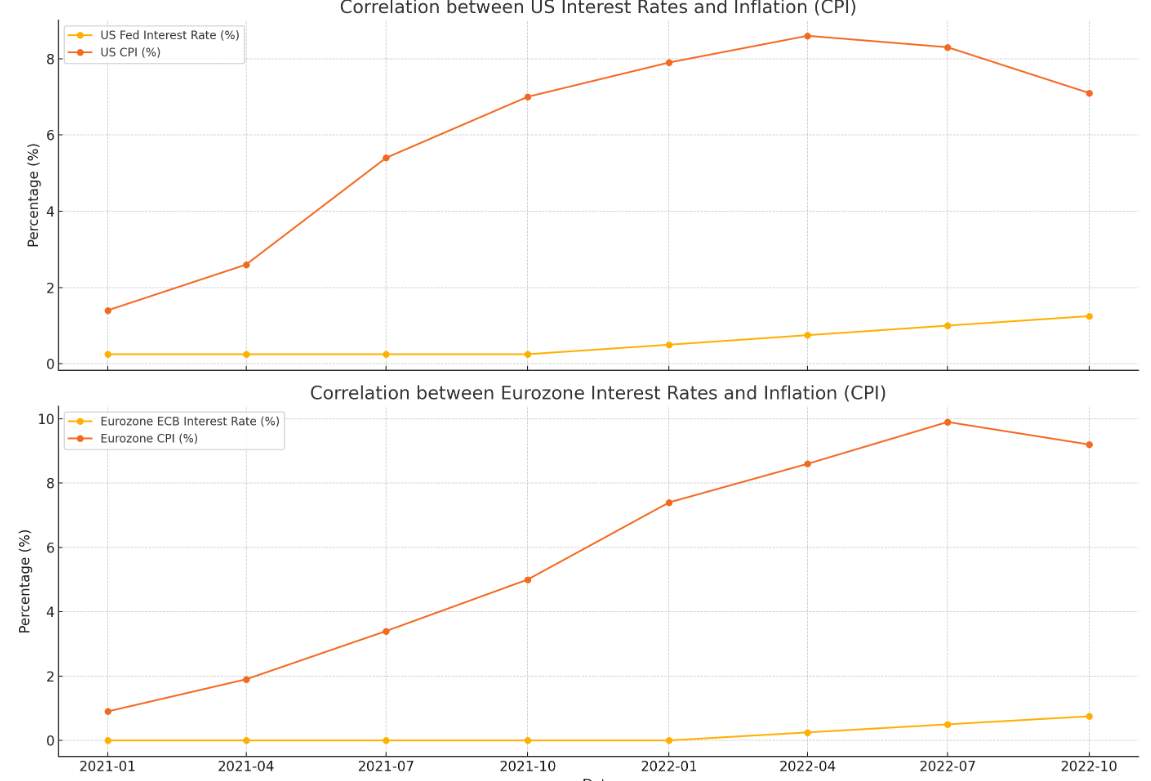
Interest rates and inflation are closely linked. Interest rates and inflation are closely related. Major central banks such as the Fed, ECB, BOJ use this economic pressure on the market to control inflation. When inflation rises, central banks often raise interest rates to cool the economy. Higher interest rates can attract foreign investors looking for higher returns, causing the currency to appreciate. Conversely, lower interest rates can lead to a depreciation, devaluing the currency and causing investors to lose interest in the country's economics.
Inflation is also considered to be a key factor for currency interventions by monetary regulators to stabilize the national currency.
Inflation measures
Knowing the differences between inflation measures such as CPI and PPI is important. The CPI tracks how much consumers pay for everyday items and services, while the PPI looks at the prices that producers get for their goods.
How to calculate:
The CPI is calculated by taking the weighted average of price changes for each item in the predetermined basket of goods and services. The weights are based on the relative importance of each item in the typical consumer's expenditure.
The PPI is calculated by tracking the changes in selling prices received by producers for a representative basket of goods. The index covers a wide range of industries, including manufacturing, agriculture, mining, and services.
While both the CPI and PPI are crucial measures of inflation, they provide different perspectives on price changes within an economy. The CPI focuses on the end consumer's perspective, capturing the direct impact of price changes on households. The PPI, on the other hand, provides insights into the cost pressures faced by producers, which can influence future consumer prices.

Macroeconomic factors
Inflation is influenced by various macroeconomic factors, including economic growth, trade balances, capital markets, and commodity prices. For example, a country with a high trade deficit might see its currency depreciate due to inflationary pressures.
How inflation affects currency values
Inflation erodes the purchasing power of a currency, leading to its depreciation. When inflation is high, the value of a currency typically falls because its purchasing power is reduced. Central banks often respond by adjusting interest rates to control inflation, which in turn affects Forex markets.
Purchasing power
High inflation decreases the purchasing power of a currency, leading to its depreciation. This makes imports more expensive and exports cheaper, affecting the trade balance.
Interest rate policies
Central banks use interest rates to control inflation. Higher interest rates can attract investment, leading to currency appreciation, while lower rates can have the opposite effect.
Trade balance effects
Inflation affects the trade balance by making exports less competitive on the world market, i.e. more expensive, while imports in such a situation become cheaper, which can lead to a trade deficit and currency depreciation.
Inflation affects government bond yields. Rising bond yields can attract foreign investors, leading to currency appreciation.
The table below compares trade balances and currency values during different inflation periods for the US and the Eurozone:
| Year- Quarter | US Trade Balance ($ bln) | US Consumer Inflation (%) | Dollar Index (DXY) | EU Trade Balance (€ bln) | EU Consumer Inflation (%) | EUR/USD exchange rate |
|---|---|---|---|---|---|---|
| 2021 Q1 | -208,6 | 1,7 | 90,4 | 37,6 | 1,1 | 1,2 |
| 2021 Q2 | -210,8 | 2,6 | 92,3 | 40,2 | 1,9 | 1,19 |
| 2021 Q3 | -213,6 | 5,3 | 94 | 43,1 | 3,4 | 1,16 |
| 2021 Q4 | -224,7 | 6,8 | 96,6 | 46 | 5 | 1,14 |
| 2022 Q1 | -233,3 | 7,9 | 98,3 | 39,4 | 7,4 | 1,11 |
| 2022 Q2 | -240,5 | 8,6 | 105 | 42 | 8,6 | 1,04 |
| 2022 Q3 | -247,4 | 8,2 | 112,5 | 44,9 | 9,1 | 0,98 |
| 2022 Q4 | -253,1 | 7,1 | 103,5 | 47,8 | 10 | 1,07 |
| 2023 Q1 | -259,6 | 5 | 101 | 41,3 | 8,3 | 1,09 |
| 2023 Q2 | -264,9 | 4 | 99,2 | 44 | 7 | 1,11 |
| 2023 Q3 | -268,4 | 3,7 | 97,8 | 46,9 | 6,5 | 1,13 |
| 2023 Q4 | -273,5 | 3,2 | 96,5 | 49,8 | 6 | 1,15 |
| 2024 Q1 | -278,9 | 2,9 | 95,3 | 43,2 | 5,4 | 1,17 |
| 2024 Q2 | -284,3 | 2,7 | 94,2 | 45,9 | 4,9 | 1,18 |
| 2024 Q3 forecast | -289,7 | 2,6 | 93,4 | 48,8 | 4,5 | 1,19 |
| 2024 Q4 forecast | -295,2 | 2,5 | 92,7 | 51,7 | 4,2 | 1,2 |
Investor sentiment
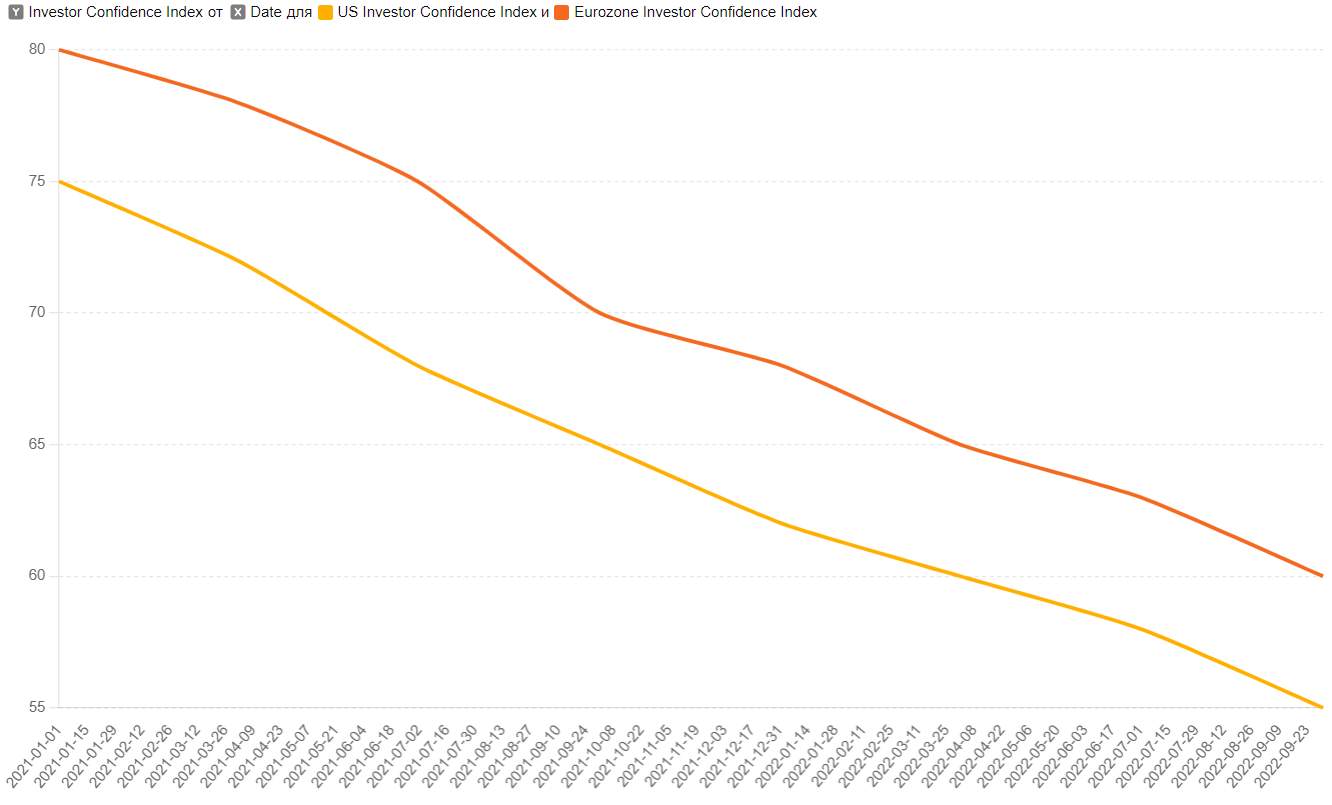
Investor sentiment is significantly influenced by inflation. High inflation can lead to negative sentiment and currency sell-offs, while controlled inflation can boost confidence and currency purchases.
Economic confidence
Inflation impacts economic confidence and stability. High inflation can lead to economic uncertainty and volatility in the Forex markets.
Trading strategies during inflationary periods
Some strategies to use during inflationary periods are based on the following major studies:
Fundamental analysis
Fundamental analysis involves evaluating economic indicators and central bank policies to forecast currency movements. During inflationary periods, analyzing reports on consumer prices, employment, and GDP growth can provide actionable insights.
Technical analysis
Technical analysis uses price patterns and market sentiment to make trading decisions. Identifying patterns like head and shoulders, double tops, and triangles can help anticipate market trends.

Here are charts illustrating common price patterns during inflationary periods:
Head and shoulders pattern. This pattern is characterized by three peaks: a higher peak (head) between two lower peaks (shoulders). It often signals a reversal from a bullish trend to a bearish trend.

Double top pattern. This pattern shows two peaks at roughly the same price level, indicating a potential reversal from an uptrend to a downtrend. The double top pattern is visible in the chart where two distinct peaks are formed.

Triangle pattern. This pattern is formed by drawing trend lines along the highs and lows of the price movement that converge to a point. Triangle patterns can indicate a continuation or reversal, depending on the breakout direction. The triangle pattern in the chart shows a narrowing range of prices over time.

Long-term strategies
Long-term strategies might include focusing on emerging markets and investing in inflation-linked assets like Treasury Inflation-Protected Securities (TIPS):
Focusing on emerging markets that often experience higher inflation rates compared to developed economies, but they also offer higher growth potential. Investing in currencies and assets from these markets can provide opportunities for substantial returns, especially if the trader can accurately predict the economic trajectory of these markets.
Inflation-linked assets like Treasury Inflation-Protected Securities (TIPS) can provide a hedge against inflation. TIPS are government bonds that are indexed to inflation, meaning their principal value increases with rising inflation, thereby protecting the investor's purchasing power. Other inflation-linked assets include commodities like gold and real estate, which tend to retain value during inflationary periods.
Short-term strategies
Short-term strategies during high volatility periods might include day trading and scalping:
Day trading involves buying and selling currencies within the same trading day. Traders look to profit from short-term price movements driven by market news, economic data releases, and other short-term factors. It requires a good understanding of technical analysis and market trends.
Scalping is a more intense form of day trading where traders make dozens or hundreds of trades within a single day. The goal is to profit from tiny price changes.
Psychological strategies
Maintaining discipline and avoiding emotional trading during inflation spikes is crucial. Strategies for managing stress and staying focused can help. Learn how to deal with it in our article Maintaining Equilibrium: How To Control Emotions in Forex Trading.
Risks and warnings
Volatility during inflation. Managing emotional discipline and avoiding impulsive trades during high volatility periods is crucial for risk management.
Regulatory changes. Keeping an eye on regulatory changes by central banks is important as they can significantly impact Forex markets.
Economic shocks. Preparing for unexpected events that could exacerbate inflation impacts is essential for managing risks.
Adapting to effects of inflation in your day to day trading

During my years of experience in trading the Forex market, one of the key things I've learned is the importance of monitoring central bank policies. Central banks, like the Federal Reserve or the European Central Bank, change interest rates to manage inflation. When inflation is high, they might raise rates to slow down the economy, which can make the currency stronger. On the other hand, lowering rates to boost growth can weaken the currency. Paying attention to these policy shifts and what they mean can help you make smarter trading choices.
Remember, trading during times of inflation needs a mix of knowledge, flexibility, and resilience. By understanding how inflation affects the market, staying updated, and using good risk management, you can handle these tough times and find chances to succeed.
Conclusion
Accounting for inflation in Forex trading requires a comprehensive approach and careful analysis of many factors. This is an important element of fundamental analysis, which helps traders make more informed decisions and minimize risks.
To succeed in Forex trading, you need to be proactive. Watch inflation indicators, keep up with central bank announcements, and regularly check economic reports. Use tools like economic calendars, financial news sites, and analytical software to stay on top of market trends. By staying disciplined and always learning, you can handle the risks of inflation better and make more profitable trades.
FAQs
What are the key inflation indicators to watch in Forex trading?
The key inflation indicators include the Consumer Price Index (CPI), Producer Price Index (PPI), and Gross Domestic Product (GDP). These indicators help traders gauge inflation trends and make informed trading decisions.
How do central banks use interest rates to control inflation?
Central banks raise interest rates to combat high inflation, making borrowing more expensive, which reduces spending and slows down inflation. Conversely, they lower rates to stimulate the economy during low inflation.
How does inflation affect the purchasing power of a currency?
High inflation decreases the purchasing power of a currency, meaning more money is needed to buy the same amount of goods and services, leading to currency depreciation.
What tools can traders use to track inflation?
Traders can use economic calendars, financial news platforms like Bloomberg and Reuters, and analytical software such as MetaTrader and TradingView to track inflation.
Editors' Top Picks and Insights

Lean Ethereum: Why Buterin wants to rebuild the network

SK Hynix debuts on Nasdaq: Largest U.S. offering by foreign company

SpaceX falls out of orbit: Does anyone still want Musk’s stock?

The crypto IPO problem: How high-profile listings became investor traps

U.S. Bitcoin reserve: Trump’s unrealized crypto promise

Aiming for leadership: Payment giants prepare a new stablecoin
Related Articles
Team that worked on the article
Chinmay Soni is a financial analyst with more than 5 years of experience in working with stocks, Forex, derivatives, and other assets. As a founder of a boutique research firm and an active researcher, he covers various industries and fields, providing insights backed by statistical data.
Dr. BJ Johnson is a PhD in English Language and an editor with over 15 years of experience. He earned his degree in English Language in the U.S and the UK.
Mirjan Hipolito is a journalist and news editor at Traders Union. She is an expert crypto writer with five years of experience in the financial markets.
Forex trading, short for foreign exchange trading, is the practice of buying and selling currencies in the global foreign exchange market with the aim of profiting from fluctuations in exchange rates. Traders speculate on whether one currency will rise or fall in value relative to another currency and make trading decisions accordingly. However, beware that trading carries risks, and you can lose your whole capital.
Yield refers to the earnings or income derived from an investment. It mirrors the returns generated by owning assets such as stocks, bonds, or other financial instruments.
Volatility refers to the degree of variation or fluctuation in the price or value of a financial asset, such as stocks, bonds, or cryptocurrencies, over a period of time. Higher volatility indicates that an asset's price is experiencing more significant and rapid price swings, while lower volatility suggests relatively stable and gradual price movements.
Risk management is a risk management model that involves controlling potential losses while maximizing profits. The main risk management tools are stop loss, take profit, calculation of position volume taking into account leverage and pip value.
Cryptocurrency is a type of digital or virtual currency that relies on cryptography for security. Unlike traditional currencies issued by governments (fiat currencies), cryptocurrencies operate on decentralized networks, typically based on blockchain technology.

-
 Afghanistan
-
 Albania
-
 Algeria
-
 Angola
-
 Argentina
-
 Armenia
-
 Australia
-
 Austria
-
 Azerbaijan
-
 Bahamas
-
 Bahrain
-
 Bangladesh
-
 Belarus
-
 Belgium
-
 Bolivia
-
 Botswana
-
 Brazil
-
 Brunei
-
 Bulgaria
-
 Cambodia
-
 Cameroon
-
 Canada
-
 Chile
Chile
-
 China
China
-
 Colombia
-
 Congo
Congo
-
 Costa Rica
-
 Cote d'Ivoire
-
 Croatia
-
 Cuba
Cuba
-
 Cyprus
-
 Czechia
-
 DR Congo
-
 Denmark
-
 Dominican Republic
-
 Ecuador
-
 Egypt
Egypt
-
 El Salvador
-
 Estonia
-
 Eswatini
-
 Ethiopia
-
 Finland
-
 France
-
 Georgia
-
 Germany
-
 Ghana
Ghana
-
 Greece
-
 Haiti
Haiti
-
 Hong Kong
-
 Hungary
-
 India
India
-
 Indonesia
-
 Iran, Islamic republic
-
 Iraq
Iraq
-
 Ireland
-
 Israel
-
 Italy
Italy
-
 Jamaica
-
 Japan
Japan
-
 Jordan
-
 Kazakhstan
-
 Kenya
Kenya
-
 Korea
Korea
-
 Kuwait
-
 Kyrgyzstan
-
 Laos
Laos
-
 Latvia
-
 Lebanon
-
 Lesotho
-
 Libya
Libya
-
 Lithuania
-
 Luxembourg
-
 Madagascar
-
 Malaysia
-
 Malta
Malta
-
 Mauritius
-
 Mexico
-
 Moldova
-
 Mongolia
-
 Montenegro
-
 Morocco
-
 Mozambique
-
 Myanmar
-
 Namibia
-
 Nepal
Nepal
-
 Netherlands
-
 New Zealand
-
 Nigeria
-
 North Macedonia
-
 Norway
-
 Oman
Oman
-
 Pakistan
-
 Palestine
-
 Panama
-
 Papua New Guinea
-
 Paraguay
-
 Peru
Peru
-
 Philippines
-
 Poland
-
 Portugal
-
 Puerto Rico
-
 Qatar
Qatar
-
 Reunion
-
 Romania
-
 Rwanda
-
 Saudi Arabia
-
 Serbia
-
 Singapore
-
 Slovakia
-
 Slovenia
-
 Somalia
-
 South Africa
-
 Spain
Spain
-
 Sri Lanka
-
 Sweden
-
 Switzerland
-
 Syria
Syria
-
 Taiwan
-
 Tajikistan
-
 Tanzania
-
 Thailand
-
 Trinidad and Tobago
-
 Tunisia
-
 Turkey
-
 UAE
UAE
-
 Uganda
-
 Ukraine
-
 United Kingdom
-
United States
-
 Uruguay
-
 Uzbekistan
-
 Venezuela
-
 Vietnam
-
 Yemen
Yemen
-
 Zambia
-
 Zimbabwe
- Forex
- Crypto











