
Best Indicators For Effective 1-Minute Scalping Strategy



Editorial Note: While we adhere to strict Editorial Integrity, this post may contain references to products from our partners. Here's an explanation for How We Make Money. None of the data and information on this webpage constitutes investment advice according to our Disclaimer.
Best indicators for 1-minute scalping strategy:
SMA & EMA: Identify trends and entry signals; crossovers indicate direction changes.
Bollinger Bands: Show overbought/oversold zones; price nearing bands may signal reversals.
RSI: Indicates trend strength; values >70 or <30 signal overbought/oversold conditions.
Stochastic Oscillator: Compares current price to past range; values >80 or <20 suggest overbought/oversold conditions.
Scalping on the 1-minute time frame is one of the most intense and fast strategies that allows traders to profit from small price movements. This technique requires not only a quick reaction, but also the right set of indicators that help to accurately determine entry and exit points. In this article, we will walk through key indicators that have proven their effectiveness in highly volatile market conditions. Each of them has its own unique advantages, allowing traders to better understand market impulses and avoid false signals. Learn how to properly set up and use these indicators to achieve consistent profits in 1-minute scalping.
Best indicators for 1-minute scalping strategy
Scalping is a strategy that is based on lightning-fast entry and exit of trades at the slightest price fluctuations. Key indicators that are actively used in this method help traders quickly react to market changes and find profitable opportunities.
SMA and EMA (Simple and exponential moving averages). These indicators are used to track current trends and generate entry signals. SMA displays the average price for a certain period of time, which helps to estimate the general direction of price movement. EMA, in turn, is more sensitive to changes in recent price data, since it assigns them more weight. The intersections of the SMA and EMA lines give traders signals about possible trend changes, which helps to enter or exit the market in time.
Bollinger bands. This tool consists of the middle line (SMA) and two deviations from it, forming a kind of channel indicating the overbought and oversold levels of the asset. If the price reaches the upper band, it may indicate a possible downside reversal, while touching the lower band often indicates a likely upside. Scalpers use these signals to determine optimal entry and exit points for short trades.
RSI (Relative strength index). The RSI indicator fluctuates between 0 and 100 and shows the strength of a trend. Values above 70 indicate that the asset is overbought, while values below 30 indicate that it is oversold. These levels give traders a basis for predicting possible reversals, which allows them to make informed trading decisions.
Stochastic oscillator. This indicator compares the current closing price of an asset with its price range over a selected period. Values above 80 indicate overbought, while values below 20 indicate oversold. Scalpers use stochastics to assess the strength of a trend and spot potential reversal points, which helps them navigate changing market conditions quickly.
Together, these indicators provide scalpers with the necessary data to instantly analyze the market and make quick decisions, increasing the accuracy and effectiveness of the strategy in dynamic scalping.
Best 1 minute scalping strategies
Minute Scalping: Quick Entry and Exit Strategy
The minute scalping strategy is one of the popular approaches in the Forex market, allowing traders to achieve quick results. Despite its apparent simplicity, effective application requires high discipline and precise skills from the trader.
This strategy uses a stochastic oscillator and two exponential moving averages (EMA) with periods of 13 and 26. These indicators help traders find entry points and make multiple trades daily to achieve their goals. To improve execution accuracy, it is recommended to choose currency pairs with minimal spreads and focus on periods of high activity, such as the London-New York session.
Success in this strategy is possible with strict adherence to risk management rules. Setting stop losses helps traders limit potential losses and protect capital, ensuring stability and security even in conditions of active scalping.

Moving average tape strategy entry method
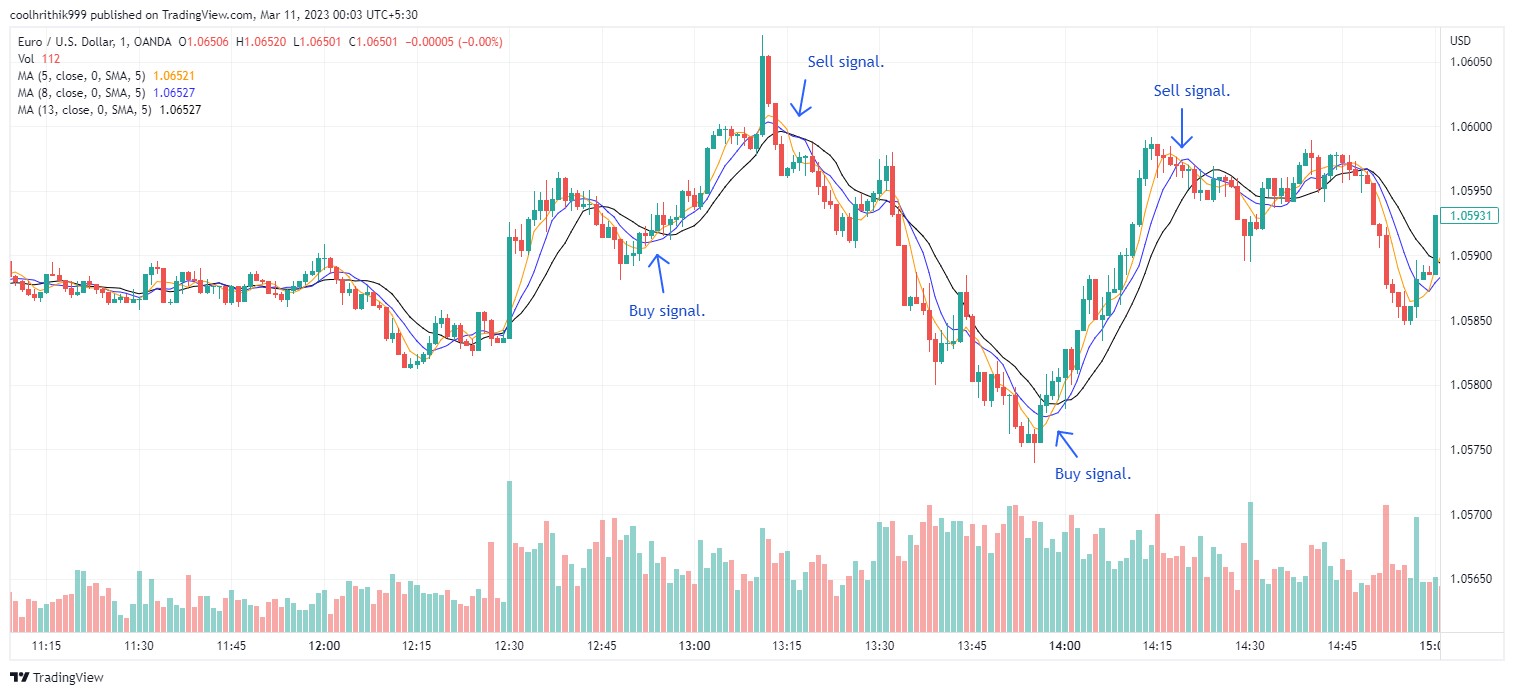
This strategy is a simple yet effective approach to Forex scalping based on the use of a set of simple moving averages (SMA) on a two-minute chart to identify strong trends. Traders use a combination of three SMAs with periods of 5, 8 and 13; when the lines line up in the same direction, this indicates a strong trend that can be entered into.
When the moving average lines are horizontal and the price often crosses them, this indicates that the momentum is fading and a possible market reversal is likely. Divergence of the tape can also serve as an additional signal to buy or sell, indicating an increase or decrease in trend momentum.
Despite its simplicity, this strategy requires risk management to protect capital.
Bollinger bands scalping
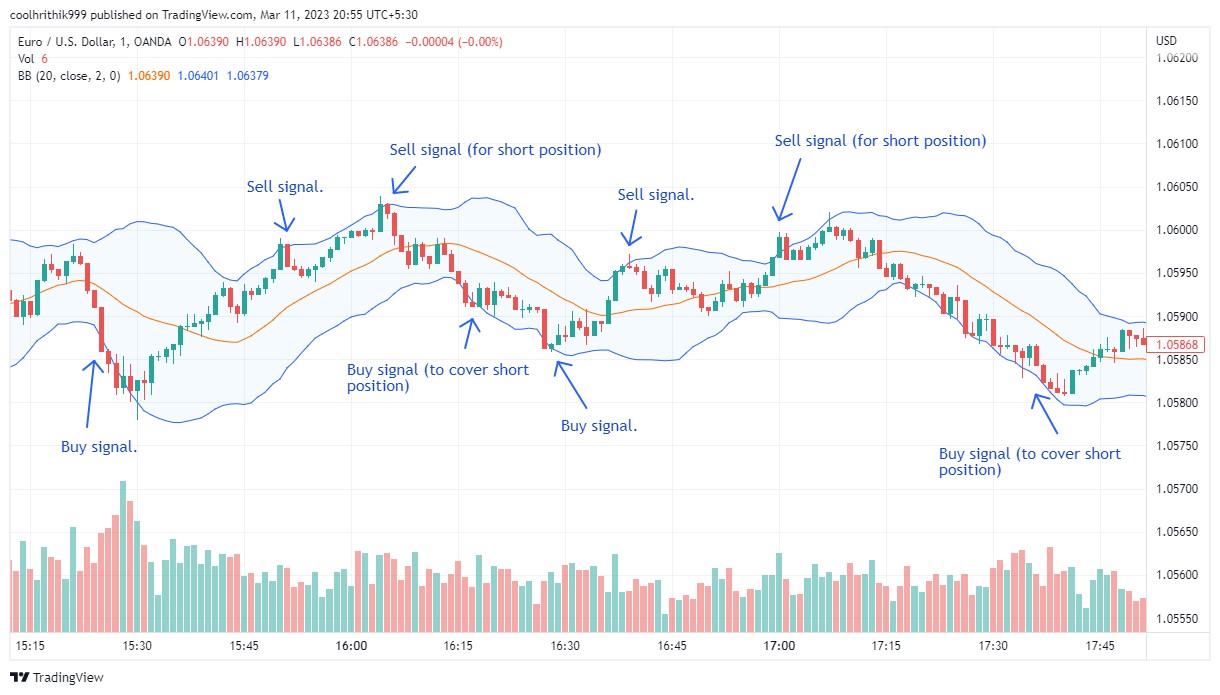
Bollinger Bands are a technical analysis tool widely used by scalpers in the volatile Forex market. The indicator consists of three lines: the upper, middle (20-period SMA) and lower bands, where each line reflects a standard deviation of the price from the average. This tool is especially suitable for working with currency pairs with a low spread, as they allow you to quickly react to price changes.
When the price reaches the upper band, the asset is considered overbought, which may signal an upcoming downward correction. If the price touches the lower band, the asset may be oversold, and a probable upward rebound is expected. Scalpers use these signals for short-term trades, quickly opening and closing positions in response to market impulses.
Suitable markets for 1-minute scalping
Efficient scalping on the 1-minute time frame requires markets with sufficient volatility and liquidity.
Major currency pairs (EUR/USD, GBP/USD, USD/JPY) with tight spreads are suitable for frequent trades.
Commodity currencies (AUD/USD, USD/CAD, NZD/USD) provide short-term opportunities due to the volatility of commodity prices.
Indices (S&P 500, DAX 30, FTSE 100) are active during the main trading sessions.
High beta stocks are volatile stocks, especially in the tech and biotech sectors, such as the NASDAQ.
Cryptocurrencies (Bitcoin, Ethereum) offer high liquidity and volatility around the clock.
Commodities (oil, gold, copper) allow scalping on changes in demand and stocks.
Avoid illiquid assets, bonds and exotic currency pairs as they rarely show significant intraday changes.
Main rule of 1-minute scalping strategy
The key rule in this strategy is to profit from small price movements by quickly identifying possible trend reversals and acting accordingly. To use the method effectively, follow these three steps:
1. Identify the short-term trend
First, assess the trend direction on the chart. If the trend is up, look for buying opportunities, and if the trend is down, look for selling opportunities. Since the strategy is focused on short moves, do not look for the perfect entry or exit time, but focus on the market direction. You can use the 50-period and 100-period EMA to determine the trend: a crossover of the 50 EMA above the 100 EMA signals an uptrend, suitable for buying, while a crossover below indicates a downtrend, favorable for selling. This makes it easier to time your trade according to the market movement.
2. Wait for a pullback
A pullback is a temporary change in price direction before it returns to the original trend. For scalpers, pullbacks allow you to enter a trade at a more favorable price. However, it is important to wait for confirmation before entering to avoid getting a false signal. The right entry time helps to avoid false breakouts and increases the chances of a successful trade.
3. Monitor the signals of the stochastic oscillator
The stochastic oscillator helps to identify when the market may change direction and serves as a signal for a more accurate entry into the trade. If the oscillator indicates overbought, this may foreshadow a correction, and if oversold, a possible increase is expected. Waiting for confirmation from the stochastic oscillator allows you to avoid false signals and increase the likelihood of a successful trade.
How to manage risk for 1-minute scalping strategy
Scalping is an intense and stressful strategy that requires instant decisions and quick reactions. Although the potential profit in scalping can be significant, the risk is also high, so risk management becomes an important component of success. Here are some tips to help minimize risks:
Choose a reliable broker. Choosing a broker that offers tight spreads and fast order execution will help avoid slippage and provide profitable trading conditions. Fast execution is especially important for scalpers, since every tick can affect the final profit.
| zForex | OANDA | Trading.com USA | FOREX.com | IG Markets | |
|---|---|---|---|---|---|
|
Scalping |
Yes | Yes | Yes | Yes | Yes |
|
One click trading |
Yes | Yes | Yes | Yes | Yes |
|
ECN Commission |
7 | 3.5 | No | 5 | 2.3 |
|
ECN Spread EUR/USD |
0.1 | 0.15 | No | 0.2 | 0.8 |
|
MT5 |
Yes | Yes | Yes | Yes | No |
|
Trading bots |
Yes | Yes | Yes | Yes | Yes |
|
Free VPS |
Yes | Yes | No | Yes | Yes |
|
Open an account |
Go to broker Your capital is at risk.
|
Go to broker Your capital is at risk. |
Go to broker Your capital is at risk. |
Study review | Study review |
Always set a stop loss. Since scalping is based on short-term movements, the price can suddenly change direction. Setting a stop loss allows you to limit potential losses, protecting your capital from unpredictable market fluctuations.
Use leverage carefully. Leverage can magnify both profits and losses, so it is important not to overdo it. In scalping, it is important to control the size of your positions to minimize potential losses and not to risk more than you can afford to lose.
Accept losses and move on. Even experienced traders sometimes experience losing trades. It is important to be able to accept such losses without emotional reactions and to stay focused on long-term goals. Success in scalping is built on making more winning trades than losing ones and not allowing temporary setbacks to throw you off course.
Follow your trading plan. A trading plan is the foundation of a stable approach to scalping. Emotional decisions can lead to a loss of control, so it is important to stick to a pre-established strategy and not deviate from it in stressful situations.
For best 1-minute scalping results, focus on small, steady price moves

One of the notable features of 1-minute scalping is the time of opening trades during periods of greatest activity. For example, the intersection of the European and American sessions provides the best volume and volatility for precise entries and exits. At this time, you can also see the greatest market reaction to economic data and news, which can serve as an additional reference point for strategy settings.
To get the most out of the 1-minute scalping strategy, start by focusing on small, consistent price movements, especially around key price levels. A helpful approach is using two EMAs, like the 50 and 100-period, to watch where the price “bounces.” Rather than waiting for a full crossover, consider entering a trade when the price moves close to these lines and still follows the trend. This way, you can catch quick trading opportunities without waiting for a complete crossover—keeping your trades faster and more flexible for scalping.
Another critical point is to avoid trading too frequently, as the fast action can lead to mistakes if you’re fatigued. Set a realistic cap on trades per hour and take short breaks in between to stay focused. Remember, this strategy isn’t about jumping into every trade; it’s about carefully picking those that match your plan. For managing risks, always use a small stop-loss placed just a few pips above or below recent highs or lows to keep any losses minimal. This method not only sharpens your focus but helps you maintain steady gains over time.
Conclusion
Mastering the 1-minute scalping strategy hinges on selecting the right combination of indicators for timely and precise trades. Tools like the Moving Average and Relative Strength Index (RSI) have proven effective for quickly spotting entry and exit points in these fast-paced markets. For instance, using an EMA crossover with volume confirmation can help filter out false signals, empowering traders to act with greater confidence. Ultimately, successful 1-minute scalping is about harnessing the reliability of your chosen indicators and adapting swiftly to market conditions. Remember, in this rapid game, precision and discipline are your greatest assets.
FAQs
What factors should be considered when choosing the best indicators for a 1 minute scalping strategy?
How important is risk management in 1 minute scalping, and what are effective techniques?
Which types of financial instruments are most suitable for applying the 1 minute scalping strategy?
What are some ways to optimize the timing of entries and exits when using indicators on the 1m chart?
Editors' Top Picks and Insights

Three trends that could reshape the crypto market over the next decade

Trump financial disclosure: How the president's crypto income became a U.S. ethics issue

Code red: What's behind Bitcoin’s sharp selloff?

MiCA is live: How EU new rules are changing crypto market

Bitcoin price prediction based on MVRV: Indicator points to BTC undervaluation

Amazon flooded with AI books: Crisis of trust in literature market
Related Articles
Team that worked on the article
Maxim Nechiporenko has been a contributor to Traders Union since 2023. He started his professional career in the media in 2006.
Dan Blystone began his trading career in 1998 as an arbitrage clerk on the floor of the Chicago Mercantile Exchange (CME). He later traded bond and Eurex futures at proprietary firms such as Altea Trading, gaining valuable experience in high-frequency trading and risk management.
Chinmay Soni is a financial analyst with more than 5 years of experience in working with stocks, Forex, derivatives, and other assets. As a founder of a boutique research firm and an active researcher, he covers various industries and fields, providing insights backed by statistical data.
Day trading involves buying and selling financial assets within the same trading day, with the goal of profiting from short-term price fluctuations, and positions are typically not held overnight.
An ECN, or Electronic Communication Network, is a technology that connects traders directly to market participants, facilitating transparent and direct access to financial markets.
Exotic currencies are currencies from countries with smaller or emerging economies, and they are less commonly traded in the foreign exchange market compared to major currencies like the US Dollar, Euro. These currencies are often considered exotic because they are not as liquid or widely used in international trade and finance.
The deviation is a statistical measure of how much a set of data varies from the mean or average value. In forex trading, this measure is often calculated using standard deviation that helps traders in assessing the degree of variability or volatility in currency price movements.
Forex leverage is a tool enabling traders to control larger positions with a relatively small amount of capital, amplifying potential profits and losses based on the chosen leverage ratio.

-
 Afghanistan
-
 Albania
-
 Algeria
-
 Angola
-
 Argentina
-
 Armenia
-
 Australia
-
 Austria
-
 Azerbaijan
-
 Bahamas
-
 Bahrain
-
 Bangladesh
-
 Belarus
-
 Belgium
-
 Bolivia
-
 Botswana
-
 Brazil
-
 Brunei
-
 Bulgaria
-
 Cambodia
-
 Cameroon
-
 Canada
-
 Chile
Chile
-
 China
China
-
 Colombia
-
 Congo
Congo
-
 Costa Rica
-
 Cote d'Ivoire
-
 Croatia
-
 Cuba
Cuba
-
 Cyprus
-
 Czechia
-
 DR Congo
-
 Denmark
-
 Dominican Republic
-
 Ecuador
-
 Egypt
Egypt
-
 El Salvador
-
 Estonia
-
 Eswatini
-
 Ethiopia
-
 Finland
-
 France
-
 Georgia
-
 Germany
-
 Ghana
Ghana
-
 Greece
-
 Haiti
Haiti
-
 Hong Kong
-
 Hungary
-
 India
India
-
 Indonesia
-
 Iran, Islamic republic
-
 Iraq
Iraq
-
 Ireland
-
 Israel
-
 Italy
Italy
-
 Jamaica
-
 Japan
Japan
-
 Jordan
-
 Kazakhstan
-
 Kenya
Kenya
-
 Korea
Korea
-
 Kuwait
-
 Kyrgyzstan
-
 Laos
Laos
-
 Latvia
-
 Lebanon
-
 Lesotho
-
 Libya
Libya
-
 Lithuania
-
 Luxembourg
-
 Madagascar
-
 Malaysia
-
 Malta
Malta
-
 Mauritius
-
 Mexico
-
 Moldova
-
 Mongolia
-
 Montenegro
-
 Morocco
-
 Mozambique
-
 Myanmar
-
 Namibia
-
 Nepal
Nepal
-
 Netherlands
-
 New Zealand
-
 Nigeria
-
 North Macedonia
-
 Norway
-
 Oman
Oman
-
 Pakistan
-
 Palestine
-
 Panama
-
 Papua New Guinea
-
 Paraguay
-
 Peru
Peru
-
 Philippines
-
 Poland
-
 Portugal
-
 Puerto Rico
-
 Qatar
Qatar
-
 Reunion
-
 Romania
-
 Rwanda
-
 Saudi Arabia
-
 Serbia
-
 Singapore
-
 Slovakia
-
 Slovenia
-
 Somalia
-
 South Africa
-
 Spain
Spain
-
 Sri Lanka
-
 Sweden
-
 Switzerland
-
 Syria
Syria
-
 Taiwan
-
 Tajikistan
-
 Tanzania
-
 Thailand
-
 Trinidad and Tobago
-
 Tunisia
-
 Turkey
-
 UAE
UAE
-
 Uganda
-
 Ukraine
-
 United Kingdom
-
United States
-
 Uruguay
-
 Uzbekistan
-
 Venezuela
-
 Vietnam
-
 Yemen
Yemen
-
 Zambia
-
 Zimbabwe
- Forex
- Crypto











