
Scalping Vs. Day Trading: Which To Choose


Editorial Note: While we adhere to strict Editorial Integrity, this post may contain references to products from our partners. Here's an explanation for How We Make Money. None of the data and information on this webpage constitutes investment advice according to our Disclaimer.
Scalping and day trading are popular trading strategies with its unique characteristics:
Scalping involves making frequent and quick trades to profit from small price movements
Day trading involves taking longer positions during the day to take advantage of larger market moves.
Forex trading offers many strategies, with scalping and day trading being the most popular among active traders. These are similar strategies, but they have fundamental differences. Understanding the differences between these two trading methods will help you choose the most suitable one, especially if you are a beginner, to develop your trading style.
Differences between Forex scalping and day trading
Scalping and day trading are two popular Forex strategies, each with its own unique characteristics. The differences between these approaches lie primarily in the time frame, trading frequency, and analysis tools used. Understanding these differences will help traders choose the strategy that best suits their trading goals and style.
| Scalping | Day trading | |
|---|---|---|
| Time frame | Trading within minutes or seconds, scalpers enter and exit positions quickly, looking to profit from small price movements. | Trading during the day with all positions closed by the end of the trading session. Day traders hold positions longer than scalpers, but still do not leave trades open overnight. |
| Frequency of transactions | Multiple trades per day. Scalpers can make dozens or even hundreds of trades during a single trading session. | Fewer Trades: Day traders typically open and close multiple trades per day, focusing on larger market moves. |
| Technical analysis and tools | Using tick and minute charts. Scalpers rely on the shortest-term charts for analysis and decision making. | Using longer-term charts (5-minute, 15-minute, and hourly) day traders analyze the bigger picture of the market to make informed decisions. |
Scalping and Day trading examples
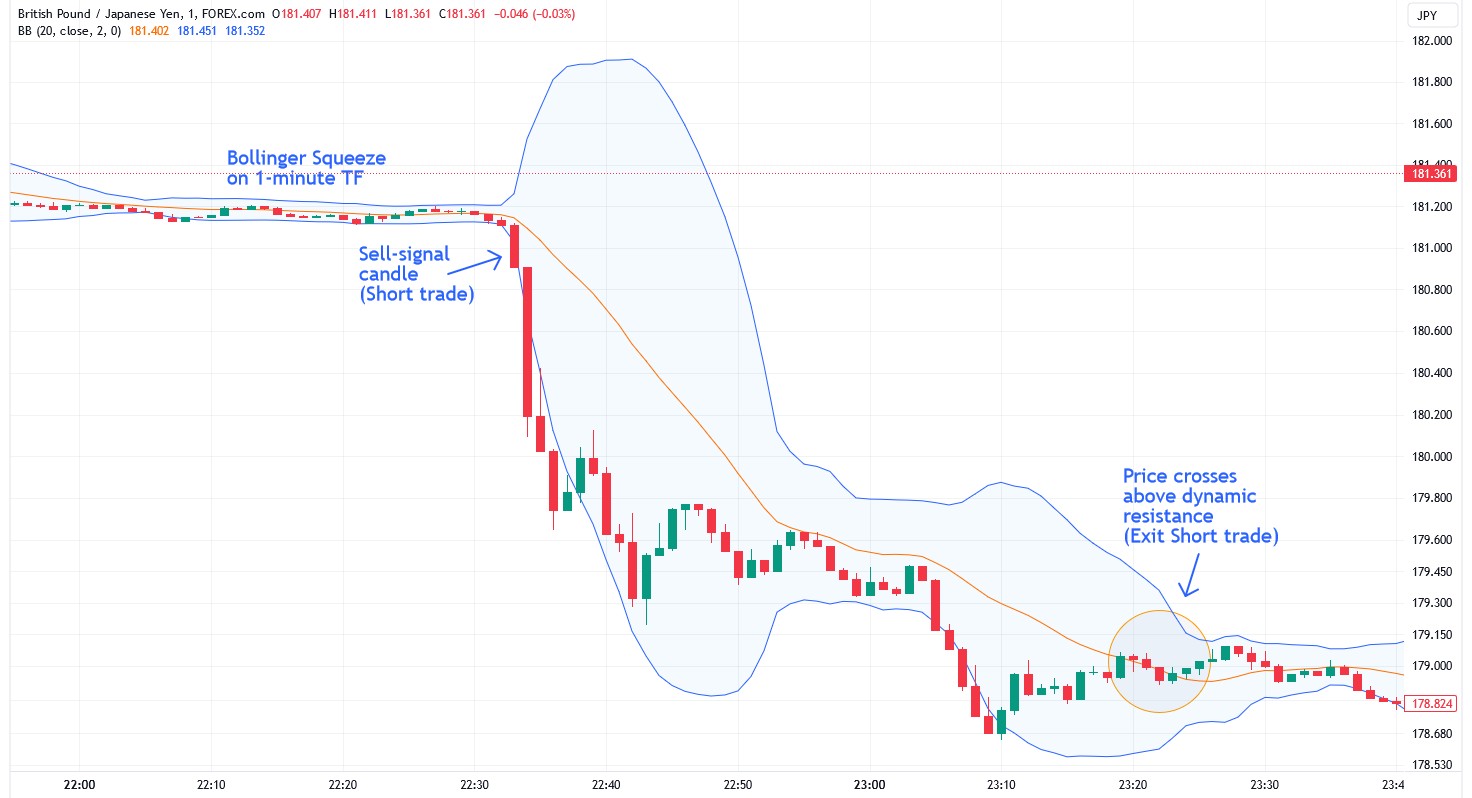
Scalping using Bollinger bands. In this scalping example, we observe a 1-minute timeframe chart of the British Pound/Japanese Yen ( GBP/JPY ) pair. The key indicators being used here are Bollinger Bands and dynamic resistance (likely the moving average). Initially, there is a visible Bollinger Squeeze, which is when the bands narrow, indicating low volatility. This often signals that a breakout might be imminent. A large red candle breaks below the Bollinger Bands, signaling a bearish momentum. This acts as a sell signal, prompting a short trade entry. Following the sell signal, the price continues to fall sharply as the bearish momentum increases. The price stays below the lower Bollinger Band, further confirming the downward move. After the decline, there is a moment where the price crosses back above the dynamic resistance (the moving average), signaling a potential reversal or slowing down of the bearish trend. This provides an exit signal for the short trade.
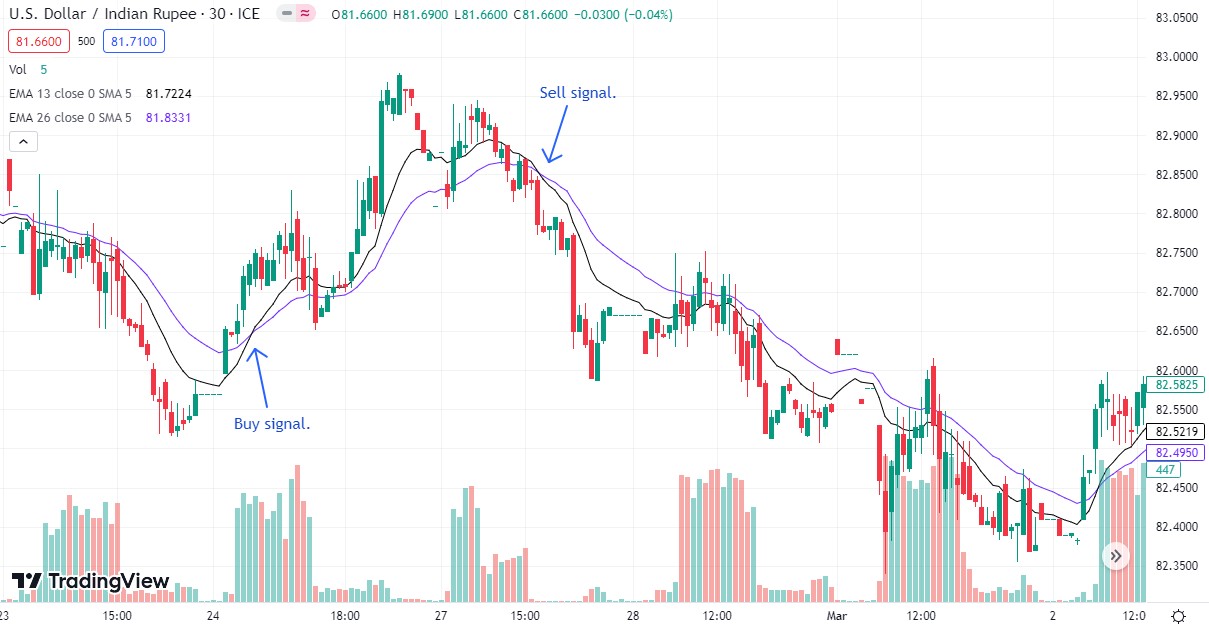
Day trading using Exponential Moving Averages (EMA). In this example, we’re looking at a 30-minute chart of the U.S. Dollar/Indian Rupee ( USD/INR ) pair, using two exponential moving averages (EMA), a 13-period (black line) and a 26-period (purple line). The buy signal shows up when the 13-period EMA moves above the 26-period EMA, suggesting that buyers are gaining control. You can see this on the left side, where the price starts to climb after a dip. Once the buy signal hits, the price continues upward for a while, showing a steady bullish trend. The price stays above both EMAs, confirming the momentum is strong. The sell signal appears when the 13-period EMA dips back below the 26-period EMA, meaning the bullish push is losing steam and sellers might take over. This would be a good spot to either close your long trade or even enter a short. After the sell signal, the price starts dropping again, supporting the call to exit or reverse the position.
Pros and cons of Forex scalping
Forex scalping is a high-speed trading strategy that can generate significant profits in short periods of time. This strategy has its own unique advantages, such as minimizing risk on each trade, but it also comes with high requirements for the trader and significant commission costs. Let's take a closer look at all the pros and cons of scalping to see if this strategy is right for you.
- Pros
- Cons
- High profit potential in a short period of time.
- Less risk per trade due to short holding periods.
- Scalping requires instant decision making and high concentration.
- A large number of trades leads to significant costs for commissions and spreads, which can reduce overall profits.
Pros and cons of day trading
Day trading is a strategy in which traders open and close all positions within a single trading day, thereby avoiding the risks associated with overnight market movements. This approach has its advantages, such as the ability to use more informed strategies and reduced stress compared to scalping. However, day trading also has its disadvantages, including the need for careful preparation and market analysis, as well as the risk of unexpected market movements during the day.
- Pros
- Cons
- Day traders have more time to analyze and develop strategies.
- Less stress compared to scalping due to longer time frames.
- Day trading requires careful market analysis and preparation for each trading session.
- Despite careful analysis, the market may make unexpected movements that may lead to losses.
Comparison of scalping and day trading
Scalping and day trading offer different approaches to Forex trading, each with its own characteristics and requirements. To successfully choose a strategy, it is important to understand how they differ in terms of risk, profitability, trader profile, and technical and cost aspects. Let's look at the main parameters that will help traders determine which strategy is best for them.
| Scalping | Day trading | |
|---|---|---|
| Risk and return | High profit potential with low risk on each trade, but overall profit depends on a large number of successful trades. | More stable returns due to fewer trades, but each trade carries more risk due to the length of time positions are held. |
| Suitable trader profile | Suitable for traders with high concentration, quick reflexes and the ability to make quick decisions. | Suitable for traders who are capable of long-term analysis, patience and sound decision making. |
| Technical support and costs | Requires powerful hardware and software to execute trades quickly, which can be costly. | Less equipment requirements, but analysis and preparation costs may be higher. |
We have selected several reliable brokers where you can fully test your trading capabilities and choose scalping or day trading as your main trading strategy. The key criteria when choosing a broker are low commissions, access to a wide range of markets, platform convenience, quality of analytical tools, as well as the reputation and reliability of the company.
| Scalping | Daily volume, $ bn | Demo | Min. deposit, $ | Max. leverage | Min Spread EUR/USD, pips | MAX Spread GBP/USD, pips | Open an account | |
|---|---|---|---|---|---|---|---|---|
| Yes | 5,000 | Yes | 50 | 1:50 | 0.9 | No | Go to broker Your capital is at risk. |
|
| Yes | 12,84 | Yes | No | 1:200 | 0.1 | 0.5 | Go to broker Your capital is at risk. |
|
| Yes | 18,6 | Yes | 100 | 1:50 | 0.7 | 1.4 | Study review | |
| Yes | 8,16 | Yes | 1 | 1:200 | 0.6 | 1.5 | Study review | |
| Yes | 4,3 | Yes | No | 1:30 | 0.2 | 1.5 | Study review |
A demo account will help to understand which strategy suits you best

When choosing between scalping and day trading, one of the key factors is your psychological comfort. Scalping requires instant decision-making and the ability to quickly adapt to changing market conditions. If you have a high concentration and resistance to stress, this strategy may be for you. However, remember that scalping also requires significant costs in commissions and spreads, which can reduce your profits.
On the other hand, day trading provides more time for analysis and decision-making. This strategy is suitable for those who prefer a more thoughtful approach and are willing to spend more time studying the market. In day trading, it is important to have a clear plan and stick to it to minimize the risk of unexpected market movements. It is also important to consider that day trading requires more time for preparation and analysis, but can be less stressful than scalping.
To be extra sure, it is better to start with a demo account to try both strategies without the risk of losing real money. This will help you understand which strategy best suits your trading style and personal preferences. Also remember the importance of risk management and never invest more than you can afford to lose. Regardless of the strategy you choose, discipline and a clear plan are key elements of successful Forex trading.
Conclusion
When choosing between scalping and day trading, it is important to consider your personal preferences, goals, and capabilities. Scalping is suitable for those who are looking for quick profits and are ready to cope with a high level of stress. Day trading, on the other hand, is suitable for those who prefer a more thoughtful approach and are ready to spend more time analyzing the market. In any case, success in trading depends on careful preparation, analysis, and the ability to adapt to market conditions.
FAQs
What role does psychology play in successful scalping?
Psychology plays a key role in scalping as a trader needs to keep a cool head and make quick decisions under pressure. Learning to control emotions such as fear and greed helps to minimize mistakes and improve trading efficiency.
What type of hardware and software is recommended for scalping?
Scalpers often use powerful computers with multiple monitors to monitor multiple charts and instruments at once. It is also recommended to use low-latency platforms for fast order execution.
What are the main risks associated with day trading that you should be aware of?
These are sudden market movements and news events that can significantly affect the market during the day. It is important to have a risk management plan and be prepared to quickly exit positions in adverse conditions.
What books or resources can be recommended for an in-depth study of scalping and day trading?
For an in-depth study of scalping and day trading, books such as "One Good Trade" by Mike Bellafiore and "Day Trading and Swing Trading the Currency Market" by Kathy Lien are recommended. Specialized forums and online courses where traders share experiences and strategies are also useful.
Editors' Top Picks and Insights






Related Articles
Team that worked on the article
Maxim Nechiporenko has been a contributor to Traders Union since 2023. He started his professional career in the media in 2006.
Chinmay Soni is a financial analyst with more than 5 years of experience in working with stocks, Forex, derivatives, and other assets. As a founder of a boutique research firm and an active researcher, he covers various industries and fields, providing insights backed by statistical data.
Mirjan Hipolito is a journalist and news editor at Traders Union. She is an expert crypto writer with five years of experience in the financial markets.
Swing trading is a trading strategy that involves holding positions in financial assets, such as stocks or forex, for several days to weeks, aiming to profit from short- to medium-term price swings or "swings" in the market. Swing traders typically use technical and fundamental analysis to identify potential entry and exit points.
Bitcoin is a decentralized digital cryptocurrency that was created in 2009 by an anonymous individual or group using the pseudonym Satoshi Nakamoto. It operates on a technology called blockchain, which is a distributed ledger that records all transactions across a network of computers.
A day trader is an individual who engages in buying and selling financial assets within the same trading day, seeking to profit from short-term price movements.
Forex leverage is a tool enabling traders to control larger positions with a relatively small amount of capital, amplifying potential profits and losses based on the chosen leverage ratio.
Day trading involves buying and selling financial assets within the same trading day, with the goal of profiting from short-term price fluctuations, and positions are typically not held overnight.

-
 Afghanistan
-
 Albania
-
 Algeria
-
 Angola
-
 Argentina
-
 Armenia
-
 Australia
-
 Austria
-
 Azerbaijan
-
 Bahamas
-
 Bahrain
-
 Bangladesh
-
 Belarus
-
 Belgium
-
 Bolivia
-
 Botswana
-
 Brazil
-
 Brunei
-
 Bulgaria
-
 Cambodia
-
 Cameroon
-
 Canada
-
 Chile
Chile
-
 China
China
-
 Colombia
-
 Congo
Congo
-
 Costa Rica
-
 Cote d'Ivoire
-
 Croatia
-
 Cuba
Cuba
-
 Cyprus
-
 Czechia
-
 DR Congo
-
 Denmark
-
 Dominican Republic
-
 Ecuador
-
 Egypt
Egypt
-
 El Salvador
-
 Estonia
-
 Eswatini
-
 Ethiopia
-
 Finland
-
 France
-
 Georgia
-
 Germany
-
 Ghana
Ghana
-
 Greece
-
 Haiti
Haiti
-
 Hong Kong
-
 Hungary
-
 India
India
-
 Indonesia
-
 Iran, Islamic republic
-
 Iraq
Iraq
-
 Ireland
-
 Israel
-
 Italy
Italy
-
 Jamaica
-
 Japan
Japan
-
 Jordan
-
 Kazakhstan
-
 Kenya
Kenya
-
 Korea
Korea
-
 Kuwait
-
 Kyrgyzstan
-
 Laos
Laos
-
 Latvia
-
 Lebanon
-
 Lesotho
-
 Libya
Libya
-
 Lithuania
-
 Luxembourg
-
 Madagascar
-
 Malaysia
-
 Malta
Malta
-
 Mauritius
-
 Mexico
-
 Moldova
-
 Mongolia
-
 Montenegro
-
 Morocco
-
 Mozambique
-
 Myanmar
-
 Namibia
-
 Nepal
Nepal
-
 Netherlands
-
 New Zealand
-
 Nigeria
-
 North Macedonia
-
 Norway
-
 Oman
Oman
-
 Pakistan
-
 Palestine
-
 Panama
-
 Papua New Guinea
-
 Paraguay
-
 Peru
Peru
-
 Philippines
-
 Poland
-
 Portugal
-
 Puerto Rico
-
 Qatar
Qatar
-
 Reunion
-
 Romania
-
 Rwanda
-
 Saudi Arabia
-
 Serbia
-
 Singapore
-
 Slovakia
-
 Slovenia
-
 Somalia
-
 South Africa
-
 Spain
Spain
-
 Sri Lanka
-
 Sweden
-
 Switzerland
-
 Syria
Syria
-
 Taiwan
-
 Tajikistan
-
 Tanzania
-
 Thailand
-
 Trinidad and Tobago
-
 Tunisia
-
 Turkey
-
 UAE
UAE
-
 Uganda
-
 Ukraine
-
 United Kingdom
-
United States
-
 Uruguay
-
 Uzbekistan
-
 Venezuela
-
 Vietnam
-
 Yemen
Yemen
-
 Zambia
-
 Zimbabwe
- Forex
- Crypto












