
Bitcoin price prediction: BTC settles at $91,500 amid labor deterioration and policy credibility concerns

Bitcoin is trading around $91,495, down 1.6% over the past 24 hours, with a market capitalization of $1.82 trillion and a 24-hour trading volume of $44.38 billion.
Highlights
- US labor data signals fastest deterioration since 2020.
- Dollar breaks below 99 as policy uncertainty grows.
- Treasury yields tighten into a narrow range before inflation data.
The price moved between $91,029 and $93,576, reflecting a corrective pullback after retail led selling and weakening global macro sentiment.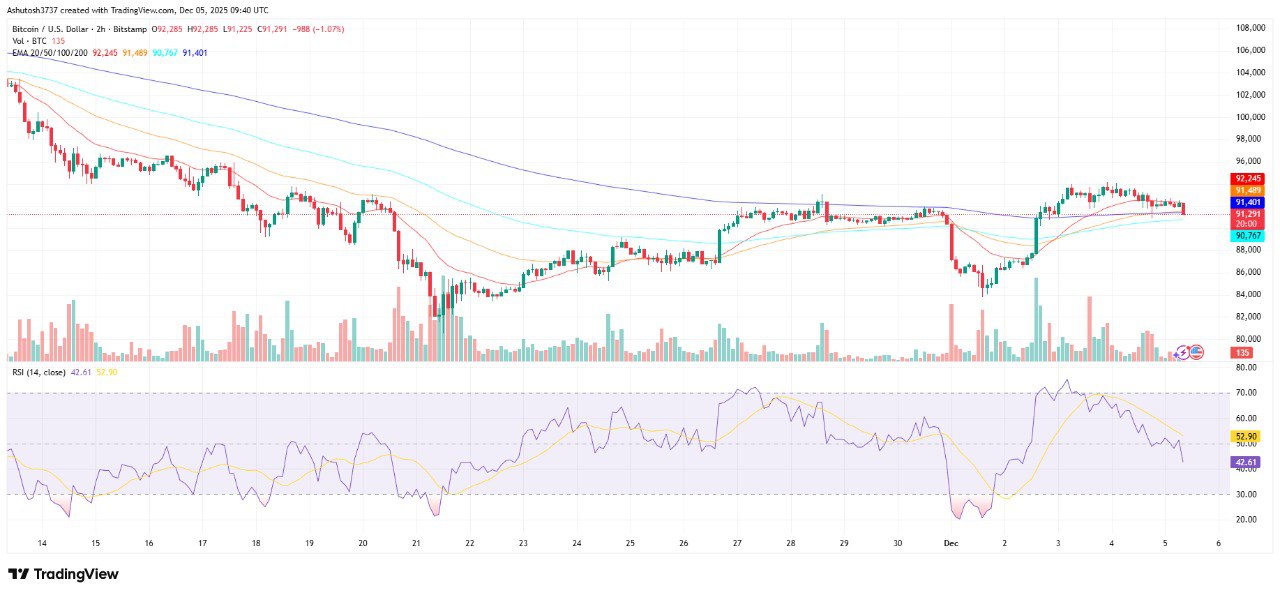
Bitcoin price dynamics (Source: TradingView)
Bitcoin softens as labor deterioration complicates easing expectations
Bitcoin is trading under pressure as U.S. labor indicators showed sharp weakening, pushing rate cut odds higher while simultaneously worsening risk sentiment. Layoffs hit their highest November level in two years, and total job cuts reached their largest year to date figure since 2020. This pushed the dollar index down to 98.9, its lowest since October, and strengthened expectations that the Fed will deliver a cut next week.
For Bitcoin, the distinction is crucial. Easing driven by softer growth normally supports crypto, but easing driven by recession fears triggers de-risking, deleveraging and broad risk aversion. Bitcoin therefore trades in a fragile zone where macro easing is supportive in theory but destabilizing in practice.
Dollar weakness persists, but for reasons that elevate volatility
The dollar held below 99 for a second week as speculation rose around potential leadership changes at the Federal Reserve. Reports that Kevin Hassett may replace Jerome Powell next year introduced policy credibility concerns and fears of politically motivated cutting. Dollar underperformance is now being interpreted as structurally driven by fiscal stress and institutional uncertainty, rather than a clean dovish shift.
Bitcoin historically benefits from a weaker dollar, but when that weakness comes from governance doubts rather than monetary easing, global risk appetite suffers. This creates a volatile rather than uniformly bullish setup for crypto.
The 10-year Treasury yield hovered near 4.08%, reflecting indecision as investors awaited delayed PCE inflation data. Markets expressed concern that a new Fed leadership team could pursue aggressive cuts for political reasons, while the end of quantitative tightening created fresh questions about balance sheet strategy.
For Bitcoin, the absence of a strong directional signal from yields results in consolidation. Clear disinflation could revive risk appetite, while sticky inflation would keep real yields restrictive and cap Bitcoin’s rebound potential.
Bitcoin’s recent downturn worsened after retail led selling triggered an 8% intraday drop and roughly $1 billion in liquidations. The spillover into equities confirmed that Bitcoin is moving in tighter alignment with broader risk cycles. Analysts warn that retail driven volatility is more erratic and less anchored to macro fundamentals than institutional positioning, increasing the probability of amplified price swings.
Leverage remains elevated despite recent corrections, making the system more vulnerable to further liquidation cascades if equities weaken or if risk sentiment deteriorates.
Analysts underline the fragile macro balance
Anton Kharitonov notes that labor deterioration raises the risk that easing expectations are being driven by weakness rather than stability, a dynamic that historically pressures Bitcoin.
Viktoras Karapetyants explains that although a weaker dollar removes one headwind, institutional credibility concerns create a risk premium that limits speculative inflows.
Jainam Mehta highlights the growing BTC-equity coupling, arguing that Bitcoin will struggle to rally meaningfully without signs of equity stabilization and reduced retail selling.
Technical view shows momentum loss with key supports nearby
Bitcoin trades near $91,495, slipping below the 20 EMA at $92,278, which has turned into immediate resistance. The 50 EMA at $92,184 marks the next ceiling, while the 100 EMA at $91,490 now sits almost exactly at current price and acts as a fragile support. The 200 EMA at $90,759 forms the final major support before deeper downside opens.
The RSI near 38 signals weakening momentum and a lack of buyer commitment, consistent with macro driven hesitation.
Background and previous analysis
In earlier analysis, Bitcoin was pressured by a weakening macro environment defined by retail selling, fragile liquidity and rising risk aversion. Today’s environment preserves that fragility. Although rate cut expectations have risen and the dollar has softened, the underlying cause is labor market deterioration and policy uncertainty rather than healthy disinflation. This keeps Bitcoin in a vulnerable stabilization zone where upside remains limited until equities firm and retail pressure subsides.









-
 Afghanistan
-
 Albania
-
 Algeria
-
 Angola
-
 Argentina
-
 Armenia
-
 Australia
-
 Austria
-
 Azerbaijan
-
 Bahamas
-
 Bahrain
-
 Bangladesh
-
 Belarus
-
 Belgium
-
 Bolivia
-
 Botswana
-
 Brazil
-
 Brunei
-
 Bulgaria
-
 Cambodia
-
 Cameroon
-
 Canada
-
 Chile
Chile
-
 China
China
-
 Colombia
-
 Congo
Congo
-
 Costa Rica
-
 Cote d'Ivoire
-
 Croatia
-
 Cuba
Cuba
-
 Cyprus
-
 Czechia
-
 DR Congo
-
 Denmark
-
 Dominican Republic
-
 Ecuador
-
 Egypt
Egypt
-
 El Salvador
-
 Estonia
-
 Eswatini
-
 Ethiopia
-
 Finland
-
 France
-
 Georgia
-
 Germany
-
 Ghana
Ghana
-
 Greece
-
 Haiti
Haiti
-
 Hong Kong
-
 Hungary
-
 India
India
-
 Indonesia
-
 Iran, Islamic republic
-
 Iraq
Iraq
-
 Ireland
-
 Israel
-
 Italy
Italy
-
 Jamaica
-
 Japan
Japan
-
 Jordan
-
 Kazakhstan
-
 Kenya
Kenya
-
 Korea
Korea
-
 Kuwait
-
 Kyrgyzstan
-
 Laos
Laos
-
 Latvia
-
 Lebanon
-
 Lesotho
-
 Libya
Libya
-
 Lithuania
-
 Luxembourg
-
 Madagascar
-
 Malaysia
-
 Malta
Malta
-
 Mauritius
-
 Mexico
-
 Moldova
-
 Mongolia
-
 Montenegro
-
 Morocco
-
 Mozambique
-
 Myanmar
-
 Namibia
-
 Nepal
Nepal
-
 Netherlands
-
 New Zealand
-
 Nigeria
-
 North Macedonia
-
 Norway
-
 Oman
Oman
-
 Pakistan
-
 Palestine
-
 Panama
-
 Papua New Guinea
-
 Paraguay
-
 Peru
Peru
-
 Philippines
-
 Poland
-
 Portugal
-
 Puerto Rico
-
 Qatar
Qatar
-
 Reunion
-
 Romania
-
 Rwanda
-
 Saudi Arabia
-
 Serbia
-
 Singapore
-
 Slovakia
-
 Slovenia
-
 Somalia
-
 South Africa
-
 Spain
Spain
-
 Sri Lanka
-
 Sweden
-
 Switzerland
-
 Syria
Syria
-
 Taiwan
-
 Tajikistan
-
 Tanzania
-
 Thailand
-
 Trinidad and Tobago
-
 Tunisia
-
 Turkey
-
 UAE
UAE
-
 Uganda
-
 Ukraine
-
 United Kingdom
-
United States
-
 Uruguay
-
 Uzbekistan
-
 Venezuela
-
 Vietnam
-
 Yemen
Yemen
-
 Zambia
-
 Zimbabwe
- Forex
- Crypto











